
Parque Nacional Torres del Paine and the granite heart of Patagonia
Published on 09/18/2026 at 13:28 | Editorial responsibility: Rafael Müller, Editor-in-Chief AD HOC NEWS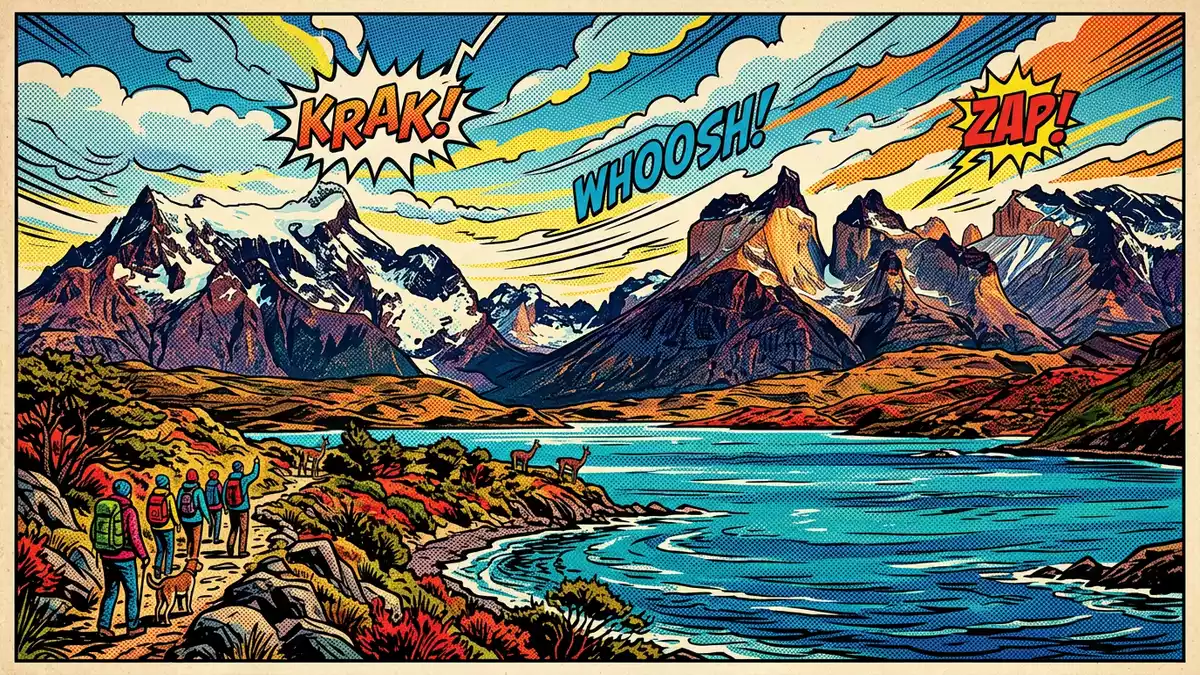
Parque Nacional Torres del Paine in southern Chile is a national park where granite mountains, glacial valleys and Patagonian steppe lie within a single protected landscape. Created as a national park in 1959, it forms the core of the wider Torres del Paine Biosphere Reserve recognised by UNESCO in 1978, with the park lying north of Puerto Natales in the Magallanes Region of Patagonia.
Granite towers above Patagonian steppe
The defining feature of Parque Nacional Torres del Paine is the Paine Massif, a group of granite peaks that rise abruptly from rolling plains and glacial valleys in the Province of Última Esperanza.The Paine Massif includes the three Torres del Paine, sheer rock towers that give the park its name, alongside the jagged Cuernos del Paine and the bulk of Paine Grande. The massif is described in geological studies as a granite intrusion dating back around twelve million years, which means visitors see rock faces that predate human presence by millions of years.Granite intrusion around twelve million years old
Below the peaks, the landscape falls away into broad glacial valleys carved by ice and lined with lakes that take on striking shades of blue and green. The park lies between the Andes and the Patagonian steppe, and this position shows in its contrasts: ridges and crags above, open plains around them, and rivers, lagoons and waterfalls connecting the elevations to the low ground.Ridges, crags, rivers, lakes and lagoons Guanacos move across the grasslands, while glaciers descend from higher ground, so that ice, rock and grass form neighbouring zones rather than distant scenes.
A protected Patagonian landscape since 1959
The origins of Parque Nacional Torres del Paine as a protected area date to 13 May 1959, when Chile created a national park under the name Parque Nacional de Turismo Lago Grey with an initial recorded area of 4,332 hectares.Created on 13 May 1959 Subsequent decrees extended and redefined the park, and contemporary documentation records Torres del Paine National Park as covering 242,242 hectares in the Province of Última Esperanza in the Magallanes Region of southern Chile.Protected area of 242,242 hectares
In 1978 UNESCO recognised the wider Torres del Paine Biosphere Reserve under the Man and the Biosphere Programme, with the national park forming the reserve’s core area.Designation as a biosphere reserve in 1978 The biosphere reserve, as recorded in UNESCO data, encompasses 770,889 hectares, with about 743,826 hectares classified as terrestrial and a smaller portion as marine.Extent of the Torres del Paine Biosphere Reserve Within this framework, the park protects a spectrum of ecosystems, from high mountain environments around Paine Grande to lowland lakes and river corridors, all set at roughly 51 degrees south latitude in Chilean Patagonia.
Water, ice and trails around the Paine Massif
Parque Nacional Torres del Paine is characterised by a network of lakes, rivers and glaciers that encircle and cut through the Paine Massif. Named lakes such as Lago Grey, Lago Pehoé and Lago Nordenskjöld sit at the foot of the mountains, many fed by glaciers that descend from the higher ridges. The Grey Glacier reaches into Lago Grey, while other ice fields occupy hollows in the massif and nearby ranges, linking the park visually and hydrologically to the Southern Patagonian Ice Field.Lakes and glaciers around the Paine Massif
The park lies north of Puerto Natales and north-west of Punta Arenas, with road access from Puerto Natales into the lake and river system around the massif.Location north of Puerto Natales and Punta Arenas Within the park, established trails run between lake shores, viewpoints and mountain passes, including multi-day circuits that loop around the massif and shorter day routes to lookout points over the Torres del Paine and Cuernos del Paine.Circuits and day routes around the massif River valleys carry meltwater towards lower ground, and waterfalls punctuate the descent, while the Patagonian steppe extends away from the massif into flatter country with shrubs and grasses adapted to strong winds.
Visiting Parque Nacional Torres del Paine: what travellers from Western Europe should know
- Parque Nacional Torres del Paine lies in the Magallanes Region of southern Chile, north of Puerto Natales, with road access linking the town to park entrances along the lakes and rivers.
- The terrain combines mountain paths, glacial valleys and stretches of Patagonian steppe, so routes can involve prolonged walking on uneven ground, exposed passages and significant changes in altitude.
- Lakes such as Lago Grey and Lago Pehoé sit close to roadheads and trailheads, while views of the Torres del Paine and Cuernos del Paine are reached on foot along established paths from valley bases.
- The official language is Spanish and the currency is the Chilean peso.
- Entry requirements depend on your nationality; UK travellers can check the FCDO travel advice at gov.uk/foreign-travel-advice, Irish travellers the Department of Foreign Affairs at ireland.ie.
Searching for Parque Nacional Torres del Paine on social platforms
These links open searches for Parque Nacional Torres del Paine on each platform.
Frequently asked questions about Parque Nacional Torres del Paine
Where is Parque Nacional Torres del Paine?
Parque Nacional Torres del Paine is in the Magallanes Region of southern Chile, in the Province of Última Esperanza, north of the town of Puerto Natales.
What should visitors expect on a visit?
Visitors encounter a combination of granite peaks, glacial lakes, rivers, valleys and Patagonian steppe, with established trails linking viewpoints, lake shores and mountain passes.
What makes Parque Nacional Torres del Paine distinctive?
The park’s distinctive character lies in the Paine Massif, where the Torres del Paine, Cuernos del Paine and Paine Grande rise above a protected landscape of lakes, glaciers and open plains within a UNESCO biosphere reserve.


