
Parque Nacional Torres del Paine and the granite skyline of Patagonia
Published on 08/25/2026 at 22:35 | Editorial responsibility: Rafael Müller, Editor-in-Chief AD HOC NEWS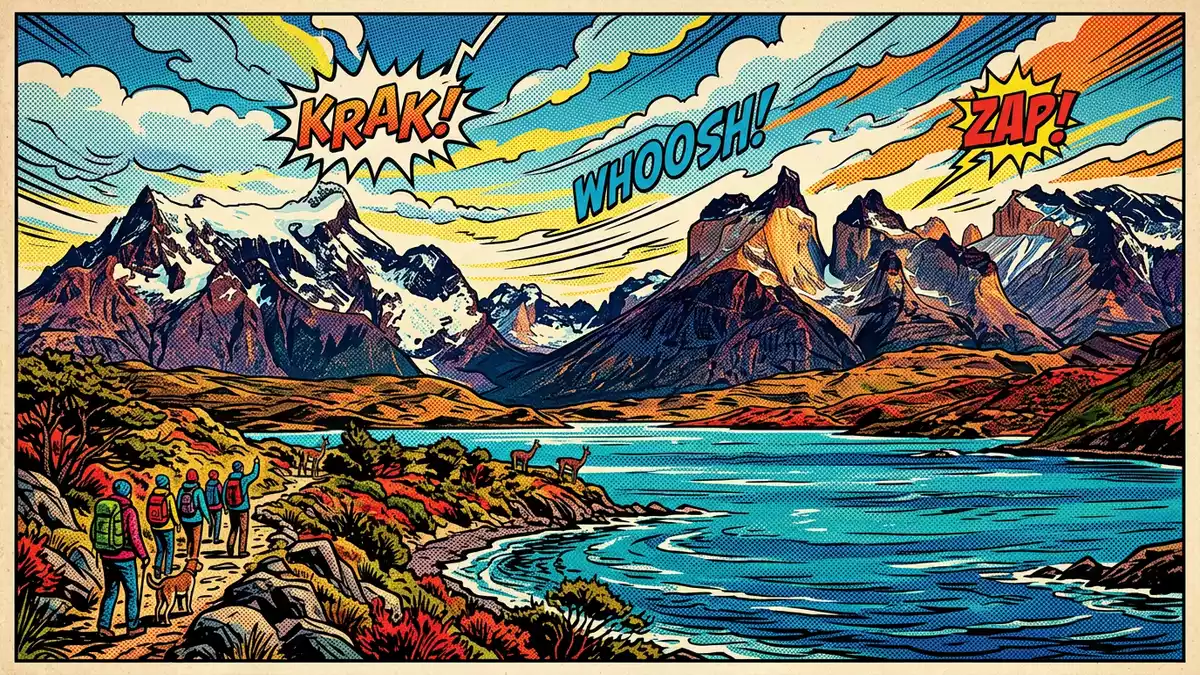
Parque Nacional Torres del Paine in southern Chilean Patagonia is a protected landscape built around a skyline of granite towers, glaciers and intensely coloured lakes, north of Puerto Natales in the Magallanes Region. Created on 13 May 1959 as a national park, it later gained recognition as a UNESCO Biosphere Reserve, anchoring a swathe of protected terrain between the Andes and the Patagonian steppe.
The granite towers that give Parque Nacional Torres del Paine its name
The name Parque Nacional Torres del Paine refers directly to a group of steep granite peaks that rise above surrounding valleys and glacial lakes, forming one of the most recognisable mountain silhouettes in Chilean Patagonia. The Paine massif stands as a distinct block of mountains separate from the main Andes chain, combining lighter sedimentary rock near the summits with pale granite lower down, a contrast that is clearly visible on the cliffs of the famous towers.the cordillera Paine Visitors encounter sheer walls that rise thousands of metres above valley floors, with glaciers clinging to the flanks and hanging above turquoise lakes fed by meltwater.
The broader park landscape spans over 227,000 ha of protected land, with figures in different sources reflecting boundary changes and survey methods but agreeing on a large, continuous area of mountains, lakes and steppe.Torres del Paine spans 227,298 hectares The high point of the massif, Paine Grande, rises to over 3,000 m (around 10,000 ft), securing the park a place among Chile’s most substantial mountain protected areas.Paine Grande Peak Around these summits, the skyline alternates between the vertical towers, broad snowfields and jagged ridges shaped by erosion and ice.
Icefields, lakes and steppe: the Patagonian setting
Parque Nacional Torres del Paine lies within Chile’s Magallanes Region, in the province of Última Esperanza, where the land transitions from the Southern Patagonian Icefield to dry grassland and shrub steppe.Región de Magallanes y Antártica Chilena The park forms part of a wider group of protected areas that together safeguard a large share of the Southern Patagonian Icefield, a plateau of interconnected glaciers feeding outlet ice into both Chile and Argentina.over 90% of the Southern Patagonian Icefield Within the park, long glacier tongues descend into valleys, ending in lakes whose blue and green tones reflect suspended rock flour carried by meltwater.
The route into Parque Nacional Torres del Paine passes from windswept steppe dotted with low shrubs and guanacos into areas of pre-Andean scrub, then into southern beech forests on sheltered slopes and ravines.four distinct vegetation zones Lakes such as Grey Lake lie at the foot of glaciers, with floating icebergs calved from the front of the ice, while other basins hold stiller water backed by grassland and rounded hills. Rivers connect these basins, carving gorges and cataracts through the sedimentary rock; wooden and steel bridges carry paths over the channels, giving views into ravines cut by water over geological timescales.
A protected Patagonian park with global recognition
Torres del Paine was established as a national park in 1959 under the name Parque Nacional de Turismo Lago Grey and later took its current designation, reflecting the towers as the defining feature of the protected area.Park officially established in 1959 Administration lies with Chile’s national forestry and protected areas agency, CONAF, which oversees a network of national parks and reserves across the Magallanes Region and beyond.CONAF Magallanes In 1978 UNESCO recognised the park as a Biosphere Reserve within its Man and the Biosphere Programme, reflecting the combination of mountain, ice, lake and steppe ecosystems and their conservation value.UNESCO Biosphere Reserve in 1978
Within Chile, Parque Nacional Torres del Paine ranks among the larger national parks by area, lying in Region XII and forming part of a chain of protected Patagonia landscapes reaching towards the Chilean Antarctic.Region XII protected area Wildlife recorded in the park includes guanacos grazing the steppe, pumas in more remote sectors, foxes, rheas and condors using the updrafts along cliffs; bird surveys list over 100 species, including a number of birds of prey associated with open ground and forest edges.25 mammals and over 100 bird species Trails and refuges follow valleys, lake shores and ridgelines, giving structured access into this environment while concentrating use on specific corridors.
Visiting Parque Nacional Torres del Paine: what travellers from Western Europe should know
- Parque Nacional Torres del Paine lies in the Magallanes Region of southern Chile, north of Puerto Natales, reached overland by road routes linking the town to entrances such as Laguna Amarga and Serrano.
- Terrain within the park ranges from level steppe to steep mountain paths with significant altitude gain; multi-day routes involve long stretches on foot, exposed to wind and weather.
- The official language is Spanish and the currency is the Chilean peso.
- Entry requirements depend on your nationality; UK travellers can check the FCDO travel advice at gov.uk/foreign-travel-advice, Irish travellers the Department of Foreign Affairs at ireland.ie.
Searching for Parque Nacional Torres del Paine on social platforms
These links open searches for Parque Nacional Torres del Paine on each platform.
Frequently asked questions about Parque Nacional Torres del Paine
Where is Parque Nacional Torres del Paine and how is it related to Puerto Natales?
Parque Nacional Torres del Paine lies in Chile’s Magallanes Region, north of the town of Puerto Natales, which functions as the main urban gateway for road journeys into the park.
What should visitors expect when entering the park landscape?
Visitors move from open Patagonian steppe into glacial valleys, lakes and steep mountain terrain, with marked tracks, refuges and viewpoints giving structured access to the granite towers and surrounding ice.
What makes Parque Nacional Torres del Paine distinctive among Patagonian parks?
The combination of the Paine massif’s granite towers, the Southern Patagonian Icefield, turquoise glacial lakes and steppe wildlife, protected since 1959 and recognised as a UNESCO Biosphere Reserve, gives the park its particular character.


