

Patuxai, Vientiane’s concrete arc of memory
Published on 08/25/2026 at 15:57 | Editorial responsibility: Rafael Müller, Editor-in-Chief AD HOC NEWS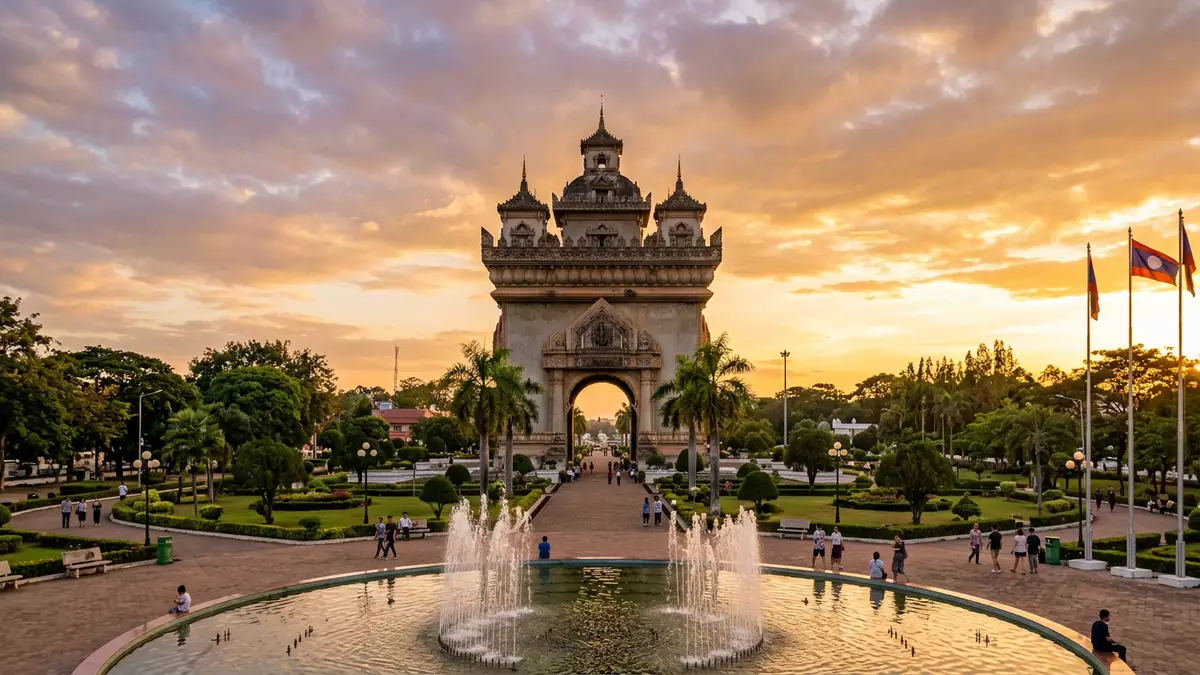
Patuxai is a monumental concrete arch in central Vientiane, built in the mid-twentieth century as a victory gate dedicated to those who fought for Laos’s independence from France. Completed in 1968, it stands on Lane Xang Avenue and combines a triumphal-arch outline with richly carved Lao Buddhist and Hindu motifs that make it one of the defining landmarks of the Lao capital.Built between 1957 and 1968
A concrete arc between France and Laos
The name Patuxai translates as “Victory Gate”, and the monument is also known in English as the Victory Monument or Patuxai Victory Gate.The literal meaning Victory Gate It was constructed between 1957 and 1968 as a war monument commemorating Laotian soldiers who died in the Second World War and in the struggle for independence from France, achieved in 1953.Built between 1957 and 1968 as a war monument
Seen from a distance along Lane Xang Avenue, Patuxai’s mass and axial position recall European triumphal arches, but close up the structure is covered in Lao decorative work. The concrete surfaces carry reliefs of kinnari figures, floral patterns and mythological creatures, and the upper levels are topped by towers that echo the forms of traditional Lao temples. Inside the monument, levels stacked one above another are linked by stairways, with small interior spaces adapted for displays and stalls.
Layouts, arches and views over Vientiane
Patuxai stands at the northern end of Lane Xang Avenue, one of Vientiane’s principal boulevards, with a formal park laid out around it.Located at the northern end of Avenue Lane Xang Paths radiate from the base of the monument across lawns and fountains, setting the arch as the focal point of a planned urban axis that faces towards the city centre. The location makes Patuxai a natural reference point when navigating Vientiane, whether arriving along the avenue or approaching from neighbouring districts.
Inside the arch, a sequence of staircases rises through several floors to viewing platforms near the top of the structure.Visitors can climb through the interior levels From the upper terraces, the view extends along Lane Xang Avenue, across the surrounding park and out towards other parts of Vientiane, giving a clear sense of the city’s low-rise skyline and the way Patuxai anchors this part of the urban grid. Within the interior levels, the concrete shell has been divided into small halls that house modest exhibits and stalls, so the ascent alternates between enclosed spaces and open platforms.
Patuxai in Laos’s twentieth-century story
Patuxai was commissioned in the years after Laos gained formal independence from France, during a period when the country’s monarchy sought to mark the sacrifices of those who had fought in earlier conflicts.Constructed between the late 1950s and late 1960s after independence The monument is frequently compared in guidebooks to the Arc de Triomphe in Paris, not only because of its outline but also because both structures serve as focal points for ceremonial avenues.Referred to as the Arc de Triomphe of Vientiane
The architect Tham Sayasithsena, who studied in Paris, is associated with the design of Patuxai, and the monument’s mixture of European arch form with Lao ornament reflects that background.Made according to the project of the architect Tham Sayasithsena Concrete was the main construction material, a marked contrast to the timber and masonry of many older Lao religious buildings, and the resulting structure has a solid, almost fortress-like presence. As a physical object, Patuxai condenses mid-twentieth-century Laos onto a single site, with its inscriptions, dedications and stylistic choices all pointing back to the country’s passage from colonial rule to a new political order.
Visiting Patuxai: what travellers from Western Europe should know
- Patuxai stands on Lane Xang Avenue in central Vientiane, aligned with a broad boulevard that runs towards the city centre and reached by city streets used by local traffic.
- The monument rises above a formal park with lawns, fountains and paved paths, and visiting the upper levels involves climbing staircases inside the structure.
- The official language is Lao and the currency is the Lao kip.
- Entry requirements depend on your nationality; UK travellers can check the FCDO travel advice at gov.uk/foreign-travel-advice, Irish travellers the Department of Foreign Affairs at ireland.ie.
Searching for Patuxai on social platforms
These links open searches for Patuxai on each platform.
Frequently asked questions about Patuxai
Where is Patuxai located?
Patuxai stands on Lane Xang Avenue in central Vientiane, the capital of Laos, at the head of a broad boulevard framed by a formal park.
What can visitors expect during a visit to Patuxai?
Visitors encounter a concrete triumphal arch decorated with Lao religious motifs, set within a landscaped park, with interior staircases leading to viewing platforms over the surrounding city.
What makes Patuxai distinctive among war monuments?
Patuxai combines a mid-twentieth-century concrete arch form, associated with its construction between 1957 and 1968, with detailed Lao Buddhist ornament and a prominent position on Lane Xang Avenue in Vientiane.


