

Patuxai, Vientiane’s concrete victory gate
Published on 08/17/2026 at 13:58 | Editorial responsibility: Rafael Müller, Editor-in-Chief AD HOC NEWS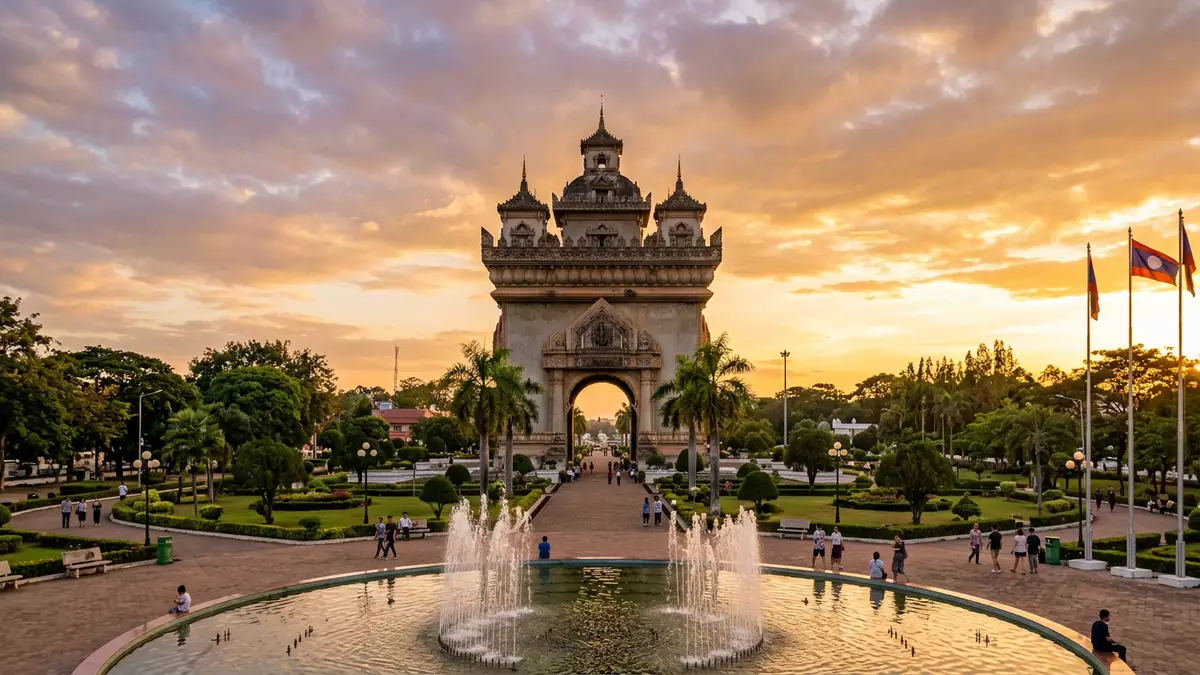
Patuxai in Vientiane is a monumental concrete arch that turns a ceremonial avenue into a framed view of the Laotian capital, combining a triumphal gateway with a towered skyline.
A concrete victory gate for an independent capital
Patuxai is a war monument in central Vientiane, built between 1957 and 1968 as Laos moved out of French colonial rule and defined its own capital cityscape.war monument in central Vientiane Its Lao name means “Victory Gate” or “Gate of Triumph”, a literal description of both its political symbolism and its architectural form.Victory Gate or Gate of Triumph The structure occupies the eastern end of Lane Xang Avenue, a principal boulevard lined with ministries and official buildings, so that the road terminates in the arch and its clustered towers rather than fading into ordinary traffic.
The monument was dedicated to those who fought in the long struggle for independence from France, including Laotian soldiers who died during the Second World War and the conflict that led to the recognition of Laos as a sovereign state in 1953.commemorates Laotian soldiers French influence is present in the overall layout, which recalls a European triumphal arch placed on a broad axial avenue, yet the monument’s role is firmly tied to Laotian history, marking a chapter in which Vientiane’s public space became a stage for independent national narratives.dedicated to those killed in struggles for independence
Architecture that mixes arch and temple
From a distance, Patuxai reads as a broad archway spanning the avenue, but the upper part rises into a cluster of structures that evoke the forms of Laotian religious architecture more than European monuments.monumental victory gate The main body is built in reinforced concrete, a material associated with mid twentieth-century public works, then finished with ornamental details that reference Buddhist and Hindu iconography, from mythological figures to lotus motifs.Buddhist and Hindu motifs These elements soften the mass of the structure and connect it visually to the stupas and temples that punctuate the wider city.
Unlike single-span arches in many European capitals, Patuxai carries several tower-like forms above its main deck, giving the silhouette a profile closer to a temple complex than a plain gateway.tower forms above the deck The facades include recessed panels, ornamental mouldings and reliefs, and visitors ascending inside encounter successive landings with viewports over the surrounding park and government district. The combination of heavy concrete and fine decorative detail reflects the period of construction, when Laos used readily available modern materials while continuing to draw on long-established religious and mythological visual language.
A memorial framed by parkland and city views
Patuxai stands on a traffic island where Lane Xang Avenue divides, and the monument is encircled by Patuxay Park, a landscaped area with lawns, paths and fountains that create a setting distinct from the surrounding streets.Patuxai Park around the monument The park gives the arch a horizontal counterpart: where the vertical mass marks the sky, the planted grounds and water features spread across the ground, making the whole ensemble a piece of urban design rather than an isolated object. Trees and seating areas offer shaded places from which to look back at the structure and its ornament.
Inside the monument, stairs rise through several levels, passing small interior spaces that house exhibits and stalls before reaching viewing platforms near the top.stairs through multiple levels and viewing platform From these platforms, the outlook takes in the straight line of Lane Xang Avenue, the nearby ministries, and more distant landmarks such as That Luang, allowing visitors to read Vientiane’s city plan with Patuxai as a focal point. The building’s role as a memorial is therefore combined with an everyday function as one of the capital’s principal viewpoints over its low-rise urban fabric.
Visiting Patuxai: what travellers from Western Europe should know
- Patuxai stands at the eastern end of Lane Xang Avenue in central Vientiane, in a district with ministries and other government buildings, and is reached by city streets used by buses, tuk-tuks and private vehicles.
- The monument’s interior is accessed by staircases that climb through several levels to the upper viewing platforms, and the steps form a sustained ascent that may feel demanding to some visitors.
- Patuxay Park surrounds the structure with paved paths, lawns and fountains, so walking routes involve a mixture of hard surfaces and garden areas in a flat urban setting.
- The official language is Lao and the currency is the Lao kip.
- Entry requirements depend on your nationality; UK travellers can check the FCDO travel advice at gov.uk/foreign-travel-advice, Irish travellers the Department of Foreign Affairs at ireland.ie.
Searching for Patuxai on social platforms
These links open searches for Patuxai on each platform.Frequently asked questions about Patuxai
Where is Patuxai located?
Patuxai is in central Vientiane, at the eastern end of Lane Xang Avenue, in a district with government ministries and broad city streets.
What can visitors expect during a visit?
Visitors encounter a large concrete monument with ornamental Lao detail, stairways inside, viewing platforms near the top and surrounding parkland with paths and fountains.
What makes Patuxai distinctive among Southeast Asian monuments?
Patuxai stands out for its combination of French-style triumphal arch planning, mid twentieth-century concrete construction and towered forms decorated with Laotian Buddhist and Hindu motifs.


