
Petergof and the theatre of fountains
Published on 09/22/2026 at 15:44 | Editorial responsibility: Rafael Müller, Editor-in-Chief AD HOC NEWS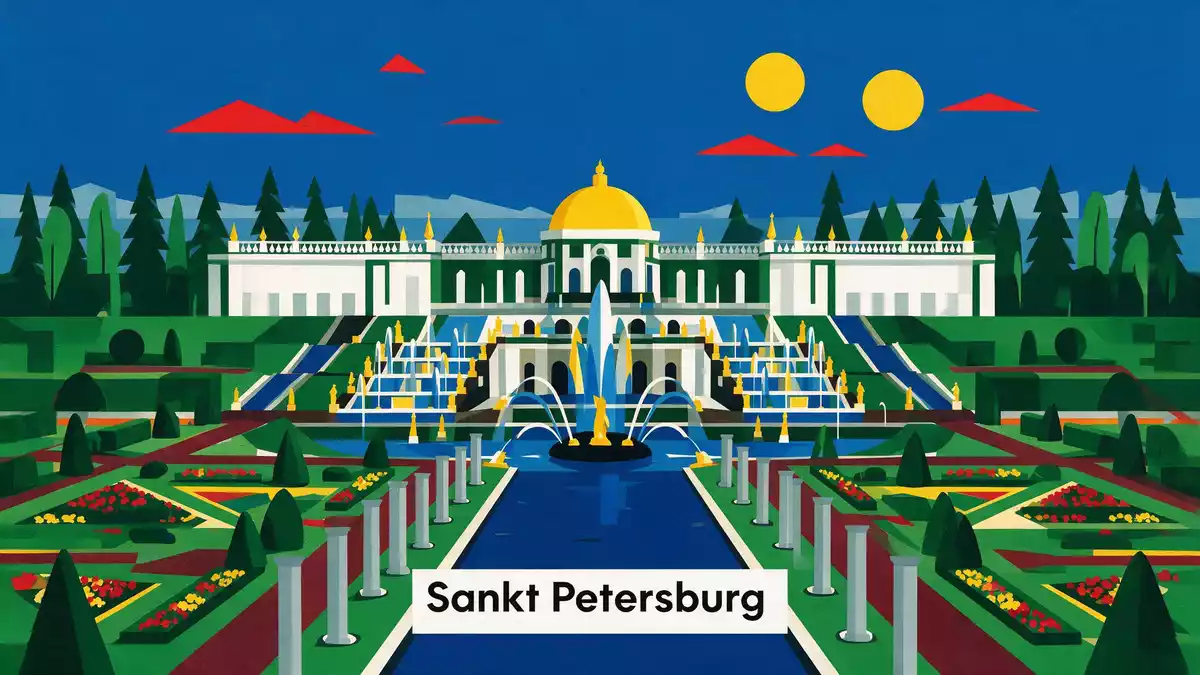
Petergof is a palace-and-park ensemble on the southern shore of the Gulf of Finland, outside Sankt Petersburg. Its defining sight is the Grand Cascade, where gilded sculpture, stone terraces and moving water form a ceremonial foreground for the Grand Palace.
Peter the Great established Petergof as an imperial residence, and the complex opened in 1723. Palaces, fountains and gardens extend across a landscape that joins court architecture with the Baltic coast.
Petergof begins with water, stone and sculpture
The Grand Cascade descends from the level of the Grand Palace towards the Lower Park. Its stairways, grottoes, statues and water channels create a carefully ordered composition, with the Samson Fountain as its central sculptural focus.
The cascade belongs to the earliest phase of the ensemble. Construction began in 1714, and the fountain complex formed part of the formal arrangement completed for the imperial residence. The Grand Cascade history records its close relationship with the palace and gardens.
From Peter the Great to the Romanov court
Petergof grew during the reign of Peter the Great, whose building programme reshaped Russia’s relationship with the Baltic Sea. The first palace structures belong to the early eighteenth century, while later rulers expanded and altered the residence.
The Grand Palace presents a long Baroque façade above the cascade. Architects associated with the ensemble include Jean-Baptiste Le Blond, Johann Braunstein, Nicola Michetti, Bartolomeo Rastrelli and later court designers. The palace history gives the building period as 1714–1723 and names its principal architects.
Petergof served as a summer residence for Russia’s emperors for two centuries. Its rooms combine gilded decoration, painted ceilings, carved woodwork and ceremonial halls, while smaller palaces preserve more intimate aspects of court life.
Upper and Lower Parks on the Gulf of Finland
The ensemble is divided into the Upper Park and Lower Park. The Upper Park lies before the Grand Palace, while the Lower Park stretches towards the Gulf of Finland with avenues, pavilions, grottos and fountains.
Monplaisir stands close to the shore and is associated with Peter the Great. The Hermitage pavilion, Marly Palace and other buildings give the Lower Park a varied architectural character. Formal planting, clipped trees and open lawns frame the routes between the separate monuments.
Petergof forms part of the Historic Centre of Sankt Petersburg and Related Groups of Monuments, inscribed on the UNESCO World Heritage List in 1990. The 1990 World Heritage inscription places the ensemble within a wider group of imperial and urban monuments.
The place is not a single palace viewed in isolation. It is a sequence of terraces, waterworks, gardens and buildings, with the Grand Palace and Grand Cascade providing the most concentrated expression of Petergof’s Baroque design.
Visiting Petergof: what travellers from Western Europe should know
- Petergof lies south-west of Sankt Petersburg on the Gulf of Finland. Suburban trains serve Novy Petergof station, and hydrofoils connect the city with the palace area by water.
- The grounds cover sloping terraces between the palace and the coast. Routes include paved avenues, stairways and extended walks through the Lower Park.
- The official language is Russian and the currency is the Russian rouble.
- Entry requirements depend on your nationality; UK travellers can check the FCDO travel advice at gov.uk/foreign-travel-advice, Irish travellers the Department of Foreign Affairs at ireland.ie.
Searching for Petergof on social platforms
These links open searches for Petergof on each platform.
Frequently asked questions about Petergof
Where is Petergof?
Petergof is on the southern shore of the Gulf of Finland, within Sankt Petersburg and south-west of the city centre.
What can visitors see there?
The ensemble contains the Grand Palace, the Grand Cascade, Upper and Lower Parks, smaller palaces, pavilions, sculptures and fountains.
What makes Petergof distinctive?
Its palaces, formal gardens and hydraulic fountains occupy connected terraces between the Grand Palace and the Baltic coast.


