

Petra’s rock-cut city in the sandstone hills of Wadi Musa
Published on 09/14/2026 at 10:51 | Editorial responsibility: Rafael Müller, Editor-in-Chief AD HOC NEWS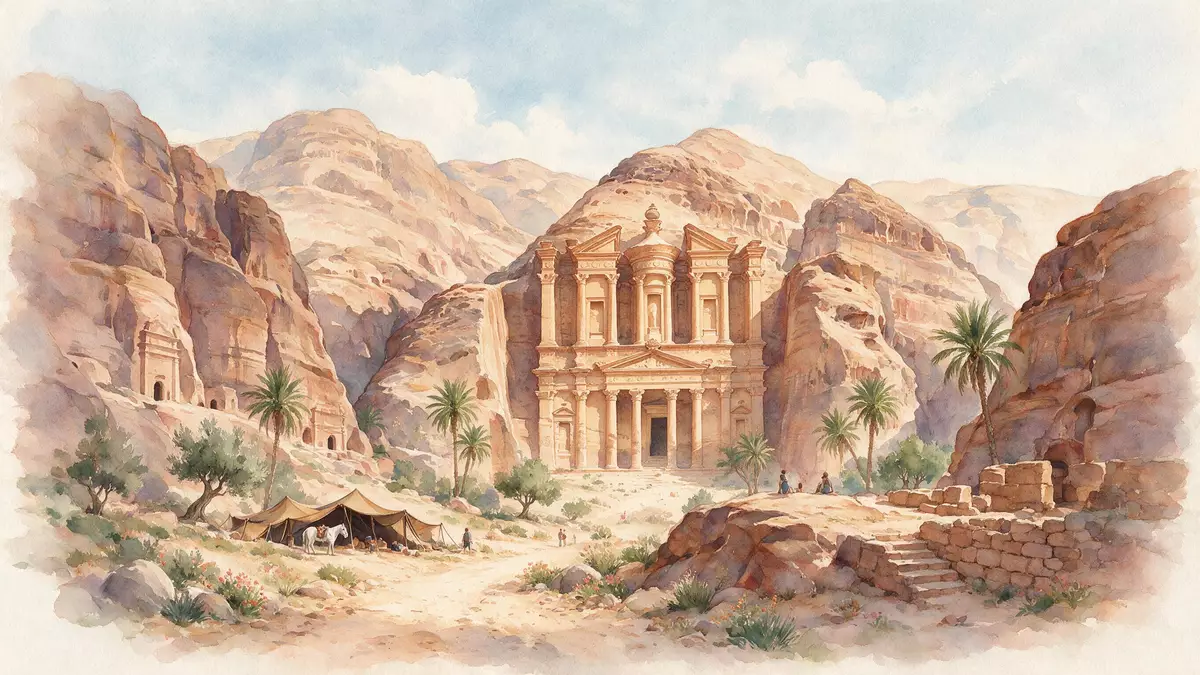
Petra in southern Jordan is an ancient city carved into sandstone cliffs near Wadi Musa, where tombs, temples and streets were cut directly into the rock during the Nabataean period.
Sandstone cliffs and a city carved into rock
Petra lies between the Dead Sea and the Red Sea in the governorate of Ma’an, where sandstone mountains surround a basin reached through narrow gorges and valleys.situated in southwest Jordan Visitors approach the heart of the site along the Siq, a natural passage that leads between high rock walls towards the city’s monumental core.the main entrance through the Siq
Petra’s cliffs are formed of coloured sandstone, giving many façades and rock faces a rose or reddish tone that has led to the city’s widely used “Rose City” nickname.colour of the sandstone The surrounding landscape includes ridges, plateaus and valleys, where rock-cut tombs, freestanding structures and remains of streets and public spaces form a wide archaeological area.
Nabataean capital, trade crossroads and later layers
Petra served as the capital of the Nabataean Kingdom, a desert-based trading power that controlled caravan routes linking Arabia with Egypt and the Mediterranean world.capital city of the Nabateans The city flourished from the fourth century BC into the first century AD, acting as a major centre for incense, spices and other goods moving between Arabia, China, India and the Levant.major trading hub between regions
Archaeological remains at Petra include traces of prehistoric settlement, extensive Nabataean works, and structures from Hellenistic, Roman, Byzantine, Islamic and Crusader periods.varied archaeological remains This long sequence of occupation can be seen in different building types, from rock-cut tombs and temples to churches and later fortifications, spread across the wider landscape.
Monumental façades, water systems and a World Heritage inscription
Petra is known for its rock-cut architecture, where tombs and temples have elaborate façades carved into cliff faces, combining Nabataean traditions with Hellenistic and Roman decorative forms.rock-cut tombs and temples Among the best-known monuments are the Treasury, or Khazneh, with its deep-cut façade, the large rock-cut structure known as the Monastery, and the Royal Tombs grouped along a prominent cliff.
Less visible but equally significant are Petra’s hydraulic works, where channels, tunnels, dams, cisterns and reservoirs were built to collect and store seasonal rainfall for the city’s population.network of cisterns and reservoirs Petra was inscribed on the UNESCO World Heritage List as a cultural property in 1985, under criteria recognising its architectural ensemble, water management systems and testimony to the Nabataean civilisation.inscription as World Heritage in 1985
Visiting Petra: what travellers from Western Europe should know
- Petra lies near the town of Wadi Musa in southern Jordan, reached overland from Amman and other Jordanian cities along highways crossing the Ma’an region.
- The approach into the main site includes walking along the Siq, a natural passage through sandstone rock where the ground surface is uneven and enclosed by high cliffs.
- Inside Petra, visiting the major monuments involves walking across rocky terrain and ancient streets, with some routes climbing on paths and stairways cut into the hillsides.
- The surroundings include desert hills and valleys, so shade is limited on many routes and footwear suitable for stone and sand is important.
- The official language is Arabic and the currency is the Jordanian dinar; entry requirements depend on your nationality, UK travellers can check the FCDO travel advice at gov.uk/foreign-travel-advice, Irish travellers the Department of Foreign Affairs at ireland.ie.
Searching for Petra on social platforms
These links open searches for Petra on each platform.
Frequently asked questions about Petra
Where is Petra and what kind of place is it?
Petra is an archaeological city in sandstone cliffs near Wadi Musa in southern Jordan, where ancient tombs, temples and streets were carved into the rock.
What should visitors expect on a visit to Petra?
A visit involves walking through the Siq into a wide valley with monumental rock-cut façades, freestanding ruins and rocky paths linking different parts of the ancient city.
What makes Petra distinctive among ancient sites?
Petra combines extensive rock-cut architecture, complex water management works and a role as the Nabataean capital on major caravan routes between Arabia, Egypt and the Mediterranean.


