
Philae Temple: an island sanctuary of Isis near Assuan
Published on 08/16/2026 at 14:51 | Editorial responsibility: Rafael Müller, Editor-in-Chief AD HOC NEWS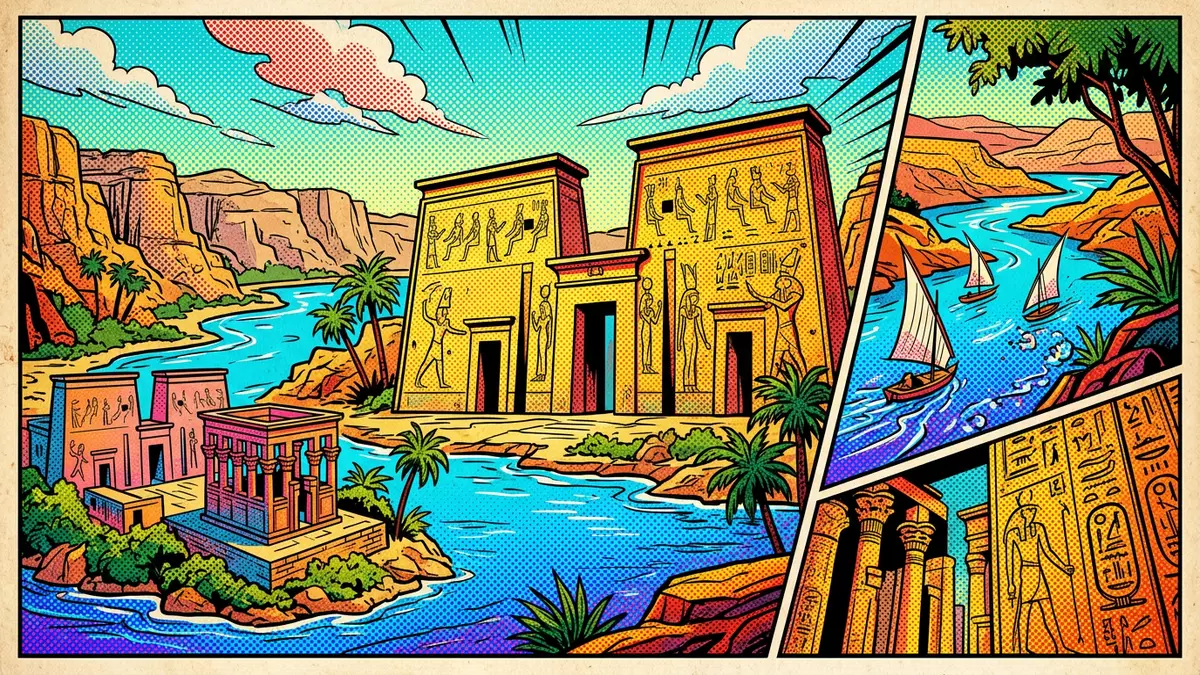
Philae Temple near Assuan in Egypt is an island temple complex dedicated primarily to the goddess Isis, where ancient pylons, courts and colonnades rise above the dammed waters of the Nile. Its monuments belong to the Ptolemaic and Roman periods and stand on Agilkia Island, a rocky outcrop reshaped to receive the rescued shrines of the original Philae site.
An island temple complex reshaped and relocated
Philae Temple is an island-based complex in the reservoir of the Aswan Low Dam, downstream of the main Aswan Dam and Lake Nasser in southern Egypt. The present sanctuary stands on Agilkia Island in the Nile, reached only by boat across the calm expanse of water impounded between the dams.island-based complex in the reservoir
The temples were originally erected on Philae Island near the First Cataract of the Nile, but the construction of large dams placed the ancient buildings at risk of submersion. An international rescue project led under UNESCO auspices dismantled the structures and re-erected them on nearby Agilkia Island, preserving their original orientation and general layout within a new shoreline setting.relocate the entire temple, stone by stonemove the temples of Philae onto the island of Agilkia
Ptolemaic architecture dedicated to Isis and Horus
The core of Philae Temple is a sanctuary for Isis, begun during the reign of Ptolemy II Philadelphus in the third century BC, at the height of Egypt’s Greco-Roman period.temple begun by Ptolemy II Philadelphus Successive rulers extended and embellished the complex, so the visitor walks through pylons, colonnaded courts and chapels that span the later Pharaonic, Ptolemaic, Roman and early Christian epochs.cover four major epochs
Within the complex, the principal Temple of Isis stands alongside a birth house, smaller temples for Hathor and other deities, and the elegant Kiosk often known as Pharaoh’s Bed, whose slender columns frame views of the reservoir and surrounding hills.great Temple of Isis, smaller chapels, courts, pylons, colonnades Later additions include Roman-period structures and Christian-era alterations, such as crosses carved over earlier reliefs, which mark the temple’s continued use into late antiquity.
Part of a wider UNESCO Nile heritage landscape
Philae Temple belongs to the group of Nubian monuments from Abu Simbel to Philae inscribed as a UNESCO World Heritage Site, recognising the cultural significance of these Nile sanctuaries and the international effort that saved them from reservoir waters.Monuments de Nubie d'Abou Simbel à Philæ As part of this chain of sites, the island temple near Assuan stands within a landscape shaped by ancient cataracts and modern dams, where granite outcrops, engineered embankments and expanses of impounded water together form the setting for the stone pylons.
Walking through the complex, a visitor moves from open courts aligned with the river to darker inner halls supported by massive columns and covered by stone roofing, before emerging again to the water’s edge at the far side of the island. From the outer terraces there are clear views back towards the structures of the Aswan dams and across the broad surface of the reservoir, situating the ancient sanctuary firmly within the geography of the modern Nile valley.Philae, island in the Nile River between the old Aswan Dam and the Aswan High Dam
Visiting Philae Temple: what travellers from Western Europe should know
- Philae Temple stands on Agilkia Island in the Nile near Assuan, in the reservoir between the Aswan Low Dam and the main Aswan Dam, and is reached by boat from the shore.
- The complex is built on rocky island terrain, and exploring it involves walking on uneven stone surfaces, climbing steps between levels and moving through roofed halls supported by columns.
- The surrounding region is arid, with exposed stone and water reflecting strong sunlight, so many visitors plan for shade within the colonnades and roofed chambers during their walk around the sanctuary.
- The temple lies in Upper Egypt, where the official language is Arabic and the currency is the Egyptian pound.
- Entry requirements depend on your nationality; UK travellers can check the FCDO travel advice at gov.uk/foreign-travel-advice, Irish travellers the Department of Foreign Affairs at ireland.ie.
Searching for Philae Temple on social platforms
These links open searches for Philae Temple on each platform.
Frequently asked questions about Philae Temple
Where is Philae Temple located?
Philae Temple is in Upper Egypt near Assuan, standing on Agilkia Island in the reservoir of the Aswan Low Dam, downstream of the main Aswan Dam.
What can visitors expect during a visit to Philae Temple?
Visitors cross to Agilkia Island by boat, then walk through pylons, colonnaded courts, roofed halls and smaller shrines, with views over the surrounding water and dam structures.
What makes Philae Temple distinctive among Nile sanctuaries?
Philae Temple combines Ptolemaic and Roman architecture dedicated to Isis with Christian-era alterations, and its entire complex was carefully relocated to Agilkia Island to escape rising dam waters.


