
Phou Si, the sacred hill between the rivers of Luang Prabang
Published on 09/01/2026 at 15:00 | Editorial responsibility: Rafael Müller, Editor-in-Chief AD HOC NEWS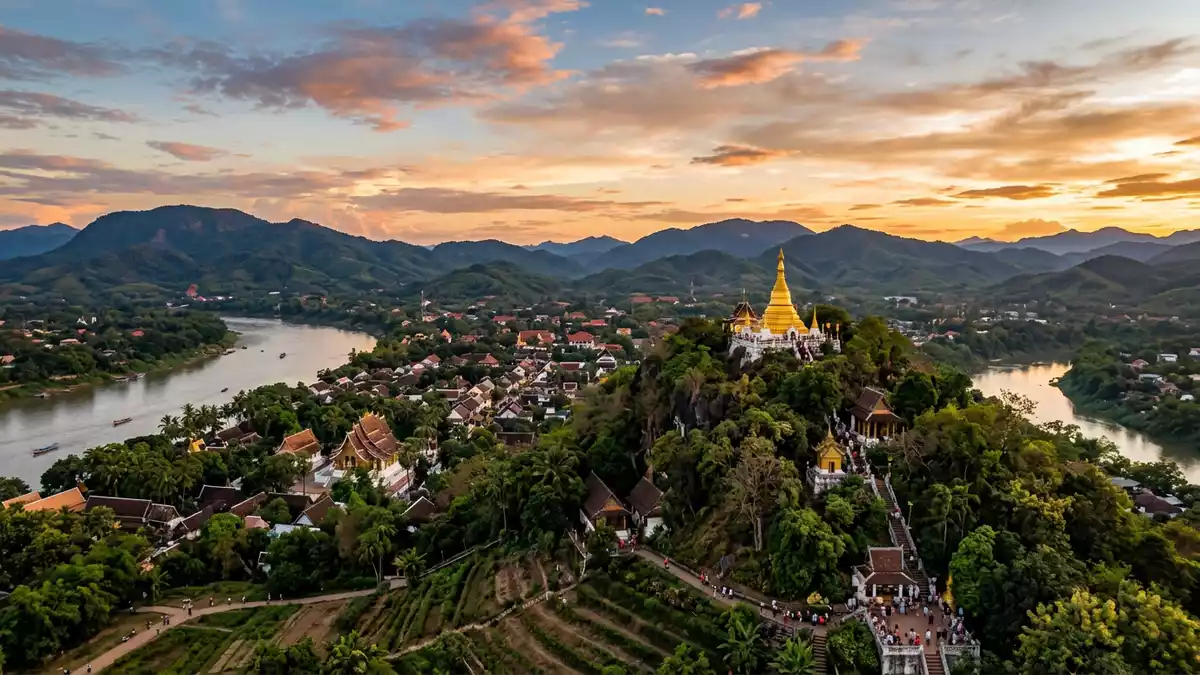
Phou Si is a sacred hill rising above the old town of Luang Prabang, set between the Mekong and Nam Khan rivers and crowned by a Buddhist temple at its summit. With its modest height and long stairways threading through shrines and trees, it gathers religion, landscape and city views into a single climb.
A hill shaped by rivers and a royal town
Phou Si stands in the centre of Luang Prabang’s old town peninsula, bordered on one side by the broad Mekong and on the other by the Nam Khan, so the hill sits between two waterways that define the town’s layout.centre of the old town peninsula From the upper paths and terraces, the roofs and streets of Luang Prabang stretch out below, framed by the line of the rivers and the low hills beyond. The modest elevation of around 100 m (328 ft) above the town means the summit gives a wide angle on the surrounding valley without feeling remote from the streets below.100 m-tall Phu Si
The hill’s name is widely translated as “sacred mountain” or “sacred hill”, and Phou Si has long been a local religious site with Buddhist shrines scattered along its flanks.translated as sacred mountain Luang Prabang itself forms part of a UNESCO-listed townscape, and Phou Si rises above the central streets near the former Royal Palace, so the climb passes from the urban grid into a landscape marked by frangipani trees, small altars and viewpoints over both rivers.separates the Mekong from the Nam Khan
Steps, shrines and the golden stupa
Phou Si is reached by stairways on its slopes, the most used ascending from the main street opposite the Royal Palace Museum, where a long flight of steps leads into the trees.set of steps opposite the Royal Palace Museum That principal stairway was built in the late 1930s and is counted at 328 steps, a steady climb that leaves the town’s traffic behind as stone treads wind upwards.main stairway counts exactly 328 steps Another stairway allows an ascent from the side nearer the Nam Khan, so visitors can approach the hill from different streets and choose their route through the shrines.
Halfway up, overlooking the Nam Khan, stands Wat Tham Phou Si, a temple set into the hillside with images and small devotional spaces that face the river valley.Wat Tham Phou Si halfway up Higher still, at the summit, the temple of Wat Chom Si crowns the hill, marked by a gilded stupa whose bright surface catches the light above Luang Prabang.gilded stupa called That Chomsi Small Buddha images, simple shrines and resting points line the terraces, so the ascent combines a sequence of religious sites with platforms that open out towards the town and the rivers.
Views over Luang Prabang’s roofs and rivers
From the top of Phou Si the view runs in several directions: down to the compact lanes and houses of Luang Prabang, across to the green banks of the Mekong, and over the bend of the Nam Khan as it curls around the peninsula.lies in the heart of the old town peninsula The summit terraces give clear sightlines to temple roofs, the spires of nearby wats, and the hills that form the wider landscape beyond the town. The stairways bring visitors up through areas of planting and rock to reach this series of platforms, where the layout makes the hill a natural vantage point for observing the structure of Luang Prabang.
Because Phou Si sits close to the Royal Palace Museum and near central streets such as Sisavangvong Road, the climb begins only a short distance from guesthouses, markets and riverfront paths.hill located in the centre of the old town From the upper levels, the contrast between the relatively low town and the surrounding hills becomes clear, and the line of the Mekong in particular stands out as a broad stripe of water running past the foot of the peninsula.located on a peninsula surrounded by the Nam Khan and Mekong Rivers The climb therefore links everyday streets with a high viewpoint, while remaining within the compact scale of Luang Prabang.
Visiting Phou Si: what travellers from Western Europe should know
- Phou Si rises above the centre of Luang Prabang’s old town, between the Mekong and Nam Khan rivers, and is reached on foot from central streets and the Royal Palace area.
- The climb uses stairways with several hundred steps, including a long staircase opposite the Royal Palace Museum, so a visit involves sustained uphill walking on stone steps.
- Approaches lead from different sides of the hill, including routes starting near Sisavangvong Road and streets closer to the Nam Khan, giving options for ascent and descent.
- The official language is Lao and the currency is the Lao kip.
- Entry requirements depend on your nationality; UK travellers can check the FCDO travel advice at gov.uk/foreign-travel-advice, Irish travellers the Department of Foreign Affairs at ireland.ie.
Searching for Phou Si on social platforms
These links open searches for Phou Si on each platform.Frequently asked questions about Phou Si
Where is Phou Si located within Luang Prabang?
Phou Si stands in the centre of Luang Prabang’s old town peninsula, between the Mekong and Nam Khan rivers and close to the former Royal Palace.
What can visitors expect when climbing Phou Si?
Visitors climb long stairways that pass Buddhist shrines and small temples, including Wat Tham Phou Si, before reaching the summit temple of Wat Chom Si and its viewpoints.
What makes Phou Si distinctive among Luang Prabang’s landmarks?
Phou Si combines a sacred role with a hilltop position, offering a sequence of religious sites on its slopes and broad views over the town and both rivers from its summit.


