
Piazza dei Miracoli and Pisa’s stone landmark group
Published on 09/21/2026 at 18:05 | Editorial responsibility: Rafael Müller, Editor-in-Chief AD HOC NEWS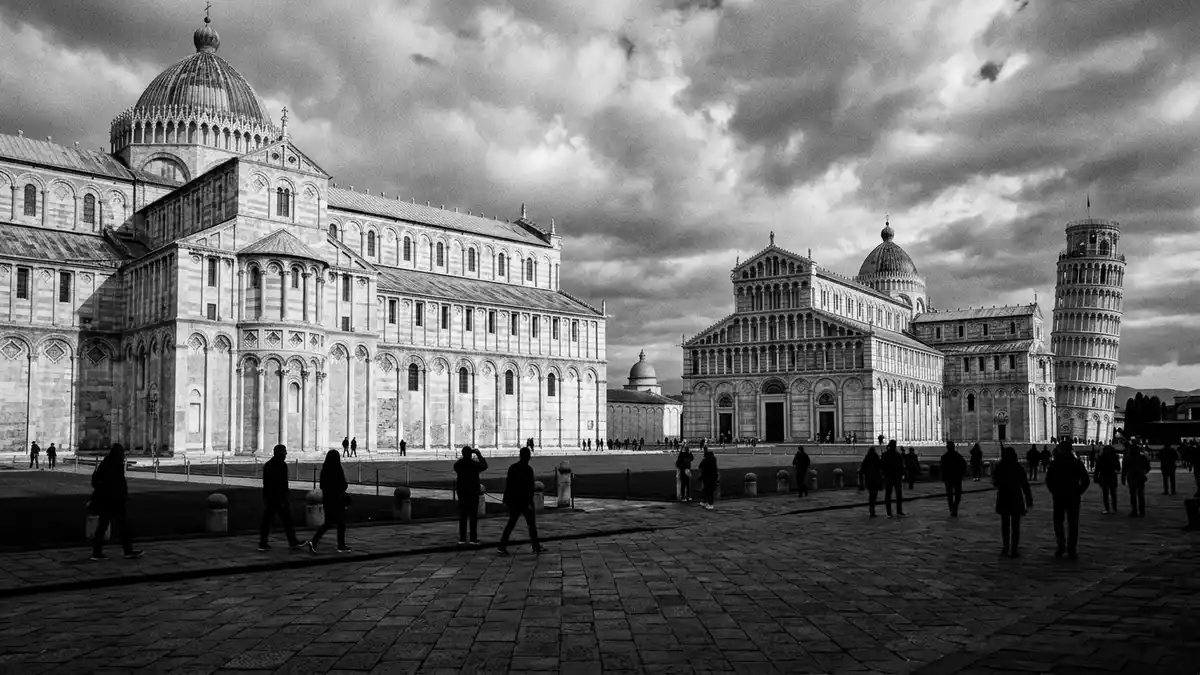
Piazza dei Miracoli in Pisa is a walled monumental ensemble, also known as Piazza del Duomo, with the cathedral, baptistery, tower and cemetery gathered around a broad lawn. It carries a UNESCO World Heritage inscription from 1987 and presents one of Italy’s most recognisable medieval urban settings.UNESCO World Heritage
Pisa’s monumental lawn and medieval ensemble
The square’s arrangement is easy to read from the edge of the grass: white stone buildings, a freestanding tower and long stretches of open ground. The group includes the Duomo, the Baptistery, the Campanile and the Camposanto, which together form the core of the site.the four masterpieces
The Duomo di Santa Maria Assunta began in 1063, in the period of the Maritime Republic of Pisa, and the wider ensemble reflects the city’s medieval rise. The setting keeps the monuments close together, with the lawn acting as the shared foreground rather than a separate park outside the historic complex.began in 1063
Stonework, towers and the long cathedral axis
The architecture mixes Romanesque massing with later medieval additions. The famous leaning campanile stands apart from the cathedral, while the Baptistery and Camposanto complete a group that reads as a sequence of separate monuments rather than a single block.medieval architectural complex
That separation is part of the site’s visual strength. Each building has its own outline and material presence, yet the whole group belongs to one compact civic and religious setting in Pisa.World Heritage Site
The World Heritage square in Pisa
The UNESCO inscription covers the whole Piazza dei Miracoli ensemble, not only the tower. The site is recognised for the way the cathedral, baptistery, campanile and cemetery form a coherent historical group in a single urban space.the whole square
Piazza dei Miracoli also belongs to the wider story of Pisa as a medieval maritime city. Its monuments preserve Romanesque forms, marble surfaces and the layered religious history of the city centre in a remarkably concentrated area.memoria del passato
Visiting Piazza dei Miracoli: what travellers from Western Europe should know
- The square lies in Pisa, in Tuscany, within easy reach of the city centre. Pisa Centrale is the main rail station for arrivals, and local streets lead towards the monumental field.
- The monuments sit on open ground, with broad paved edges and a large lawn between them. The setting is level, but the tower, cathedral and baptistery each rise as separate masses.
- The official language is Italian and the currency is the euro.
- Entry requirements depend on your nationality; UK travellers can check the FCDO travel advice at gov.uk/foreign-travel-advice, Irish travellers the Department of Foreign Affairs at ireland.ie.
- The baptistery, cathedral, campanile and cemetery are closely grouped, so the place is best understood as a connected ensemble. Each part has its own exterior and interior character.
Searching for Piazza dei Miracoli on social platforms
These links open searches for Piazza dei Miracoli on each platform.
Frequently asked questions about Piazza dei Miracoli
Where is Piazza dei Miracoli?
It is in Pisa, in Tuscany, as part of the city’s monumental centre. The square gathers the cathedral complex into one enclosed setting.
What can be expected on a visit?
The place consists of separate monuments set around open ground and lawn. The cathedral, baptistery, tower and cemetery are the main elements to look for.
What makes Piazza dei Miracoli distinctive?
Its identity comes from the combined presence of those monuments in one medieval ensemble. The 1987 UNESCO World Heritage inscription recognises the whole group.


