
Piazza dei Miracoli, Pisa’s meadow of marble and faith
Published on 09/17/2026 at 12:07 | Editorial responsibility: Rafael Müller, Editor-in-Chief AD HOC NEWS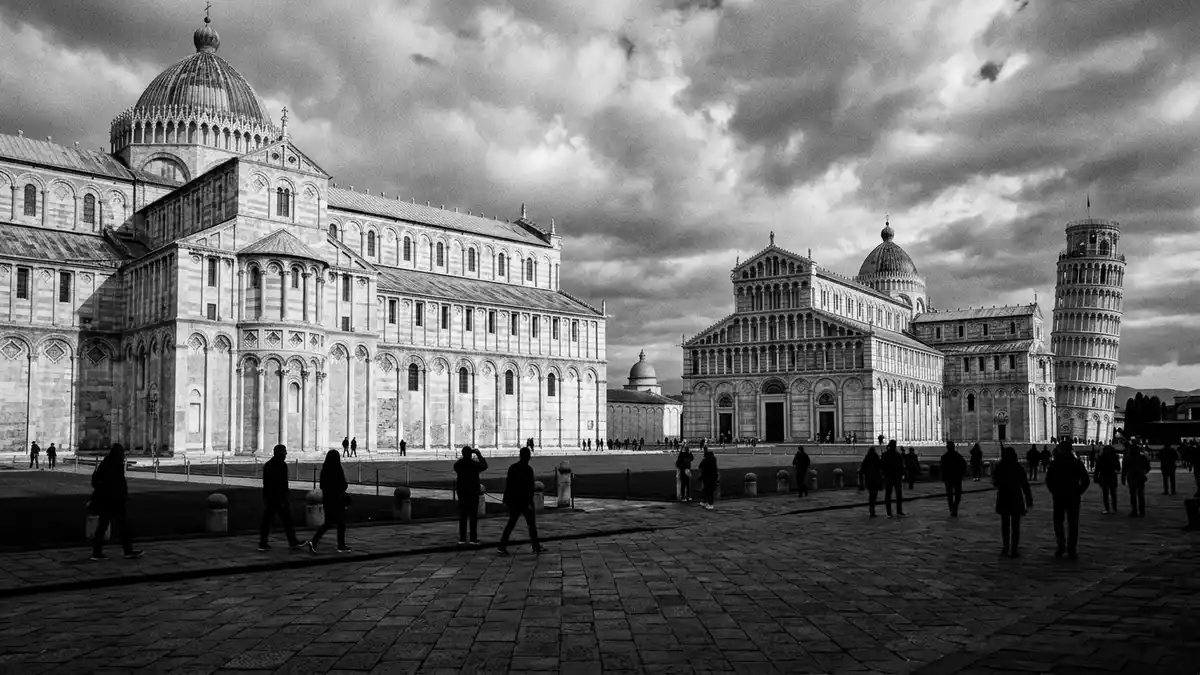
Piazza dei Miracoli in Pisa brings four monumental religious buildings together on a single expanse of grass, turning carved marble and stone into a self?contained landscape of faith. The walled square, formally known as Piazza del Duomo, has been recognised as a UNESCO World Heritage Site since 1987 and concentrates the medieval city’s most ambitious architecture in one place.
A walled meadow of monuments
Piazza dei Miracoli lies on the northern edge of Pisa’s historic centre in Tuscany, forming a roughly rectangular compound enclosed by defensive walls and entered through gates in the masonry.The piazza’s formal name, Piazza del Duomo, reflects its role as the city’s religious heart. Within the enclosure, a broad lawn runs beneath the buildings, so that each structure stands as a separate volume rising from the grass rather than as part of a continuous street front.
The ensemble gathers four principal monuments: the Cathedral of Santa Maria Assunta, the Baptistery of San Giovanni, the freestanding campanile known worldwide as the Leaning Tower of Pisa, and the arched cemetery of the Camposanto Monumentale.Together these works define the square as the focus of Pisa’s religious life. Their white stone and marble facades catch the light differently as the day advances, and the open grass between them makes their distinct outlines and decorative programmes easy to read from multiple angles.
The cathedral and baptistery: Tuscan Romanesque in stone
The oldest and largest building on Piazza dei Miracoli is the Cathedral of Santa Maria Assunta, a Latin cross church begun in the eleventh century when Pisa was a maritime republic projecting power across the Mediterranean.Construction of the present church is recorded from 1063 under the architect Buscheto, with later work by Rainaldo extending the structure in subsequent centuries.The cathedral’s plan follows a long nave with side aisles and a projecting transept, and its exterior blends Romanesque massing with arcaded galleries and inlaid stone taken from classical sources.
Opposite the cathedral stands the Baptistery of San Giovanni, aligned with the main facade so that the two buildings form a balanced pair along the lawn.Work on the baptistery began in 1152 under the architect Diotisalvi, and later campaigns led by Nicola and Giovanni Pisano carried it into the fourteenth century.The building is notable for being the largest baptistery in Italy, with an interior volume that mirrors the cathedral’s grandeur. Outside, its lower storey carries rounded Romanesque arches, while upper zones add more vertical elements and sculpted details.
The Leaning Tower and Camposanto: vertical marker and cloistered edge
South of the cathedral rises the freestanding bell tower that has become Pisa’s most recognisable profile.Building of this campanile began in 1173, and the tower was completed in the fourteenth century. The structure rises in stacked arcaded galleries, each ringed with slender columns, so that the shaft reads as a sculpted cylinder set slightly off the vertical. Its inclination, now held at roughly 4 degrees from the perpendicular after stabilisation works, is visible from any point on the lawn, and the tower’s offset relationship to the cathedral emphasises both its function and its independence.
Along one side of the piazza runs the Camposanto Monumentale, a rectangular cloister enclosing a burial ground.The cemetery forms the architectural boundary of the square, its arcaded walls facing the grass and setting a calm frame for the more sculptural buildings within. Inside, the cloister walks surround earth historically brought from Golgotha, and walls once carried extensive cycles of fresco painting, some of which survive after damage and restoration. Together, tower and cemetery give the piazza both a vertical marker and a quiet, enclosed edge, completing the composition begun by cathedral and baptistery.
Visiting Piazza dei Miracoli: what travellers from Western Europe should know
- Piazza dei Miracoli stands in the city of Pisa in Tuscany, north of the Arno and just outside the tight medieval street grid; it is reached on foot from the central railway station and by road approaches that follow the city’s modern avenues.
- The monuments rise from a broad lawn, and moving between them involves walking on grass and paved paths; interior visits include staircases, with the tower’s ascent following a stone stair inside the wall.
- The official language is Italian and the currency is the euro.
- Other named sites stand close to the square, including the Museo dell’Opera del Duomo and medieval city walls that can be walked along as a separate visit.
Searching for Piazza dei Miracoli on social platforms
These links open searches for Piazza dei Miracoli on each platform.
Frequently asked questions about Piazza dei Miracoli
Where is Piazza dei Miracoli and what does it include?
Piazza dei Miracoli stands in Pisa in Tuscany and contains the Cathedral of Santa Maria Assunta, the Baptistery of San Giovanni, the Leaning Tower and the Camposanto Monumentale.
What should visitors expect on a visit to Piazza dei Miracoli?
Visitors encounter a walled lawn with separate monumental buildings in white stone and marble, along with interiors ranging from the cathedral’s nave to the baptistery’s vast circular space and, for those who choose it, the tower’s stair.
What makes Piazza dei Miracoli distinctive among Italian squares?
The square gathers a complete set of major medieval religious buildings on one enclosed meadow, combining Tuscan Romanesque architecture, a leaning campanile and a cloistered cemetery into a single coherent ensemble.


