
Piazza dei Miracoli, Pisa’s stone lawn of medieval masterpieces
Published on 08/14/2026 at 15:01 | Editorial responsibility: Rafael Müller, Editor-in-Chief AD HOC NEWS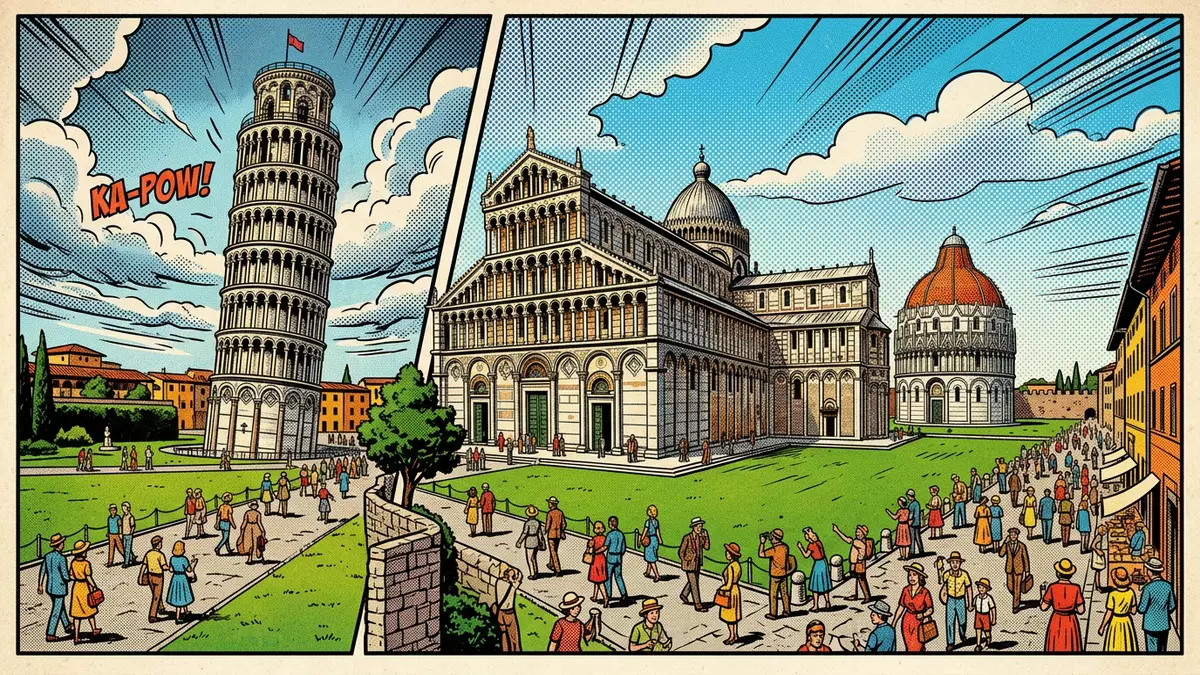
Piazza dei Miracoli in Pisa brings together a cathedral, baptistery, bell tower and monumental cemetery on a single expanse of grass enclosed by walls, forming one of Italy’s most concentrated ensembles of medieval religious architecture. The square, formally known as Piazza del Duomo, has been recognised as a UNESCO World Heritage Site since 1987, anchoring Pisa’s identity around these stone monuments.
A walled meadow of stone and grass
The core of Piazza dei Miracoli is a rectangle of lawn framed by the pale masonry of churches and cloisters, set slightly apart from the dense streets of central Pisa. The space is enclosed by historic walls, giving the monuments a distinct boundary from the rest of the city and creating a clear architectural precinct dedicated to worship and commemoration, described in UNESCO records as a single monumental complex of cathedral, baptistery, campanile and cemetery.monumental complex On this grass the main structures stand close together: the Cathedral of Santa Maria Assunta, the Baptistery of San Giovanni, the Leaning Tower as the cathedral’s campanile, and the arcaded enclosure of the Camposanto Monumentale cemetery.Cathedral of Santa Maria Assunta
The square’s nickname “Piazza dei Miracoli”, or “Square of Miracles”, reflects the way these four major structures share the same lawn yet maintain distinct forms and functions. Stone pavements mark routes between the grass and the buildings, but large areas remain covered by turf, so views of the monuments are framed by green foreground and pale marble. The whole composition occupies several hectares, giving visitors long sightlines along the facades while still keeping every element within an enclosed, legible field.several hectares
The cathedral, baptistery and Leaning Tower
The cathedral at the centre of Piazza dei Miracoli is a Romanesque basilica begun in the eleventh century, dedicated to Santa Maria Assunta and built in marble with bands and arches that run across its long flanks. Its western front is articulated in tiers of arcades and sculpted columns, with bronze doors and carved details reflecting the skills of medieval artisans in the region.Romanesque basilica Inside, the church has a nave and aisles divided by columns, and it historically formed the liturgical focus of the entire complex.
To one side of the cathedral stands the Baptistery of San Giovanni, a free-standing building whose construction began in 1152 under the architect Diotisalvi and continued into the following century under Nicola Pisano.construction began in 1152 The baptistery shows a transition from Romanesque to Gothic forms, with lower zones marked by rounded arcades and upper levels enriched by more vertical, pointed elements. It is covered in light-coloured stone, and its exterior carries statues, including a figure of St John the Baptist, reflecting its role in the rites of initiation.
The Leaning Tower of Pisa rises near the cathedral as its campanile, distinguished by the visible tilt that has made it one of the most recognisable towers in Europe. Built in stages from the twelfth century onward, the tower consists of stacked arcaded rings of white stone with a bell chamber on top.stacked arcaded rings The inclination develops over its height and is clearly evident when viewed against the straight lines of the cathedral, emphasising the contrast between the tower’s geometry and the level lawn beneath it.
Camposanto and the wider religious ensemble
Along one edge of Piazza dei Miracoli stretches the Camposanto Monumentale, a monumental cemetery defined by a rectangular cloister with arcaded walls facing inwards onto a central courtyard. This enclosure forms the burial ground associated with the cathedral complex, and its internal walls carry tombs, sculpted monuments and traces of historic fresco decoration.Camposanto Monumentale The position of the Camposanto along the boundary of the lawn links the liturgical centre of the cathedral and baptistery with a dedicated space for memory and burial.
Together, the cathedral, baptistery, Leaning Tower and Camposanto form the nucleus of a wider religious and cultural district that has been formally recognised by UNESCO for its exceptional value. The World Heritage listing identifies Pisa’s Piazza del Duomo as a cultural site meeting several criteria, including the presence of outstanding examples of medieval Christian architecture and the influence of these works on artistic developments.World Heritage listing Additional buildings, such as the historic hospital and the archbishop’s palace, lie near the square and complete the religious landscape, but it is the four principal monuments on the grass that define the image most visitors associate with Pisa.
Visiting Piazza dei Miracoli: what travellers from Western Europe should know
- Piazza dei Miracoli lies north-west of Pisa’s historic centre, a short walk from the River Arno, and is reached by city buses and roads that connect with Pisa’s railway station.
- The square itself is largely level lawn and paved paths, with steps leading into the cathedral, baptistery, tower and Camposanto, and staircases inside the tower are narrow and steep.
- Nearby streets carry shops and houses, and beyond the walls the urban fabric of Pisa resumes quickly, so the monumental lawn sits directly beside residential and commercial districts.
- The official language is Italian and the currency is the euro.
Searching for Piazza dei Miracoli on social platforms
These links open searches for Piazza dei Miracoli on each platform.
Frequently asked questions about Piazza dei Miracoli
Where is Piazza dei Miracoli located?
Piazza dei Miracoli is in Pisa in Tuscany, Italy, north-west of the city’s medieval centre and close to the course of the River Arno.
What should visitors expect on a visit to Piazza dei Miracoli?
Visitors encounter a walled lawn with the cathedral, baptistery, Leaning Tower and Camposanto standing in close proximity, with stone paths and entrances leading into each monument.
What makes Piazza dei Miracoli distinctive among Italian historic squares?
The square is distinctive because it concentrates four major medieval religious monuments on a single grassed precinct enclosed by walls and recognised as a UNESCO World Heritage Site.


