
Piazza del Campo and the medieval theatre of civic life in Siena
Published on 08/15/2026 at 14:57 | Editorial responsibility: Rafael Müller, Editor-in-Chief AD HOC NEWS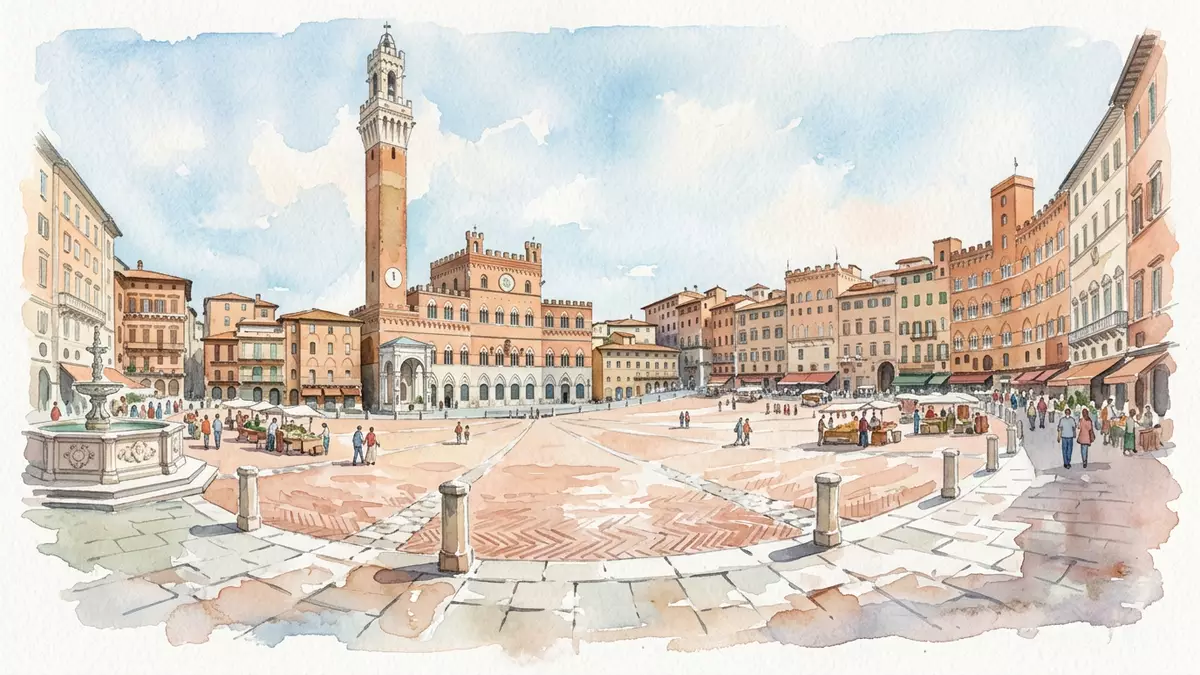
Piazza del Campo is the great civic square of Siena in central Italy, a concave brick basin where the medieval city seems to flow down its hillsides into a single space. Its distinctive form emerged under the Government of the Nine in the late thirteenth and early fourteenth centuries, when Siena’s rulers reshaped an earlier market field into the organised centre of a powerful republic.Government of the Nine
A sloping medieval square shaped like a shell
Piazza del Campo occupies a natural hollow where the territories of three hill communities met, a site that long functioned as a field and marketplace before it acquired its brick surface and regular architectural frame.meeting point of the three hillside communities The square’s plan is often described as resembling a shell, a result of following the steep topography while drawing a clear perimeter that gathers the surrounding streets into a single open space.“snail-shell” shape
The paving of Piazza del Campo is one of its defining features, laid in bricks on edge with radial bands that divide the surface into nine segments converging towards the lowest point in front of the Palazzo Pubblico.brick paving divided into nine segments These divisions echo the period when the Government of the Nine ruled Siena between 1287 and 1355, and they still give the square a subtle pattern that visitors see in changes of brick orientation and pale stone lines amid the red surface.paved in 1349 with brick and travertine
From market field to the seat of a republic
Long before its brick paving, the space known as the Campo served as a marketplace at the confluence of important roads, with documented references dating back to 1169 that cover both today’s Piazza del Campo and the nearby Piazza del Mercato.first documented mention dates to 1169 During the thirteenth century the city council acquired land in the valley and gradually separated the Campo from the Mercato, giving each square a distinct role in Siena’s commercial and civic life.subdivision between the two piazzas
Under the Government of the Nine, ruling from 1287 to 1355, the Campo began to take on its present form as a controlled civic space framed by coherent facades and governed by strict architectural rules.statutes on palace facades and windows Statutes obliged palaces facing the square to adopt regular openings, and guidelines issued in 1297 coordinated the construction of civic buildings and the shaping of the piazza so that political gatherings and public festivals could be held in a setting that reflected the ambitions of the Sienese republic.guidelines in 1297
Palazzo Pubblico and Torre del Mangia on the brick basin’s edge
On the lowest side of Piazza del Campo stands the Palazzo Pubblico, the brick-built town hall that became the seat of Siena’s republican government at the beginning of the fourteenth century.Public Palace built between 1288 and 1342 Construction of this palace began in the late thirteenth century, and by 1310 the Government of the Nine had taken up residence there, looking out over the square that was being progressively paved and refined.Palazzo Pubblico rose from 1297
Beside the palace rises the Torre del Mangia, a slender brick and stone tower whose construction ran through the 1330s and 1340s and whose height in metres has become a familiar figure in descriptions of Siena’s skyline.tower finished in 1348 The tower’s completion around 1348 coincided with the final stages of work on the Campo’s brick paving, giving Siena a composition of square and belfry that expressed the city’s civic order just before the disruptions brought by the mid-fourteenth-century plague and the later Medici takeover.plague of 1348 and Medici control
Visiting Piazza del Campo: what travellers from Western Europe should know
- Piazza del Campo lies in the historic centre of Siena in Tuscany, reached on foot from the surrounding streets that descend towards the square’s gently concave brick surface.
- The square’s floor slopes towards the Palazzo Pubblico, so crossing it involves walking on a gradient rather than a level surface.
- Several narrow streets lead into Piazza del Campo, with approaches that can feel enclosed until they open onto the wide expanse of the Campo.
- The official language is Italian and the currency is the euro.
Searching for Piazza del Campo on social platforms
These links open searches for Piazza del Campo on each platform.Frequently asked questions about Piazza del Campo
Where is Piazza del Campo located?
Piazza del Campo is located in Siena, a Tuscan city in central Italy, and forms the main civic square of its historic centre.
What should visitors expect when they arrive in Piazza del Campo?
Visitors encounter a broad concave brick-paved square framed by medieval palaces, with the Palazzo Pubblico and Torre del Mangia marking its lowest edge.
What makes Piazza del Campo distinctive among Italian squares?
The square’s sloping shell-like form, nine-part brick paving and close association with the Government of the Nine give it a strongly unified medieval character.


