
Piazza del Campo, Siena’s shell-shaped civic stage
Published on 08/14/2026 at 14:20 | Editorial responsibility: Rafael Müller, Editor-in-Chief AD HOC NEWS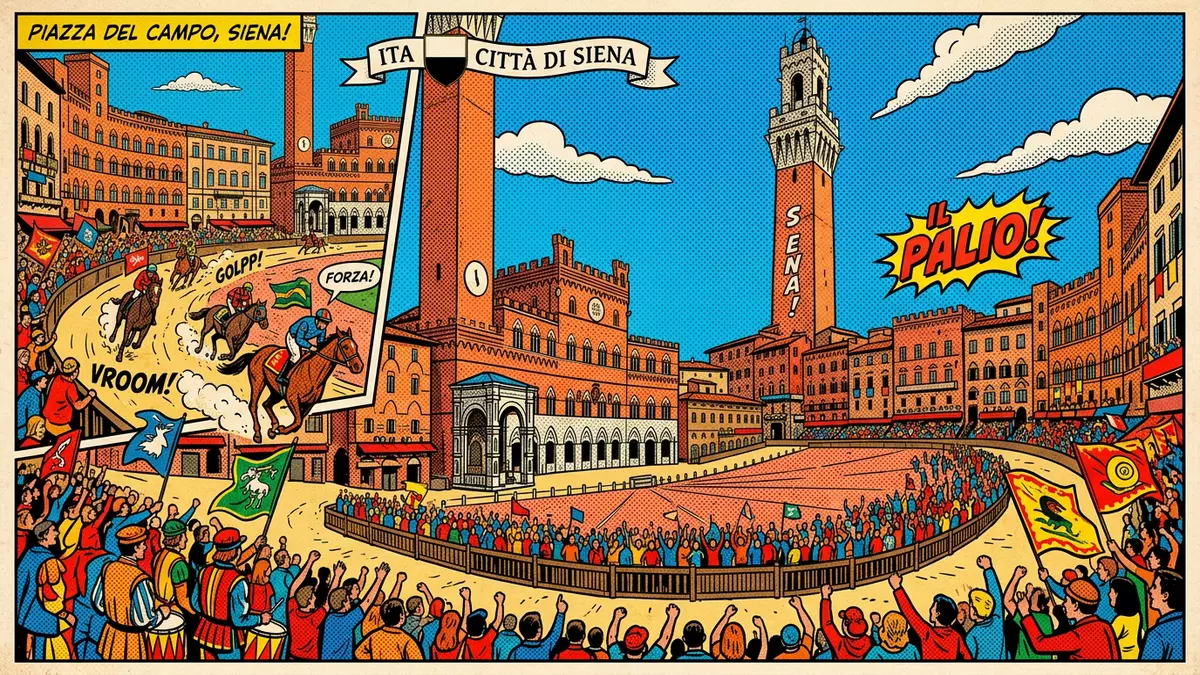
Piazza del Campo is the brick-paved central square of Siena in Tuscany, laid out as a broad shell-shaped space that slopes gently towards the Palazzo Pubblico at its lower edge. Its present form dates back to the late thirteenth and fourteenth centuries, when the republican Government of the Nine consolidated Siena’s civic centre around this piazza.
A medieval square shaped like a brick shell
The most striking first impression of Piazza del Campo is its distinctive plan, a shallow basin paved in red brick and enclosed by tall medieval buildings. The paving is arranged in a fan pattern that converges toward the lowest point of the square, while subtle lines mark out nine wedge-like segments associated with the council of the Nine who ruled Siena during the city’s peak of prosperity.Nine segments in the paving The surface is laid in herringbone courses of brick, bounded by a pale stone band that traces the outline of the piazza and accentuates its shell-like form against the surrounding facades.Brick paving in a shell form
The Campo occupies a natural hollow where three ancient hilltop communities converged, and documents from 1169 already mention the valley that became the square.Early records from 1169 In the medieval period this space served as a market ground, gradually formalised as Siena’s principal public piazza. By the 1320s the brick surfacing of the Campo had begun, and by the middle of the fourteenth century the characteristic shell-like layout was in place.Surfacing completed in the mid-fourteenth century Standing on the upper edge of the square, the slope and curvature are clear, drawing the eye down to the civic buildings that anchor the composition.
Palazzo Pubblico and Torre del Mangia: Siena’s civic architecture
The lower side of Piazza del Campo is dominated by the Palazzo Pubblico, a large Gothic town hall constructed in brick and stone at the turn of the thirteenth and fourteenth centuries.Gothic Palazzo Pubblico Its long facade presents a series of pointed arches at ground level with elegant windows above, unified by battlements and a central section that subtly projects towards the piazza. Behind this front are halls that housed the republican institutions of Siena, including the council chamber of the Government of the Nine.
Rising from one side of the Palazzo Pubblico is the Torre del Mangia, the city’s slender civic tower that reaches about 102 m (335 ft) above the square.Torre del Mangia height Construction of the tower began in 1325, and it was completed in the middle decades of the fourteenth century, giving Siena one of Italy’s tallest historic secular towers.Tower dates in the fourteenth century The tower’s stone upper section and clock mark a vertical counterpoint to the horizontal arc of the square, while its base opens into the Palazzo Pubblico, linking views of the piazza with civic rooms decorated by fresco cycles from Siena’s medieval heyday.
Fonte Gaia and the palazzi around the Campo
The upper part of Piazza del Campo is marked by Fonte Gaia, a rectangular fountain set within a low parapet of carved stone. The present layout recalls the work of sculptor Jacopo della Quercia, whose early fifteenth-century reliefs and figures for the fountain asserted the importance of water and civic pride in Siena’s artistic language.Fonte Gaia by Jacopo della Quercia The fountain’s basin and surrounding steps form one of the focal points of the upper Campo, balancing the visual weight of the Palazzo Pubblico below.
Around the curve of the square stand palazzi that once belonged to Siena’s noble families and merchant dynasties, many dating from the fourteenth century and sharing the brick-and-stone language of the town hall.Fourteenth-century palazzi facing the square Their facades follow rules issued by the commune in the late thirteenth century, which aimed to keep the fronts aligned and harmonious around the Campo.Communal regulations on facades From the paving a visitor can trace the gentle curve of these buildings and the way they form an amphitheatre of brick that frames the hollow of the piazza.
Visiting Piazza del Campo: what travellers from Western Europe should know
- Piazza del Campo lies in the historic centre of Siena in Tuscany, and is reached on foot along medieval streets radiating from the square.
- The paving slopes downwards from the upper edge to the Palazzo Pubblico, so walking across the Campo involves a noticeable gradient on brick and stone surfaces.
- From the square there are direct views of Siena Cathedral nearby, and several side streets lead towards the surrounding district of narrow lanes and smaller piazzas.
- The official language is Italian and the currency is the euro.
Searching for Piazza del Campo on social platforms
These links open searches for Piazza del Campo on each platform.
Frequently asked questions about Piazza del Campo
Where is Piazza del Campo located?
Piazza del Campo is the main square of Siena, a historic hill town in the Tuscan region of Italy, set within its medieval walled centre.
What should visitors expect when they enter the square?
Visitors step into a large sloping piazza paved in red brick, enclosed by Gothic civic buildings, noble palazzi and the high Torre del Mangia tower.
What makes Piazza del Campo distinctive among Italian squares?
Its shell-shaped plan, brick paving divided into nine segments and the ensemble of Palazzo Pubblico, Torre del Mangia and Fonte Gaia give the Campo a singular civic character.


