
Piazza Navona’s long oval: from Domitian’s stadium to Baroque stage
Published on 08/25/2026 at 15:49 | Editorial responsibility: Rafael Müller, Editor-in-Chief AD HOC NEWS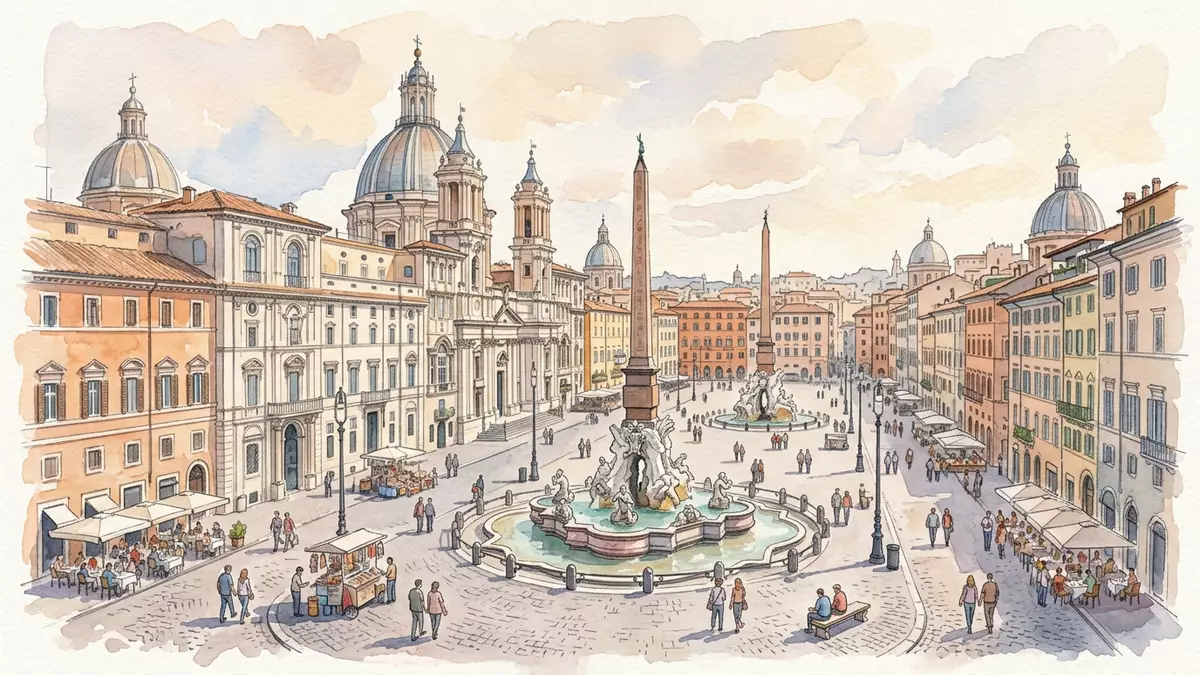
Piazza Navona in Rom stretches along a long, unmistakable oval, mirroring the footprint of the Stadium of Domitian built in the first century AD and wrapped in Baroque facades from the seventeenth century. The square’s present form grew around ancient masonry and later fountains by Gian Lorenzo Bernini under Pope Innocent X, so that an imperial arena and a Baroque stage share the same stone outline.
An ancient stadium hiding in plain sight
The outline of Piazza Navona follows the plan of the Stadium of Domitian, built for athletic contests in the first century AD and associated with the year 80 AD in literary sources.Stadium of Domitian Its elongated floor traces the arena where runners and wrestlers once performed in front of rows of stone seating, and the surrounding buildings rise from the same alignment. The stadium belonged to Emperor Domitian, whose building programme added this Greek-style venue to Rome’s collection of performance spaces.Stadium attributed to Emperor Domitian
The Roman name of the arena, linked with athletic agones, gradually shifted into the modern name of the square as Latin phrases evolved in local speech.Agonal games and the name Navona Beneath parts of the present piazza, remains of the stadium masonry survive in arches and walls, and archaeological areas in neighbouring buildings reveal the depth of the Roman foundations. Walking the piazza is, in effect, a lap around a buried arena, with the measurements and orientation of a Roman stadium translated into a city square.
From marketplace to Baroque showpiece
After the Roman Empire, the old stadium walls provided solid foundations for later housing, and by the fifteenth century the open space functioned as a city market.Market square in the fifteenth century Stalls and carts occupied the same central strip that had once held sand for sport. The continuous building front grew denser as palaces and modest houses alike took advantage of the ready-made outline, enclosing the oval completely.
A major transformation came in the seventeenth century under Pope Innocent X, who reigned from 1644 to 1655 and whose family palace, Palazzo Pamphilj, faces the square.Pamphilj palace overlooking the piazza During this period Piazza Navona took on its Baroque character, with new facades, churches and fountains framing the long space. The papal commission drew leading artists to the site and gave the former stadium a new life as an urban salon lined with high-status buildings.
Bernini’s rivers and the Baroque stage
The visual centre of Piazza Navona is the Fontana dei Quattro Fiumi, the Fountain of the Four Rivers, designed by Gian Lorenzo Bernini and completed in 1651 for Innocent X.Bernini’s Fountain of the Four Rivers The fountain stands in the middle of the oval, where ancient spectators once watched the arena, and piles water, rock and statuary into a dramatic vertical composition. At its heart rises an obelisk, re-erected on Bernini’s sculpted base so that ancient Egyptian stone joins Baroque figures over Roman foundations.Obelisk over the Four Rivers Fountain
The four river gods around the base personify the Nile, the Danube, the Ganges and the Río de la Plata, representing the continents recognised by seventeenth-century Europe: Africa, Europe, Asia and the Americas.Rivers representing four continents Their muscular bodies twist around carved rock pierced by arches and basins, while animals and plants associated with each river occupy ledges and recesses. Behind and beside the fountain, the Baroque church of Sant’Agnese in Agone and the long front of Palazzo Pamphilj complete a theatrical backdrop, making the entire piazza feel like a stage set built along the ancient curve.
Visiting Piazza Navona: what travellers from Western Europe should know
- Piazza Navona lies in the historic centre of Rom, west of the Pantheon and north of Campo de’ Fiori, within an area served by city buses and taxis.
- The square itself is level and paved, with broad pedestrian space, but some surrounding streets narrow into cobbled lanes that can feel uneven underfoot.
- Several churches open directly onto the piazza, and older buildings around it contain small archaeological areas where remains of the Stadium of Domitian can be viewed.
- The official language is Italian and the currency is the euro.
Searching for Piazza Navona on social platforms
These links open searches for Piazza Navona on each platform.
Frequently asked questions about Piazza Navona
Where is Piazza Navona in Rom?
Piazza Navona lies in central Rom within the historic core, west of the Pantheon and close to the bend of the River Tiber.
What can visitors expect when they arrive?
Visitors find a long, enclosed urban space shaped by Baroque palaces and churches, with Bernini’s Fountain of the Four Rivers placed at its centre over the ancient stadium.
What makes Piazza Navona distinctive among Rom’s squares?
The square’s character comes from the way a first-century stadium for Domitian survives as the outline of a seventeenth-century Baroque piazza with monumental fountains and facades.


