
Piazza San Marco, a stone theatre in Venedig
Published on 09/19/2026 at 09:05 | Editorial responsibility: Rafael Müller, Editor-in-Chief AD HOC NEWS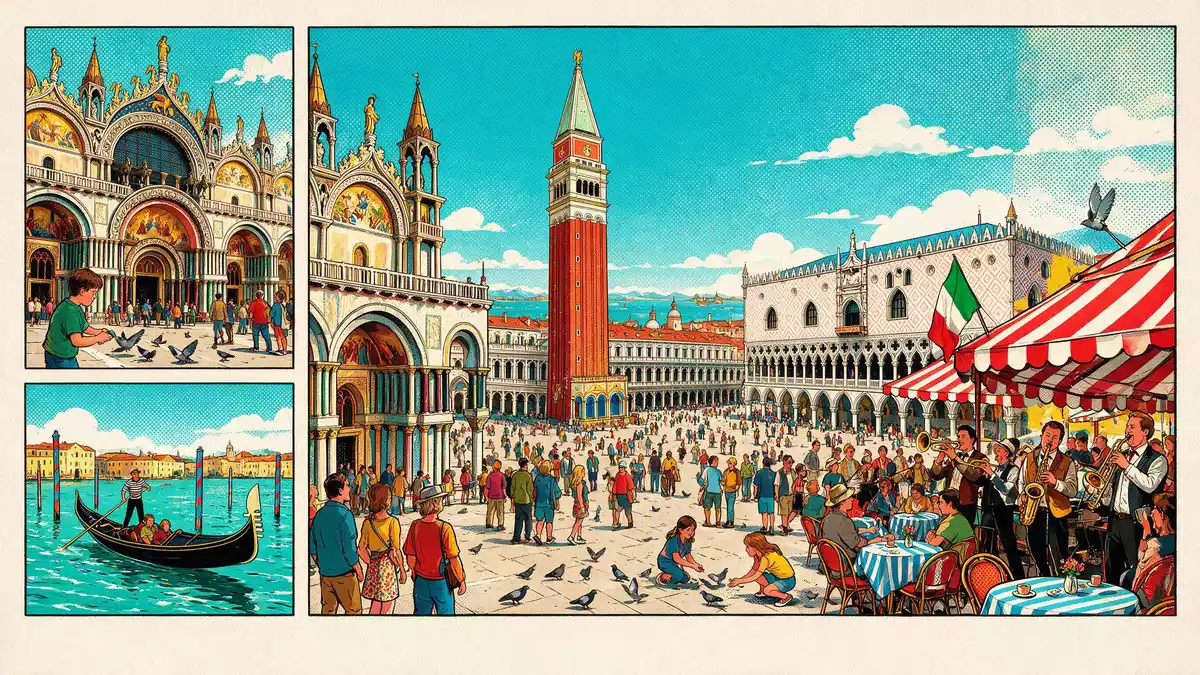
Piazza San Marco in Venedig is a broad, gently widening expanse of stone framed by church, palace and arcades, a space where the city’s history is written into its paving and façades. At its eastern end stands St Mark’s Basilica, and beside it the Doge’s Palace, anchoring the square in the medieval and Renaissance life of the Venetian Republic.
An architectural room of basilica, palace and Procuratie
Piazza San Marco lies at the edge of Venice’s historic centre, close to the Bacino San Marco where the lagoon opens towards the Adriatic Sea. The square forms an architectural room, a trapezoidal rectangle with Basilica San Marco closing its eastern side and long arcaded ranges known as the Procuratie defining the north and south flanks.
The basilica itself grew from a sanctuary around the relics of St Mark the Evangelist, which reached Venice in the ninth century and came to symbolise the city’s identity. relics of St Mark the Evangelist Its domes, mosaics and mixture of Byzantine and western influences give the eastern end of the square a distinctive silhouette. Alongside, the Doge’s Palace presents arcaded loggias and tracery, a Gothic façade looking towards both the piazza and the waterfront.
From a forecourt to the heart of the Serenissima
The origins of Piazza San Marco lie in the ninth century, when it began as a small free area in front of the first basilica of San Marco.small free area in front In the twelfth century the square was enlarged considerably by filling in a canal known as Rio Batario and a landing stage between the square and the Doge’s Palace, creating the broader trapezoidal space closer to its present outline.enlarged in the twelfth century
Over subsequent centuries the square became the ceremonial centre of the Venetian Republic, the Serenissima, hosting religious processions, civic gatherings and diplomatic encounters. The surrounding buildings were adapted to this role: the Procuratie housed officials charged with managing the basilica’s property, and later became a setting for government offices and prestigious residences.Procuratie housed officials By the sixteenth century the outline of Piazza and the adjoining Piazzetta, leading to the waterfront between the palace and the library, was largely fixed.
Paving, bell tower and the geometry of the square
The surface of Piazza San Marco is a key part of its character. The square was paved from the late twelfth century, initially with bricks laid in patterns, before the current grey trachyte pavement with lighter geometric bands was introduced in the eighteenth century.grey trachyte pavement These lighter lines follow the long axis and cross it in a controlled geometry, giving structure to the open surface and echoing the rhythm of the surrounding arcades.
Near the basilica stands St Mark’s Campanile, the square’s tall bell tower that rises as a simple shaft above the paving.St Mark’s Campanile The tower reached its completed historical form in the early sixteenth century after a long building period that began in the ninth century, and was rebuilt in the twentieth century after a collapse, following its previous appearance closely.collapse and rebuild Along the square’s shorter side towards the waterfront, two columns stand in the Piazzetta bearing statues linked to the city’s patron saints and forming a visible threshold between land and lagoon.
Visiting Piazza San Marco: what travellers from Western Europe should know
- Piazza San Marco lies in the eastern part of Venice’s historic centre, close to the Bacino San Marco and opposite the island of San Giorgio Maggiore. It is reached on foot from the city’s alleys and bridges and by public boats serving the nearby waterfront.
- The square itself is a broad, level paved area of stone, with approaches that include arcades, short flights of steps and narrow alleys. Moving between the piazza and surrounding streets involves walking across hard surfaces and negotiating occasional steps.
- St Mark’s Campanile rises beside the basilica at the eastern end of the square, and access to its viewing platform is via internal stairs and lifts inside the tower structure.
- The official language is Italian and the currency is the euro.
Searching for Piazza San Marco on social platforms
These links open searches for Piazza San Marco on each platform.
Frequently asked questions about Piazza San Marco
Where is Piazza San Marco located in Venice?
Piazza San Marco is situated in the eastern part of Venice’s historic centre, adjoining the Bacino San Marco and close to the Doge’s Palace and St Mark’s Basilica.
What can visitors expect when they arrive on the square?
Visitors step into a large paved space framed by arcades, with the domes of St Mark’s Basilica, the Gothic Doge’s Palace and St Mark’s Campanile rising around the stone surface.
What makes Piazza San Marco distinctive among Venetian squares?
Its combination of Byzantine-influenced basilica, Gothic palace, long arcaded Procuratie and eighteenth-century trachyte paving around a single open rectangle gives Piazza San Marco a layered architectural character.


