
Piazza San Marco in Venedig, framed by stone
Published on 09/18/2026 at 16:31 | Editorial responsibility: Rafael Müller, Editor-in-Chief AD HOC NEWS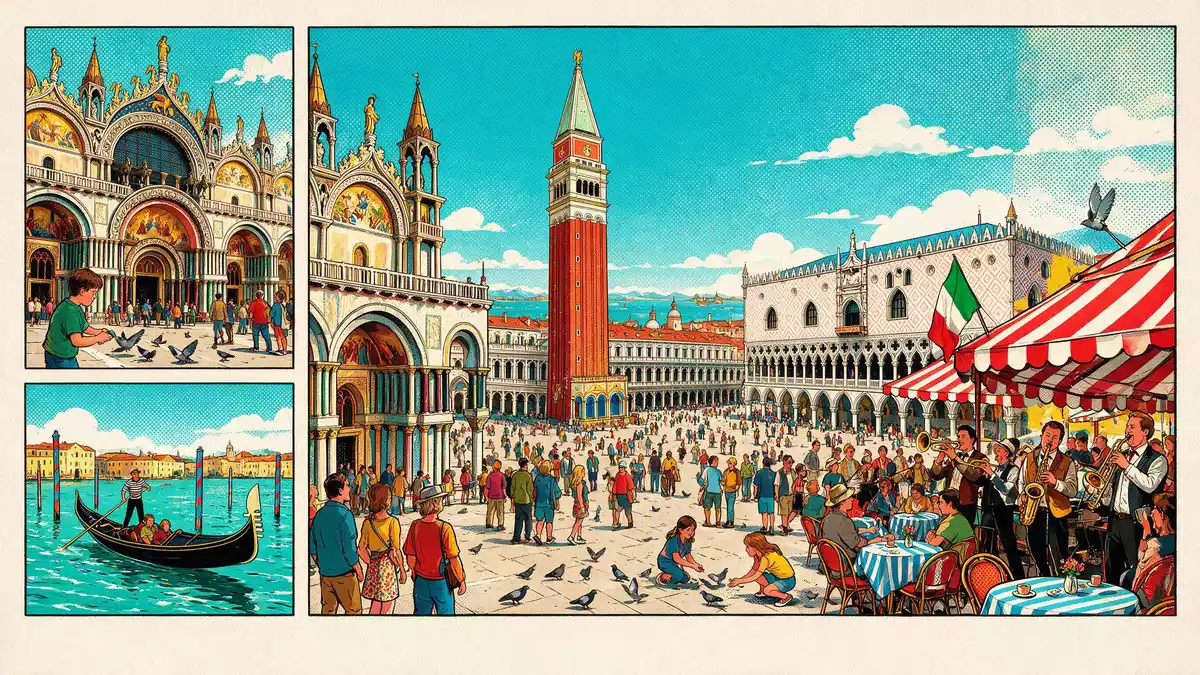
Piazza San Marco in Venedig is the city’s principal public square, and its most striking feature is the way stone, arcades and major monuments share one open frame. The square centres on St Mark’s Basilica and the Doge’s Palace, with the wider ensemble forming Venice’s civic heart for centuries.principal public squarecivic centre since the 9th century
The basilica side and the open square
The eastern end is anchored by St Mark’s Basilica, whose façade faces the square with layered stonework and deep ornament. Opposite it, the long flank of the Procuratie and the open span of the piazza create a broad, ordered foreground rather than a cramped forecourt.northern and southern wingsaround 175 by 82 metres
The square’s present outline belongs to a medieval reworking associated with Doge Sebastiano Ziani, and the space later gained the paved surface that visitors see today. The pattern underfoot and the line of buildings around it make the piazza read less like a void and more like an architectural room in the open air.12th-century redesigngrey trachyte
Palace, tower and the edges of power
Along the Piazzetta, the Doge’s Palace and the Marciana Library face one another across a narrower water-facing space. The two granite columns at the water’s edge, linked to Saint Mark and Saint Theodore, add a vertical counterpoint to the square’s horizontal stone surface.Doge's Palacetwo great columns
Higher up, the Campanile stands free of the surrounding ranges and gives the square a single tall marker. Nearby, the Torre dell’Orologio and the arcaded fronts of the Procuratie bring Renaissance and later layers into the same field of view, without breaking the square’s basic enclosure.CampanileProcuratie Nuove
Piazza San Marco as a civic stage
The square’s importance lies in the meeting of religious, political and ceremonial architecture around one paved centre. St Mark’s Basilica, the ducal palace and the long state buildings give it a formal clarity that is easy to read on foot.St. Mark's Basilicasocial, religious and political centre
The result is a place where four centuries of rebuilding remain legible in a single composition. It is one of Venice’s clearest examples of urban space shaped by power, ceremony and monumentality.architectural ensemblepresent dimensions
Visiting Piazza San Marco: what travellers from Western Europe should know
- The square lies in central Venedig, beside the Basilica di San Marco and the Doge’s Palace. Vaporetto stops at San Marco and San Zaccaria give the shortest approach to the square.
- The ground is flat and paved, with an open expanse that can flood at high water. The Piazzetta and the arcades provide the square’s strongest vertical edges.
- The Campanile stands free of the main building ranges. The tower, the clock tower and the basilica make orientation straightforward from within the square.
- The square is surrounded by major monuments rather than ordinary street frontages. That gives it a defined, formal character from almost every angle.
Searching for Piazza San Marco on social platforms
These links open searches for Piazza San Marco on each platform.
Frequently asked questions about Piazza San Marco
Where is Piazza San Marco?
Piazza San Marco is in Venedig, Italy, at the heart of the historic centre. It sits beside St Mark’s Basilica and opens towards the Piazzetta and the lagoon side.
What can be seen there?
The square brings together St Mark’s Basilica, the Doge’s Palace, the Campanile, the Torre dell’Orologio and the arcaded Procuratie. The open centre is paved stone, with water-facing edges on one side.
What makes it distinctive?
Its distinctiveness lies in the arrangement of major buildings around one broad civic space. The square combines Byzantine, Gothic, Renaissance and later forms without losing its clear outline.


