
Picos de Europa: limestone peaks above Cangas de Onis
Published on 09/19/2026 at 08:14 | Editorial responsibility: Rafael Müller, Editor-in-Chief AD HOC NEWS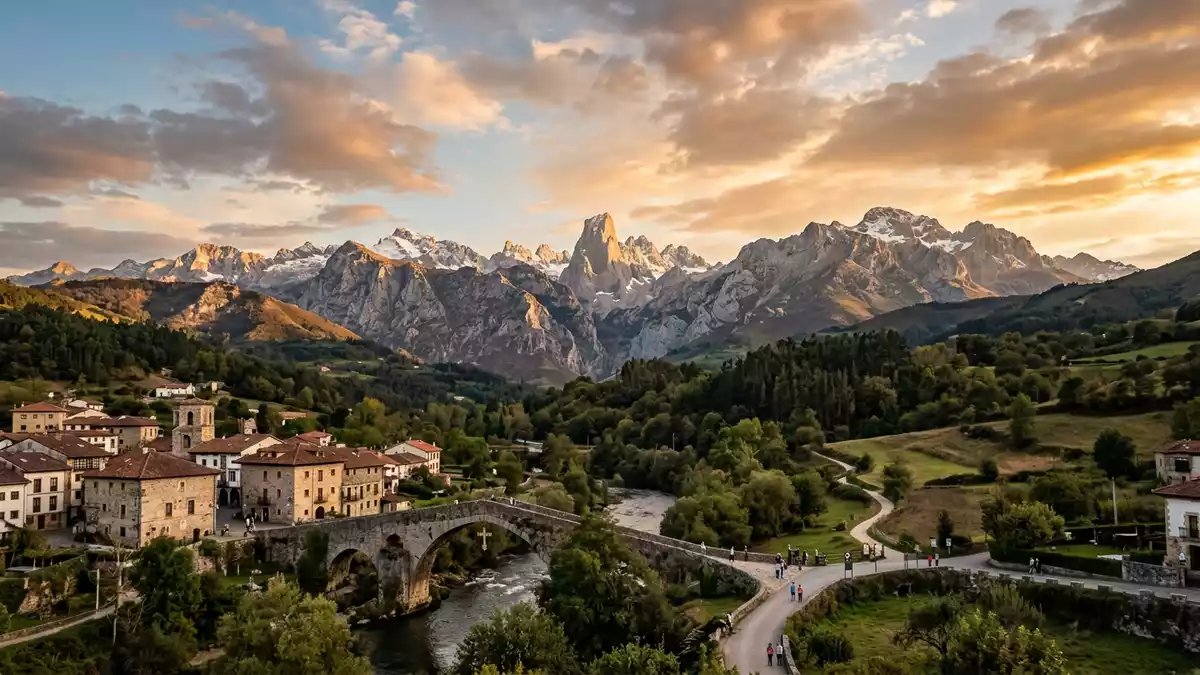
Picos de Europa is a compact limestone mountain range in northern Spain, rising above Cangas de Onis and forming part of the broader Cantabrian Mountains.mountain range in northern Spain Within a relatively small footprint it concentrates high peaks, deep river gorges and high pastures that have shaped the landscape and culture of Asturias, Cantabria and Castile and León for generations.spans three autonomous communities
Limestone massifs facing the Cantabrian Sea
The range forms part of the central section of the Cantabrian Mountains, set inland from the Bay of Biscay yet close enough that the highest summits rise a short distance from the coast.part of the Cantabrian Mountains It extends for around 20 km (12 mi), occupying a roughly triangular area bounded by river catchments including the Sella, Cares and Deva, so that steep walls rise directly above narrow valleys and deep gorges.extends for about 20 km
Geologically, Picos de Europa is built from Carboniferous limestone that has been folded and uplifted, then carved by glacial and river erosion into cliffs, cirques and sinkholes.Carboniferous limestone formation Over time the massif has come to be described in terms of three main massifs: the Western sector, often called Cornión, the Central sector known as Urrieles, and the Eastern sector Ándara, each separated by deep valleys and river gorges such as the Cares gorge between the Central and Eastern massifs.three massifs Cornión Urrieles Ándara
A national park rooted in early conservation
Most of the range is protected within Picos de Europa National Park, which occupies 671 km² (259 sq mi) across the autonomous communities of Asturias, Cantabria and Castile and León.671 km² shared by three regions The highest point of the park is Torre de Cerredo, reaching 2,648 m (8,688 ft) above sea level, while the Deva River at about 75 m (246 ft) marks one of its lowest points, giving the protected area a dramatic vertical range.Torre de Cerredo 2,648 m
Conservation here has long roots in Spanish environmental history. In 1918 the Covadonga Mountain area on the Asturian side was declared Spain’s first national park, centred on the western Cornión massif.first Spanish National Park in 1918 In 1995 protection expanded to cover all three massifs and the headwaters of the Sella, Cares and Deva rivers, and the area took the unified name Picos de Europa National Park.park expansion in 1995 UNESCO later recognised the wider mountain system as a biosphere reserve within its Man and the Biosphere programme, underlining the ecological value of these limestone peaks and valleys.biosphere reserve designation
Cangas de Onis and the Asturian gateway
On the Asturian flank of Picos de Europa, Cangas de Onis stands as a gateway town, with roads rising from its valley towards the highlands and the lakes above Covadonga.Asturian municipalities including Cangas de Onís Within the municipal area lies the high plateau of the Lakes of Covadonga, and the visitor centre at Buferrera serves as an orientation point for excursions into this part of the park.Pedro Pidal visitor centre at Buferrera
Across the range, settlements such as Cangas de Onis, Cabrales and Potes in neighbouring Cantabria sit at the foot of high walls, linking mountain pastures with valley fields.towns in proximity to the park Traditional routes from these valleys connect onward to historic centres including Oviedo and León, reflecting the long-standing role of Picos de Europa as a physical barrier and cultural meeting ground between the coast and interior.links to Oviedo and León
Visiting Picos de Europa: what travellers from Western Europe should know
- Picos de Europa lies in northern Spain within the Cantabrian Mountains, reached by road from Oviedo through Arriondas and on to Cangas de Onis on the Asturian side.
- The terrain is mountainous limestone with steep slopes, narrow gorges and high plateaus, and many routes involve sustained walking on uneven ground and substantial changes in altitude.
- The wider protected area spans Asturias, Cantabria and Castile and León, so different valleys give access to the three main massifs and their surrounding villages.
- The official language is Spanish and the currency is the euro.
Searching for Picos de Europa on social platforms
These links open searches for Picos de Europa on each platform.
Frequently asked questions about Picos de Europa
Where is Picos de Europa?
Picos de Europa is a limestone mountain range in northern Spain, forming part of the Cantabrian Mountains and shared between Asturias, Cantabria and Castile and León.
What should visitors expect on a first visit?
Visitors encounter steep limestone peaks, deep gorges and high pastures, with approaches from valley towns such as Cangas de Onis and other settlements around the three main massifs.
What makes Picos de Europa distinctive among Spanish mountain ranges?
Its compact area combines high elevations, a large vertical drop between peaks and river valleys, early national park protection and a strong cultural link to surrounding towns in three autonomous communities.


