
Pike Place Market and Seattle’s layered public square
Published on 09/23/2026 at 15:26 | Editorial responsibility: Rafael Müller, Editor-in-Chief AD HOC NEWS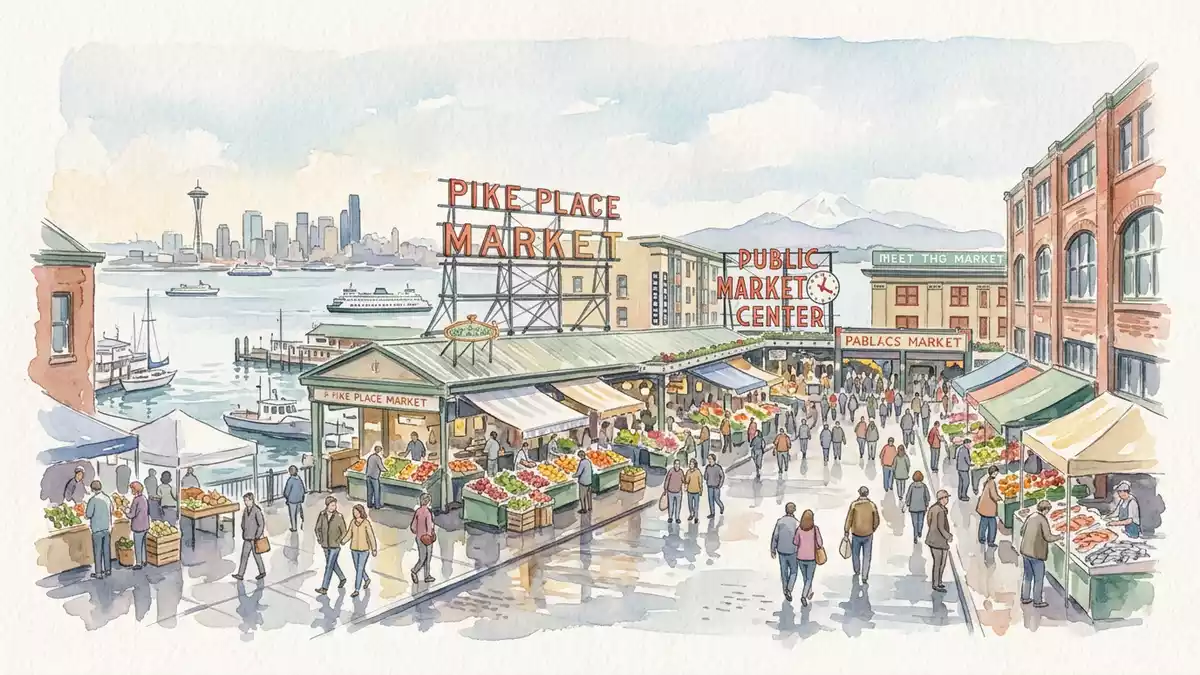
Pike Place Market occupies a hillside above Seattle’s waterfront, where a public market has operated since 17 August 1907. Its identity lies in the mixture of trading spaces, historic buildings, independent businesses, housing and social services gathered across a compact urban district.
From a farmers’ market to a Seattle district
The market began after Seattle City Council member Thomas Revelle secured an ordinance establishing a public market on Pike Place. The first trading day brought farmers with produce wagons to the planked street, and the market’s first permanent arcade opened on 30 November 1907.
Within its first months, the market had grown from outdoor stalls into a built complex. By the early twentieth century, the Main Market, Economy Market, Corner Market and Sanitary Market formed the architectural framework recognised in Seattle today. The 1907 opening history remains central to the place’s character.
The Main Arcade and the hillside buildings
Pike Place Market is not a single hall. It is a collection of buildings, arcades, covered passages and public spaces arranged along the slope between First Avenue and the waterfront. The market’s different levels contain stalls, restaurants, specialist shops, craft businesses and spaces connected with daily life.
The district covers about nine acres and includes more than 30 buildings. Its buildings combine timber, brick, concrete, painted signs and large glazed shopfronts. The public market sign and clock provide a visible marker above the main entrance, while Post Alley runs through the lower parts of the complex.
The market’s vertical layout is part of its physical identity. A walk across Pike Place can lead from open-air produce stalls to covered arcades, basement shops and lower streets. The nine-acre historic district records the market as an urban group rather than an isolated building.
Produce, seafood and a community of small businesses
Fresh produce remains closely associated with Pike Place Market, alongside seafood, flowers, baked goods, prepared food and handmade products. The market also contains cafés, restaurants, galleries, bookshops and specialist retailers.
Pike Place Fish Market is linked with the public tradition of handling fish in full view of customers. Another recognisable feature is Rachel the Piggy Bank, a bronze sculpture by Georgia Gerber installed in 1986 beneath the market sign. Donations placed in Rachel support community services connected with the market.
The market’s social character extends beyond shopping. Its district includes apartments, low-income housing, childcare, a food bank, a medical clinic and a senior centre. The Pike Place Market Preservation and Development Authority, created by Seattle in 1973, manages the historic district and supports its buildings, businesses and community services.
Public protection followed a long preservation campaign. Seattle voters established the Pike Place Market Historic District in 1971, safeguarding the market’s physical fabric and social role. The market’s preservation framework remains part of its identity.
Visiting Pike Place Market: what travellers from Western Europe should know
- Pike Place Market is in downtown Seattle, between First Avenue and the waterfront. Seattle’s Link light rail, buses and street-level routes connect the district with other parts of the city.
- The market occupies a steep hillside. Its passages include stairs, ramps, covered levels and changes in pavement between First Avenue, Pike Place and the lower streets.
- English is the official language of the United States, and the currency is the US dollar.
Searching for Pike Place Market on social platforms
These links open searches for Pike Place Market on each platform.
Frequently asked questions about Pike Place Market
Where is Pike Place Market?
Pike Place Market is in downtown Seattle, Washington, on the hillside between First Avenue and the city’s waterfront.
What can visitors find at Pike Place Market?
The market contains produce stalls, seafood counters, flower sellers, food businesses, cafés, restaurants, craft shops and independent retailers.
What makes Pike Place Market distinctive?
Its distinctive character comes from the combination of a public market founded in 1907, a layered historic district, small businesses, housing and community services.


