

Pike Place Market, Seattle’s layered public marketplace
Published on 09/16/2026 at 06:48 | Editorial responsibility: Rafael Müller, Editor-in-Chief AD HOC NEWS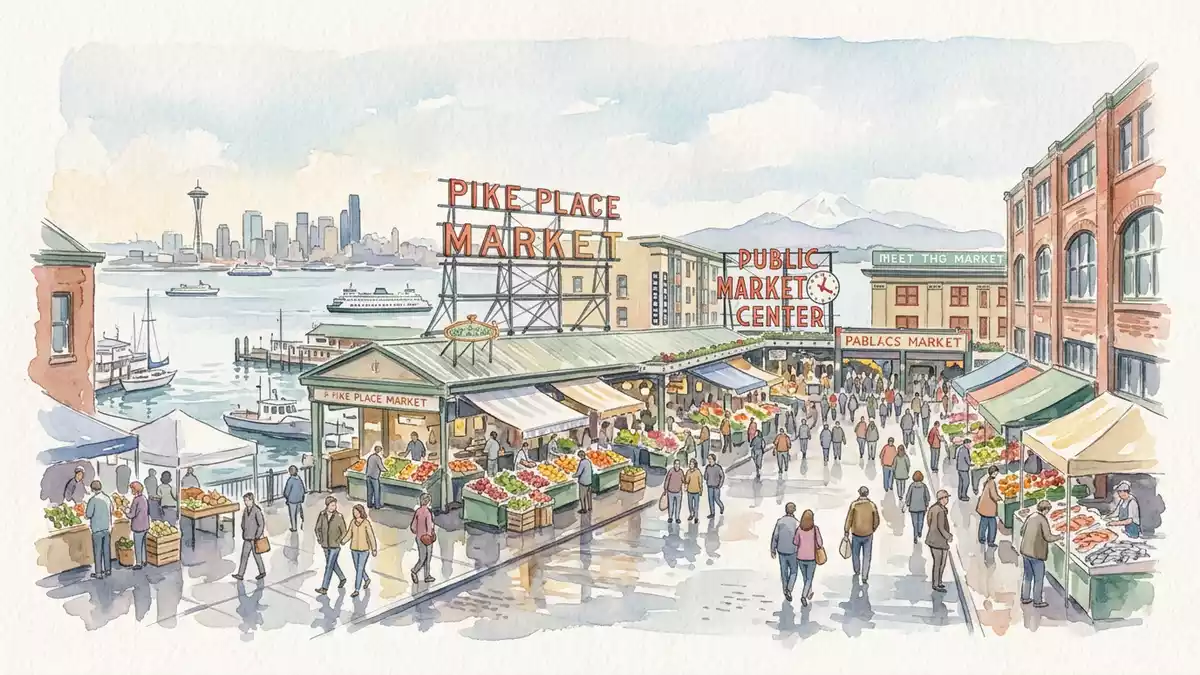
Pike Place Market is a public market district in Seattle, built along the steep streets above Elliott Bay where farmers first brought wagons of produce in 1907. It took shape as a city-sponsored experiment in direct sales between growers and urban shoppers and has grown into a compact maze of arcades, alleys and lower levels that still follow the same hillside down towards the waterfront.
A market born on a bluff above Elliott Bay
The origins of Pike Place Market lie in Seattle City Council legislation in 1907 that designated part of Pike Place as land for a public farmers’ market, allowing producers to sell directly from wagons and stalls.designated as a public market area in 1907 Farmers first set up their carts just west of First Avenue, on newly planked street boards above the tideflats of Elliott Bay.farmers selling produce from wagons on Market Day in August 1907
The market’s opening in August 1907 created a permanent place for agricultural producers to meet city demand and soon became a fixture at the edge of downtown Seattle.founded in 1907 as a city-sponsored experiment City Council member Thomas P. Revelle was a central political figure in setting aside the land, and the early market quickly expanded from a handful of wagons into organised stalls along Pike Place.opened in August 1907 and linked to Thomas P. Revelle
Arcades, signs and the historic district on the hill
Within the first decade, Pike Place Market acquired permanent structures, including the Main Arcade, which opened in November 1907 as one of the early covered buildings for produce stalls.the Main Arcade opened in November 1907 Additional market buildings followed, such as the Economy Market and Corner Market, creating a continuous line of commercial frontages stepping down the slope towards the waterfront.by 1917 much of the present-day Market had been constructed
In the twentieth century the market gained its neon “Public Market” sign and clock, mounted high above the street and visible from the surrounding downtown blocks.neon Public Market sign and clock installed in 1927 The market’s built fabric, spread across several buildings and lower levels, was later recognised formally through inclusion on the National Register of Historic Places and the creation of a historic district in the early 1970s, giving legal protection to this multi-level commercial quarter on the bluff.a historic district and preservation authority established in the 1970s
From farmers’ carts to a layered urban community
Pike Place Market began as a farmers’ market responding to high food prices in commission houses and became one of the longest-running public markets in the United States, continuously operating since its founding year.one of the older continuously operated public farmers’ markets Over the decades the district expanded into a nine-acre area of interconnected buildings housing produce stalls, speciality food shops, crafts tables and residential units.expanded to multiple buildings along several acres near the waterfront
The surrounding hillside and street grid mean that the market’s different levels align with various streets, producing interior corridors, small courtyards and lower floors that feel close to the harbour below. Within the historic district, stalls and shops still operate in structures dating from the early twentieth century, while the preservation framework maintains the market’s role as a working commercial community rather than a single monument.
Visiting Pike Place Market: what travellers from Western Europe should know
- Pike Place Market stands on the western edge of downtown Seattle, above the waterfront of Elliott Bay, reached along Pike Street and nearby First Avenue.
- The market occupies sloping terrain with streets, ramps and stairways linking upper and lower levels, and walking between sections involves frequent changes in level.
- The historic district extends across several blocks with covered arcades and indoor corridors, so exploring the market means moving between open street fronts and interior passages.
- The official language is English and the currency is the United States dollar.
Searching for Pike Place Market on social platforms
These links open searches for Pike Place Market on each platform.Frequently asked questions about Pike Place Market
Where is Pike Place Market in Seattle?
Pike Place Market occupies several blocks on the western side of downtown Seattle, on streets that run above the shoreline of Elliott Bay.
What can visitors expect during a visit?
Visitors encounter a dense mix of produce stalls, speciality food counters, craft tables and shops arranged through arcades, corridors and open-fronted street sections.
What makes Pike Place Market distinctive among urban markets?
Pike Place Market combines early twentieth-century commercial buildings, a hillside layout overlooking Elliott Bay and formal historic district protection while remaining an active working market.


