
Pike Place Market, Seattle’s layered waterfront marketplace
Published on 09/18/2026 at 17:33 | Editorial responsibility: Rafael Müller, Editor-in-Chief AD HOC NEWS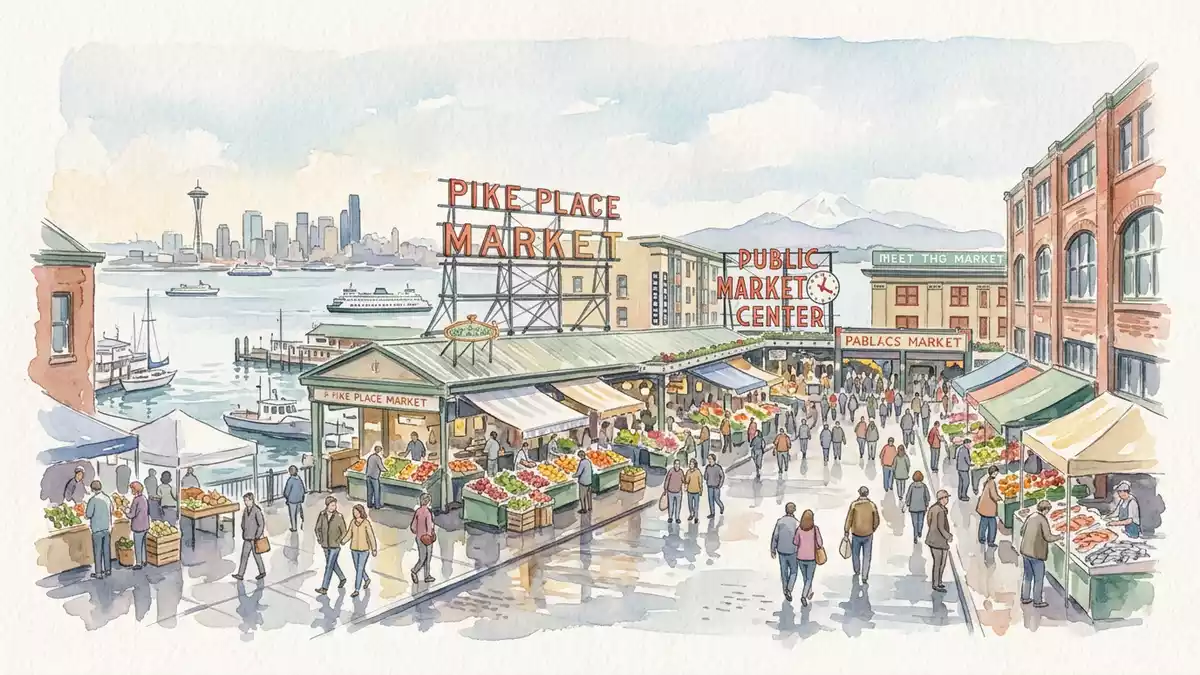
Pike Place Market in Seattle is a historic public market overlooking Elliott Bay, where a compact maze of arcades, alleys and terraces has grown from a farmers’ street market founded in 1907. The market’s buildings, signs and levels still reflect the early twentieth-century experiment that brought local growers directly together with city shoppers and turned a simple planked street into one of Washington’s best known urban marketplaces.
A public market born in 1907
Pike Place Market began as a city-sponsored farmers’ market on the west side of Pike Place in the summer of 1907, created so local growers could sell produce directly from wagons to shoppers rather than through commission houses.farmers sell their produce The Seattle City Council passed an ordinance that August designating part of Pike Place as a location for this new public market, and a first group of farmers brought their crops to the newly planked street.founded in 1907
That first market day in August 1907 saw produce sold out quickly and crowds returning, turning what had started as an experiment into a permanent fixture by the end of the year.first rainy Saturday it was open Later that year the Main Arcade building opened beside the street, bringing the market partly indoors and adding rows of produce stalls along a covered passage.first building at the Market Over the following decade further structures such as the Economy Market and Corner Market extended the complex down the slope towards the waterfront, giving Pike Place Market the layered form visitors recognise.
Arcades, alleys and a neon sign above Elliott Bay
The present-day market spreads across several interconnected buildings and levels between First Avenue and the edge of the waterfront, with internal passageways linking food stalls, craft tables and small shops along corridors that bend and step with the hillside.expanded to 11 buildings Arcades run parallel to Pike Place itself, while cross passages drop down towards Western Avenue, creating a dense urban interior where floors, ramps and staircases connect street level to lower terraces.
One of the market’s most recognisable features is the large neon “Public Market” sign and clock set above the entrance, installed in the 1920s and facing out over the street and Elliott Bay beyond.neon “Public Market” sign Behind it, the arcades house produce sellers, fishmongers and delicatessens, while the lower levels accommodate bakeries, bookshops and specialist retailers in spaces with relatively low ceilings and concrete or timber floors. The market’s proximity to Elliott Bay means that many viewpoints within the complex frame the harbour and ferries, connecting the everyday bustle of trading to the broader landscape of Seattle’s waterfront.
Historic district and a community of producers
By the early twentieth century Pike Place Market had developed into a community of farmers and merchants that included many Japanese American producers, whose stalls lined the arcades before their forced removal and incarceration during the Second World War.Japanese American farmers In the decades after the war the complex aged and was threatened with demolition and replacement by large-scale commercial redevelopment.
Public campaigns in the late 1960s and early 1970s led to Pike Place Market being listed on the National Register of Historic Places in 1970 and the creation of a seven-acre historic district the following year, protecting the market’s buildings and streets as a heritage area.seven-acre Market Historical District Subsequent restoration projects channelled public and private investment into the arcades and surrounding structures, and Pike Place Market remains an active community of traders, craftspeople and residents in the centre of Seattle’s historic waterfront district.
Visiting Pike Place Market: what travellers from Western Europe should know
- Pike Place Market stands between First Avenue and Western Avenue in central Seattle, above the Elliott Bay waterfront and a short walk inland from the ferry terminals.
- The market’s buildings sit on a slope, with staircases, ramps and stepped corridors linking the upper street level on Pike Place to lower floors closer to the water.
- Several downtown streets and pedestrian routes intersect near the market, including First Avenue and Pike Street, so approaches involve crossing busy city roads and pavements.
- The official language is English and the currency is the United States dollar.
- Entry requirements depend on your nationality; UK travellers can check the FCDO travel advice at gov.uk/foreign-travel-advice, Irish travellers the Department of Foreign Affairs at ireland.ie.
Searching for Pike Place Market on social platforms
These links open searches for Pike Place Market on each platform.
Frequently asked questions about Pike Place Market
Where is Pike Place Market in Seattle?
Pike Place Market occupies the blocks around Pike Place between First Avenue and Western Avenue in downtown Seattle, overlooking the Elliott Bay waterfront.
What can visitors expect on a first visit?
Visitors encounter a dense network of covered arcades, outdoor stalls and lower-level corridors, with food vendors, craft tables and small shops spread across several interlinked floors.
What makes Pike Place Market distinctive among urban markets?
The combination of early twentieth-century arcades, the neon “Public Market” sign and the steep site above Elliott Bay gives Pike Place Market a layered character tied closely to Seattle’s waterfront history.


