
Pingyao Gucheng and the living Ming–Qing street grid
Published on 09/19/2026 at 08:24 | Editorial responsibility: Rafael Müller, Editor-in-Chief AD HOC NEWS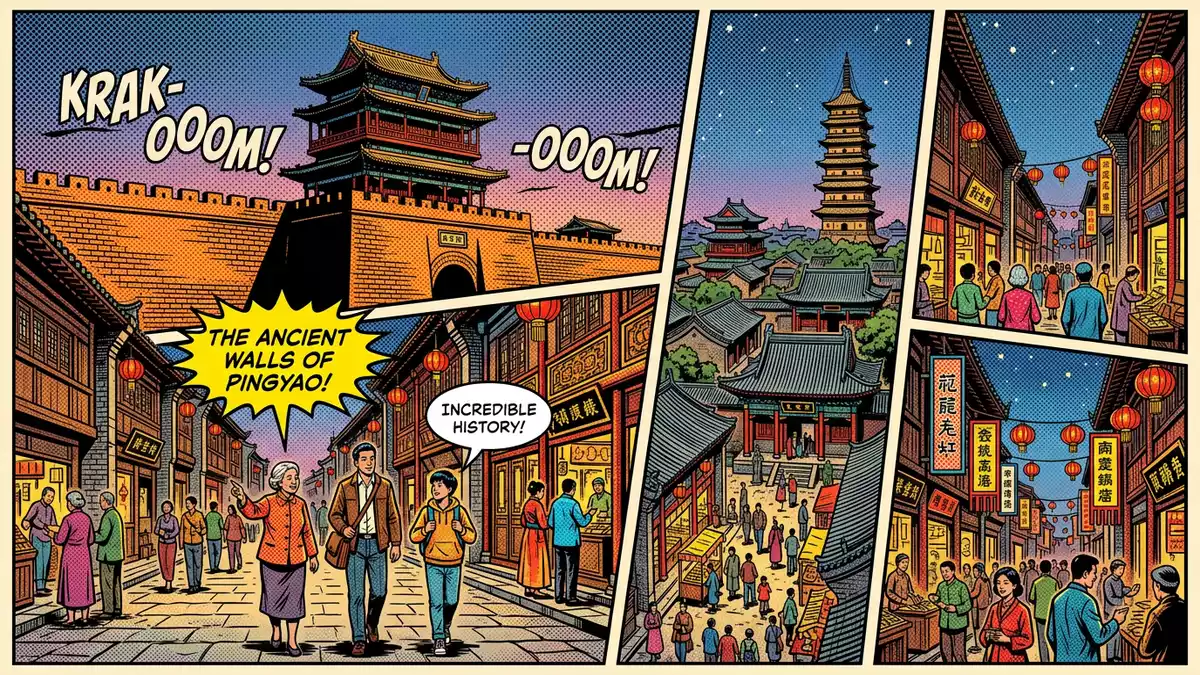
Pingyao Gucheng is the walled historic core of Pingyao in Shanxi Province, an old town where a Ming–Qing street grid, city walls and courtyard houses still form a continuous urban fabric. Founded as a county seat in the fourteenth century, the ancient city is protected as a UNESCO World Heritage Site and retains its role as a compact record of traditional Han Chinese town planning.
The square city and its Ming brick wall
The outline of Pingyao Gucheng is close to a square, enclosed by a city wall that traces more than 6 km (about 3.7 mi) around the old town. The fortification stands around 10 to 12 m (33 to 39 ft) high and is broad enough at the top for several people to walk side by side, expressing its role as both defensive structure and elevated promenade for overlooking the roofs and lanes inside the enclosure.The perimeter of this square city was built as a rammed-earth wall and was faced in brick in 1370 during the reign of the Ming emperor Hongwu, giving Pingyao one of the earliest and largest intact city walls in China.
The wall forms the core of a World Heritage property recognised under the name Ancient City of Ping Yao, inscribed in 1997 for its town plan, fortifications and associated temples. Within the ramparts the street grid is laid out in a regular pattern that descends from four main avenues to smaller streets and dozens of lanes, with the wall punctuated by towers and gates that mark its military character.The wall runs about 6 km around the old town and dates in its present brick form to the Ming dynasty, while keeping the earlier earthen core.
A preserved Ming–Qing commercial town
Inside Pingyao Gucheng the lanes, dwellings, temples and former office buildings sit within a planned grid that shows the evolution of architectural styles over several centuries. The urban fabric records the arrangement of streets and courtyard houses typical of a traditional Han Chinese town and reflects the economic history of Shanxi merchants, who built large compounds and banking houses here during the nineteenth and early twentieth centuries.Ping Yao is an exceptionally well-preserved example of a traditional Han Chinese city, and its Outstanding Universal Value highlights the survival of its dense pattern of commercial and residential buildings.
The protected area covers the entire space within the city walls, together with two important temples in the surrounding countryside, Shuanglin Temple to the south-west and Zhenguo Temple to the north-east.The Ancient City of Ping Yao property includes these three parts and extends over more than 200 ha, giving Pingyao Gucheng a setting where fortifications, streets and religious sites form one protected ensemble. Within the walls, former banking halls and merchant courtyards recall a period when Pingyao served as a major financial centre for China.
Location, temples and approaches
Pingyao Gucheng lies in Pingyao County in central Shanxi, south of the provincial capital Taiyuan, on the Loess Plateau of northern China. The old town forms the heart of a medium-sized city and is reached along streets that lead to its gates; inside, the area is compact enough that most points of interest sit within walking distance through lanes and market streets.Pingyao Ancient City is officially recognised as a cultural attraction at national level, reflecting both the old town and its surrounding temples.
Beyond the wall line two historic temple complexes form part of the same World Heritage listing. Shuanglin Temple lies several kilometres to the south-west of the county seat, while Zhenguo Temple stands to the north-east, each preserving timber architecture and sculpture that mirror the religious life connected to the merchant town.Shuanglin Temple 6 kilometres southwest and Zhenguo Temple 12 kilometres northeast sit within the boundaries of the inscription, adding depth to a visit centred on the walled city.
Visiting Pingyao Gucheng: what travellers from Western Europe should know
- Pingyao Gucheng stands in Pingyao County in central Shanxi, south of Taiyuan, and is reached by rail services to Pingyao and roads that lead directly to the old city gates.
- The terrain inside the walls is largely level but paved; the city wall rises above the town and access to its upper walkway involves climbing stairways that can be steep and lengthy.
- The surrounding region has a continental climate with cold winters and warm summers; snow may cover the approaches and wall in the colder months.
- Pingyao lies in China; the official language is Chinese and the currency is the renminbi (yuan).
- Entry requirements depend on your nationality; UK travellers can check the FCDO travel advice at gov.uk/foreign-travel-advice, Irish travellers the Department of Foreign Affairs at ireland.ie.
Searching for Pingyao Gucheng on social platforms
These links open searches for Pingyao Gucheng on each platform.
Frequently asked questions about Pingyao Gucheng
Where is Pingyao Gucheng and what does it include?
Pingyao Gucheng is the walled old town of Pingyao in Shanxi Province, China, including the area within the city walls and forming part of the Ancient City of Ping Yao World Heritage Site.
What should visitors expect inside the walls?
Visitors encounter a regular Ming–Qing street grid with lanes, merchant courtyards, temples and former banking houses, all framed by an intact brick-faced wall dating to 1370.
What makes Pingyao Gucheng distinctive among historic towns?
Pingyao Gucheng is distinctive for the completeness of its fortifications and street pattern, and for its role as a preserved traditional Han Chinese city recognised by UNESCO since 1997.


