
Plage de Legzira and the red sandstone arch
Published on 09/23/2026 at 15:43 | Editorial responsibility: Rafael Müller, Editor-in-Chief AD HOC NEWS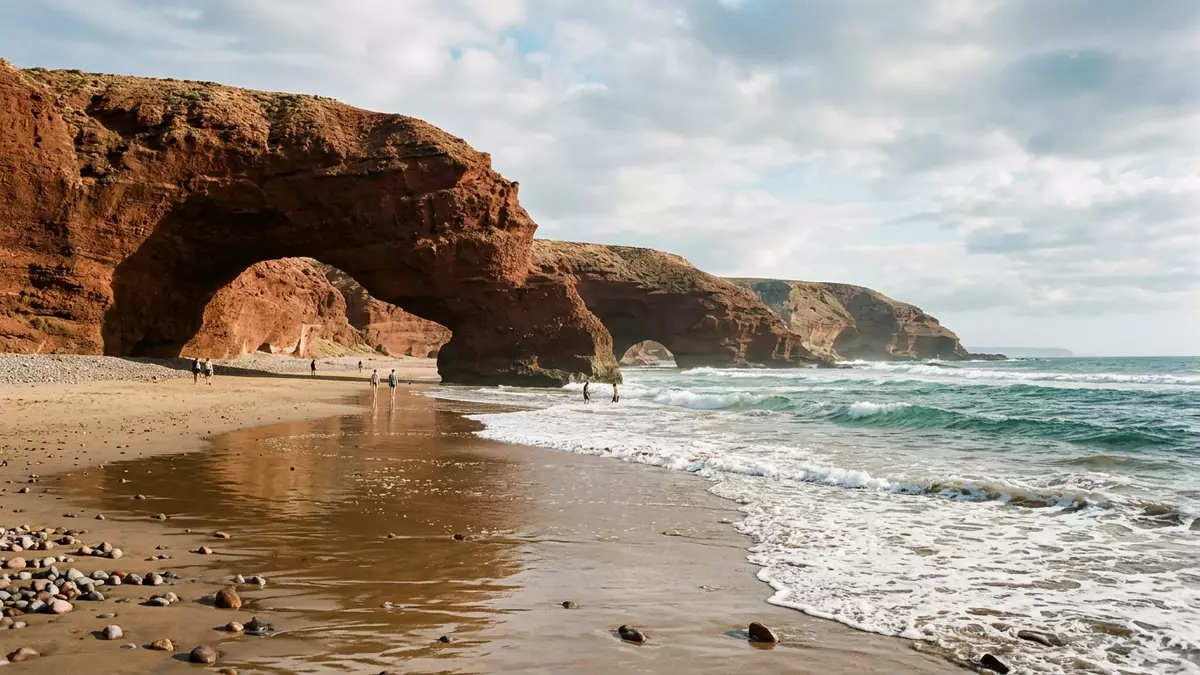
Plage de Legzira is an Atlantic beach near Sidi Ifni, where red sandstone cliffs meet a broad strip of sand. A natural arch reaches across the shoreline, turning the meeting point between rock and sea into the defining view of the coast.
Plage de Legzira beneath the red cliffs
The beach lies on Morocco’s south-west Atlantic coast, between Sidi Ifni and Mirleft, within the Guelmim-Oued Noun region. Its setting belongs to the Souss-Anti-Atlas coast, where sedimentary rock reaches the ocean in headlands, ledges and cliff faces.
Red sandstone gives the shore its colour and texture. Bands of rock rise behind the sand, with exposed layers, recesses and projecting forms visible along the coastal edge. The beach itself forms a long, open foreground beneath the cliffs, while the Atlantic occupies the seaward side of the landscape. Plage de Legzira’s coastal setting places the beach between Sidi Ifni and Tiznit on this Atlantic stretch.
The surviving arch and a changing coastline
The natural arch is a span of red sandstone at the tide line. Its opening passes through the rock between the beach and the sea, with waves moving beneath the overhanging mass. Smaller buttresses and outcrops continue along the shore, giving the main formation a wider geological setting.
Plage de Legzira was associated with two prominent arches until September 2016, when one collapsed. The remaining arch preserves the feature that made the beach recognisable, while the collapse also records the continuing action of marine erosion. The remaining sea arch belongs to a coastline shaped by waves acting on sedimentary rock.
Sand, surf and exposed geology
The shoreline changes in appearance with the tide. When water withdraws, wet sand reflects the cliffs and the sky, and the base of the arch becomes part of the open intertidal zone. When the Atlantic reaches farther inland, water occupies the passages around the rock.
Walking along the beach reveals differences in colour and texture across the cliff line. Red, orange and ochre surfaces appear beside darker wet rock, while layers and ledges mark the sedimentary structure. The arch is not an isolated monument; it is a visible section of the coastal geology. The red sandstone outcrops provide a geological feature that extends beyond the principal arch.
Plage de Legzira therefore brings together three elements that remain visible from the beach: red sandstone, Atlantic water and a natural opening through the cliff. Its character lies in that direct contact between a geological formation and the moving shoreline.
Visiting Plage de Legzira: what travellers from Western Europe should know
- Plage de Legzira lies north of Sidi Ifni on Morocco’s Atlantic coast. It is reached by road from Sidi Ifni, with Mirleft and Tiznit serving as named points along the surrounding coastal route.
- Access to the sand involves descending from the cliff area towards the shoreline. The beach contains exposed rock, loose sand and an intertidal zone around the arch.
- The official language is Arabic and the currency is the Moroccan dirham.
- Plage de Legzira is an Atlantic beach, so the shoreline includes surf, changing water levels and rock formations shaped by marine erosion.
Searching for Plage de Legzira on social platforms
These links open searches for Plage de Legzira on each platform.
Frequently asked questions about Plage de Legzira
Where is Plage de Legzira?
Plage de Legzira is on Morocco’s Atlantic coast near Sidi Ifni, between Sidi Ifni and Mirleft. The beach belongs to the Guelmim-Oued Noun region.
What can visitors expect at the beach?
The setting includes broad sand, Atlantic surf, red sandstone cliffs and an intertidal area around the remaining arch. Access from the cliff area leads down towards the shoreline.
What makes Plage de Legzira distinctive?
A surviving natural arch crosses part of the red sandstone cliff at the water’s edge. Its relationship with the beach, surf and exposed coastal layers gives Plage de Legzira its recognisable form.


