
Plaza de Espana in Sevilla, a vast arc of brick, water and ceramic colour
Published on 08/13/2026 at 14:08 | Editorial responsibility: Rafael Müller, Editor-in-Chief AD HOC NEWS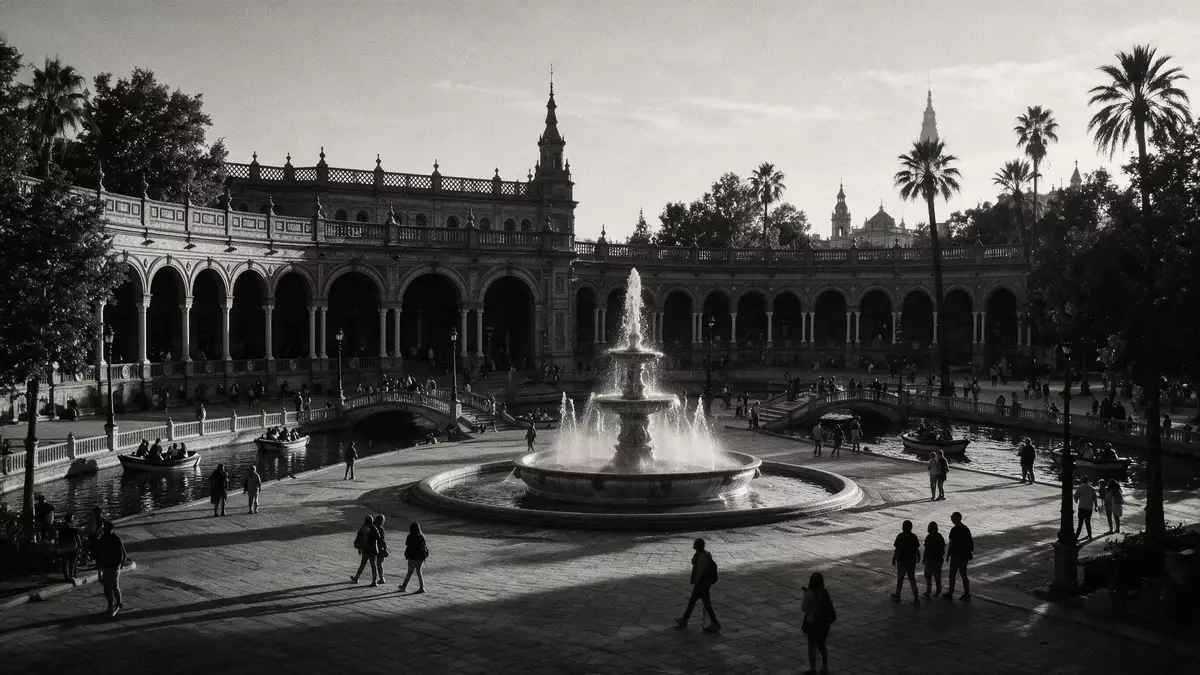
Plaza de Espana in Sevilla is a vast semi-circular ensemble of brick, water and glazed ceramic set within Maria Luisa Park, created for the Ibero-American Exposition of 1929 in Spain. Designed by Sevillian architect Aníbal González in the early twentieth century, it has become one of the city’s most recognisable architectural set pieces.
A sweeping semi-circle around a canal
Plaza de Espana takes the form of a huge semi-circular plaza enclosed by a continuous brick building that follows the curve of the space. The plan creates an open central area, edged by a canal that runs in front of the façades and separates the plaza from the building with water and bridges. The semi-circular layout, described in detail in official information about its floor plan and towers, gives visitors a clear sense of enclosure while remaining open to the park.
At each end of the curved building stands a tall tower that anchors the composition and frames the plaza. These towers, visible from many points around Sevilla, rise above the horizontal sweep of the galleries and mark Plaza de Espana on the city skyline as an identifiable architectural silhouette.Descriptions of Plaza de España as a semi-circular brick building with a tower at either end underline how central this geometry is to its identity.
Regionalist architecture in brick, tile and wrought iron
The ensemble belongs to the Regionalism Architecture of early twentieth-century Andalusia, combining Renaissance Revival, Baroque Revival and Neo-Mudéjar motifs in one expansive composition.Accounts of Plaza de España as a landmark example of Spanish Regionalism mixing these styles give a clear picture of its architectural language. Brick forms the main structural and visual material, laid in warm tones and articulated with pilasters, balustrades and cornices.
Along the façades and lower walls, coloured ceramic tiles introduce pattern and narrative. Glazed azulejos frame doorways, line balustrades and cover benches, adding blues, yellows and whites to the brick background. Wrought iron railings and lanterns, crafted by local workshops such as those named in detailed studies of materials like exposed brick, ceramics, wood and wrought iron, complete the palette, giving Plaza de Espana a texture that rewards close inspection of its surfaces.
A pavilion for the 1929 Ibero-American Exposition
Plaza de Espana was conceived in the context of the Ibero-American Exposition of 1929, a world’s fair held in Sevilla to present Spain’s connections with Portugal and the countries of Latin America. Work on the complex began in the 1910s, and sources on the history of its construction between 1914 and 1929 under architect Aníbal González show how long the project occupied the edge of Maria Luisa Park. The plaza formed the largest single construction of the exposition, acting as Spain’s national pavilion within the exhibition grounds.
The surrounding Maria Luisa Park had already been selected as the main site for the fair and remodelled under French landscape architect Jean-Claude Nicolas Forestier, giving Plaza de Espana a setting of formal gardens, tree-lined avenues and ornamental water.Municipal information on Maria Luisa Park and the role of Aníbal González and Forestier places the plaza within this wider landscape of exhibition buildings and parkland.
Details along the arc of the building
Inside the semi-circle, the curved building is organised as a sequence of arcaded galleries that overlook the canal and the square. The rhythm of arches, columns and balustrades creates sheltered walkways and changing views across the water to the central fountain and tiled patterns of the plaza. Under the galleries, a series of tiled alcoves represent the provinces of Spain as they were counted at the time of construction, each with its own bench and ceramic scene.Descriptions of the 48 tiled alcoves and benches for the provinces highlight how these details turn the architecture into a kind of ceramic atlas of the country.
Closer to the canal, stone and brick bridges cross the water, connecting the central paved area with the galleries. Their balustrades carry more ceramic decoration, and from the bridges the curve of Plaza de Espana can be seen in both directions, framed by the end towers. The combination of brick mass, decorative tilework and water gives visitors multiple vantage points and reflections, particularly along the canal where the towers and galleries appear doubled in the surface.
Visiting Plaza de Espana: what travellers from Western Europe should know
- Plaza de Espana stands on the edge of Maria Luisa Park, south of Sevilla’s historic centre, and is reached on foot, by bicycle or by city bus along broad avenues.
- The plaza’s surface is paved and largely level, but the towers are accessed by staircases, and the arcaded galleries sit above the water, reached by steps and bridges.
- The Guadalquivir River flows to the west of the park, and other exposition-era pavilions stand nearby, so Plaza de Espana can be combined with walks through surrounding gardens and monuments.
- Spain is a member of the European Union; the official language is Spanish and the currency is the euro.
Searching for Plaza de Espana on social platforms
These links open searches for Plaza de Espana on each platform.Frequently asked questions about Plaza de Espana
Where is Plaza de Espana and what is its setting?
Plaza de Espana stands within Maria Luisa Park in Sevilla, in southern Spain, bordered by gardens, tree-lined paths and exposition-era pavilions.
What should visitors expect when walking through Plaza de Espana?
Visitors encounter a large semi-circular paved plaza, a canal crossed by bridges, and long brick galleries with ceramic decoration, framed by tall towers at each end.
What makes Plaza de Espana distinctive among Spanish squares?
Its combination of Regionalist architecture, semi-circular plan, canal, and ceramic alcoves representing the provinces of Spain gives Plaza de Espana a character closely tied to the 1929 exposition.


