
Pont du Gard and the arc of a Roman aqueduct
Published on 09/19/2026 at 21:14 | Editorial responsibility: Rafael Müller, Editor-in-Chief AD HOC NEWS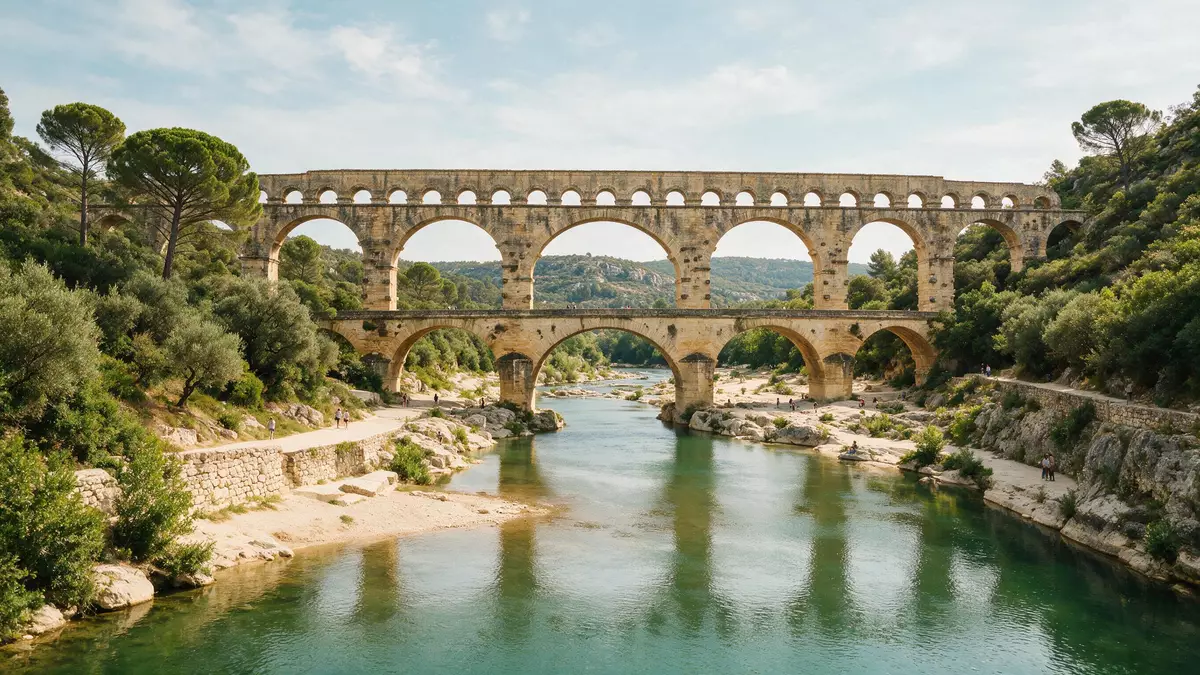
South of Vers-Pont-du-Gard in southern France, Pont du Gard lifts a Roman aqueduct across the Gardon river on three stacked tiers of stone arches. Built in the first century AD to carry water towards the Roman city of Nîmes, it combines hydraulic engineering with monumental architecture in a way that still defines this stretch of the Gardon valley.
A three-tiered bridge in Roman stone
Pont du Gard is the most monumental surviving section of the aqueduct that linked a spring near Uzès with ancient Nemausus, the Roman colony that became Nîmes.Aqueduct from the Eure source The bridge carries the water channel high above the Gardon on three distinct levels, each formed by rows of arches resting on massive piers cut from local stone.Three tiers of arches
The structure reaches close to 49 m (around 160 ft) above the river, making it one of the tallest Roman bridge-aqueducts known.Height of 49 metres Its visible length over the Gardon gorge is a little over 270 m (about 890 ft), with the water conduit running along the top level in a covered channel that once led water on towards Nîmes.Bridge length and conduit
The aqueduct and its Roman context
The bridge belongs to an aqueduct system extending for about 50 km (31 mi) between the Eure spring near Uzès and Nîmes, following a carefully chosen, winding route to maintain a gentle gradient.Aqueduct length and route Built around the middle of the first century AD under the Roman Empire, it reflects the period when provincial cities in Gaul were being equipped with monumental infrastructure similar to that of Rome itself.Construction around 50 AD
The aqueduct’s gradient is reported as around 25 cm per kilometre, a remarkably slight slope that allowed gravity to carry large volumes of water without causing damaging turbulence.Gentle gradient and water flow Accounts describe daily flows of tens of thousands of cubic metres of water, supplying Nîmes with a steady stream for centuries and supporting baths, fountains and other public uses typical of Roman urban life.Water supply to Nîmes
World Heritage and a shaped river landscape
Pont du Gard crosses the Gardon in a setting of wooded slopes and rocky riverbanks, giving visitors clear views of its stone arcades against the river and valley. The bridge and surrounding area form part of a protected cultural landscape that highlights the relationship between Roman engineering and the terrain of the Gard department in France.Location in the Gard department
In 1985, Pont du Gard was inscribed on the UNESCO World Heritage List as an exceptional example of Roman aqueduct construction and as a masterpiece of ancient hydraulic engineering.UNESCO inscription in 1985 The designation specifically recognises its three-storey form, its state of preservation and its value as a testimony to Roman civilisation in what is now the Occitanie region of France.Recognition as an exceptional monument
Visiting Pont du Gard: what travellers from Western Europe should know
- Pont du Gard stands near Vers-Pont-du-Gard in the Gard department of southern France, between Nîmes and Uzès, and is reached by road from those towns.
- The bridge spans the Gardon river in a rocky valley; visiting the monument involves walking on uneven ground and using paths and stairways around the riverbanks.
- The wider site includes viewpoints over the aqueduct and the river, so visitors can expect outdoor walking in a Mediterranean landscape with stone surfaces and exposed slopes.
- The official language is French and the currency is the euro.
Searching for Pont du Gard on social platforms
These links open searches for Pont du Gard on each platform.
Frequently asked questions about Pont du Gard
Where is Pont du Gard and what kind of site is it?
Pont du Gard is an ancient Roman aqueduct bridge over the Gardon river near Vers-Pont-du-Gard in the Gard department of southern France.
What should visitors expect on a visit to Pont du Gard?
Visitors encounter a large stone bridge with three levels of arches in a river valley, with outdoor paths, viewpoints and access to the banks near the monument.
What makes Pont du Gard distinctive among Roman remains?
Pont du Gard stands out for its height, three-tiered form and role within a 50 km aqueduct, and for its recognition as a UNESCO World Heritage Site.


