
Pont du Gard and the Roman aqueduct across the Gardon
Published on 09/24/2026 at 04:43 | Editorial responsibility: Rafael Müller, Editor-in-Chief AD HOC NEWS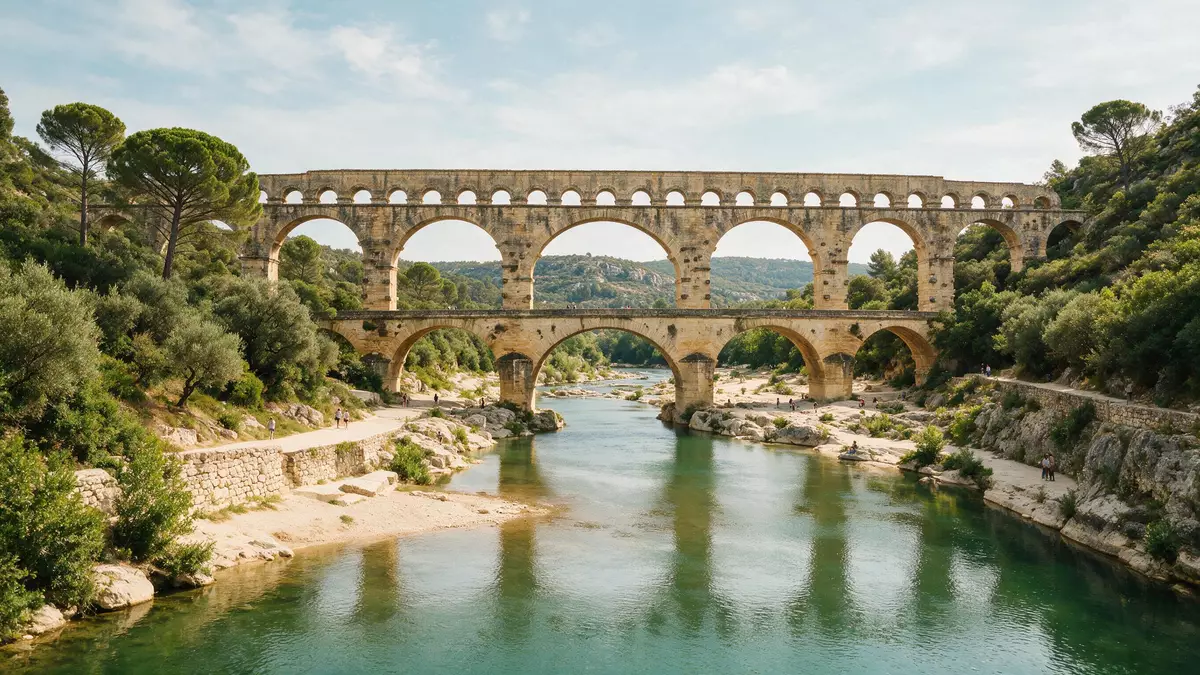
Pont du Gard rises above the Gardon near Vers-Pont-du-Gard as a three-tier Roman aqueduct bridge. Its arches form a monumental stone profile, while the upper level marks the route of a water channel that once connected the Eure source near Uzès with Nemausus, the Roman city of Nîmes.
Built in the first century AD, the bridge reaches nearly 49 metres above the river. The structure is part of an aqueduct extending for about 50 kilometres, turning a crossing in the Gard landscape into a lasting record of Roman hydraulic engineering.
Pont du Gard: three levels of Roman arches
The bridge is arranged in three superimposed levels, each with arches of a different scale. The lower arcade carries six broad openings, the middle level has eleven, and the upper level has thirty-five smaller arches.
Local shelly limestone gives the monument its warm, textured surface. The voussoirs and masonry remain legible across the elevations, revealing a construction based on carefully fitted stone rather than a smooth, uniform wall. The upper arcade extends for roughly 275 metres, while the whole monument rises close to 49 metres.
The Gardon passes beneath the lower arcade. From the river corridor, the three rows read as a single bridge, although Pont du Gard is the most visible surviving section of a much longer water system.
From Uzès to Nîmes through the Roman landscape
The aqueduct began near the Eure source close to Uzès and ended at Nemausus, the Roman colony known today as Nîmes. Its course crossed the landscape through channels, tunnels and bridge sections, with Pont du Gard carrying the water across the Gardon.
The water channel occupied the upper part of the bridge. Roman aqueducts depended on a controlled gradient, and the long route combined underground and open sections before reaching the city.
Nîmes developed public fountains, baths and domestic water systems during the Roman period. The aqueduct connected those urban uses with a source beyond the city, while Pont du Gard provided the most conspicuous crossing along the route.
The monument also records a change in function. After the aqueduct ceased carrying water, the lower level served as a crossing for people and animals. The bridge therefore belongs to both Roman hydraulic history and the later movement through the Gardon valley.
A Roman monument with a modern heritage status
Pont du Gard has been protected as a historic monument since 1840 and entered the UNESCO World Heritage List in 1985. Its significance rests on the surviving relationship between engineering, architecture and the ancient landscape.
The bridge is also the central surviving element of the Nîmes aqueduct. Its three-storey arrangement makes the water system visible at an architectural scale, while the river, limestone and wooded banks place the masonry within its original geographical setting.
The site forms part of the cultural landscape around Vers-Pont-du-Gard. Paths and viewpoints present the bridge from the river level and from the approaches, where the separate arcades can be read against the surrounding limestone country.
Pont du Gard combines a clear visual form with a precise historical role. It is a bridge, an aqueduct and a surviving fragment of Roman infrastructure, with each identity visible in the same stone structure.
Visiting Pont du Gard: what travellers from Western Europe should know
- Pont du Gard lies near Vers-Pont-du-Gard in the Gard department of southern France. The nearest rail stations include Nîmes centre, Nîmes Pont du Gard, Avignon centre and Avignon TGV.
- Bus links include line 115 from Avignon and Alès and line 121 from Nîmes. Shuttle connections also link the monument with Nîmes and Avignon.
- The site is divided by the Gardon, with the bridge approached from the surrounding river landscape. The upper arcade is high above the lower river crossing.
- The official language is French and the currency is the euro.
Searching for Pont du Gard on social platforms
These links open searches for Pont du Gard on each platform.
Frequently asked questions about Pont du Gard
Where is Pont du Gard?
Pont du Gard stands near Vers-Pont-du-Gard in southern France. The bridge crosses the Gardon as part of the ancient aqueduct linking Uzès with Nîmes.
What can visitors expect at the monument?
The site presents a large Roman stone bridge above the river, with paths and viewpoints around the Gardon valley. The three levels of arches remain the defining feature.
What makes Pont du Gard distinctive?
Its three superimposed arcades rise close to 49 metres and belong to a 50-kilometre Roman aqueduct. The monument has held UNESCO World Heritage status since 1985.


