
Potala in Lhasa: the palace on Red Mountain
Published on 09/19/2026 at 17:57 | Editorial responsibility: Rafael Müller, Editor-in-Chief AD HOC NEWS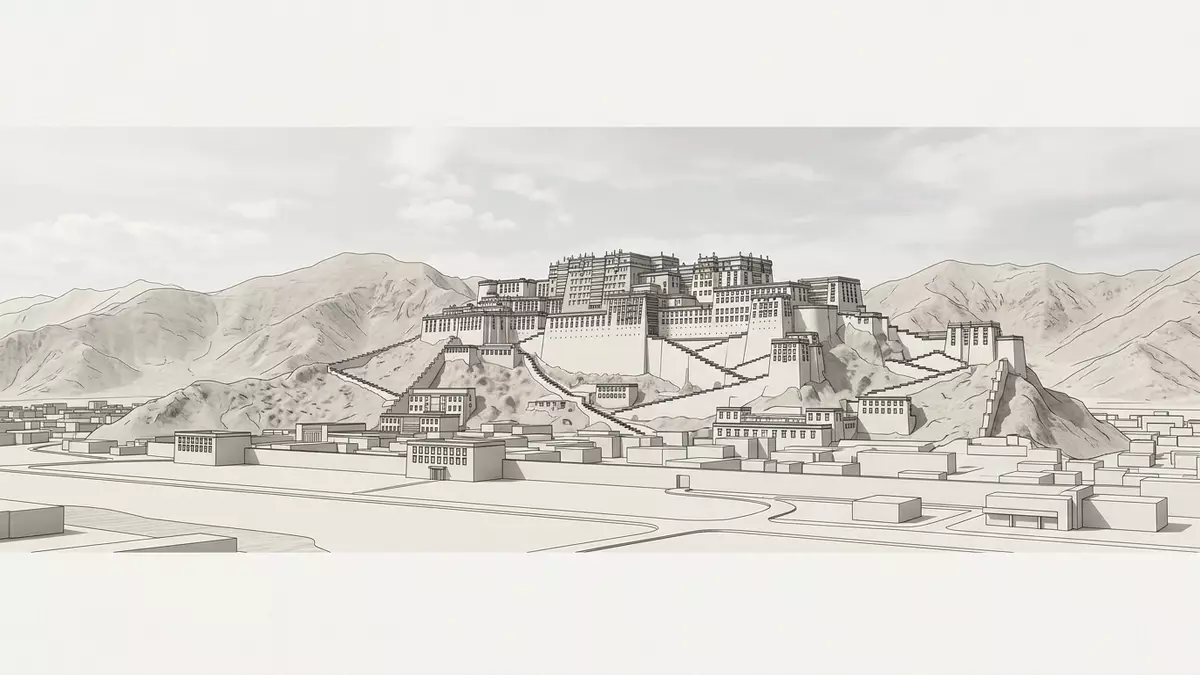
Potala in Lhasa rises from Red Mountain above the valley floor as a palace complex of White and Red sections. It is the winter palace of the Dalai Lama and part of the Historic Ensemble of the Potala Palace, Lhasa World Heritage ensemble.
Red Mountain and the palace mass
The first impression is scale: the palace sits high above Lhasa and presents long walls, towers and layered roofs against the hillside. The whole complex is tied to the centre of Lhasa Valley and stands at about 3,700 m, a fact that gives the setting its elevated profile 3,700 m.
The White and Red Palaces form the visible core. Their massing, together with ancillary buildings, gives Potala a stepped silhouette that reads as architecture and hilltop landscape at once.
Dalai Lama, Srong-brtsan-sgam-po and the historic frame
Potala is tied to two long historical layers: a 7th-century palace tradition linked to King Srong-brtsan-sgam-po and the later rebuilding associated with the Fifth Dalai Lama. Britannica places the 7th-century foundation in that royal period and identifies the later complex as the Potala seen today 7th-century palace tradition.
The later palace includes Potrang Karpo, the White Palace completed in 1648, and Potrang Marpo, the Red Palace completed in 1694. Those dates belong to the building’s established form and are among the clearest anchors for the site completed 1648 and 1694.
UNESCO status and the palace’s larger ensemble
The UNESCO listing is not for the palace alone, but for an ensemble that also includes Jokhang Temple and Norbulingka. That wider designation helps place Potala within the ceremonial and religious geography of Lhasa Jokhang Temple and Norbulingka.
The complex is associated with Tibetan Buddhism, the Dalai Lamas and the traditional administration of Tibet. Inside the palace, the White Palace held ceremonial and residential rooms, while the Red Palace contains chapels and burial stupas for past Dalai Lamas.
Visiting Potala: what travellers from Western Europe should know
- Potala stands in central Lhasa on Red Mountain, and the approach is urban rather than remote. The palace is reached through the city streets below the hill.
- The site rises sharply above the valley. Any visit involves altitude and long internal climbs rather than level floors.
- The palace complex is built of rammed earth and stone. That material is visible in the walls, towers and fortified massing.
- The surrounding ensemble includes Jokhang Temple and Norbulingka. Together they frame Potala as part of Lhasa’s religious landscape.
Searching for Potala on social platforms
These links open searches for Potala on each platform.
Frequently asked questions about Potala
Where is Potala?
Potala is in Lhasa, in the Tibet Autonomous Region of China. It rises from Red Mountain in the centre of Lhasa Valley.
What does a visit involve?
The palace is an uphill urban landmark with extensive interiors and long climbs inside. Its White and Red Palaces define the route through the complex.
What makes Potala distinctive?
Its profile combines a fortress-like mass, a royal and monastic history, and a UNESCO-listed ensemble. The association with the Dalai Lamas and the 7th century gives it a long historical depth.


