
Potala rises above Lhasa as a palace of white and red
Published on 09/22/2026 at 12:40 | Editorial responsibility: Rafael Müller, Editor-in-Chief AD HOC NEWS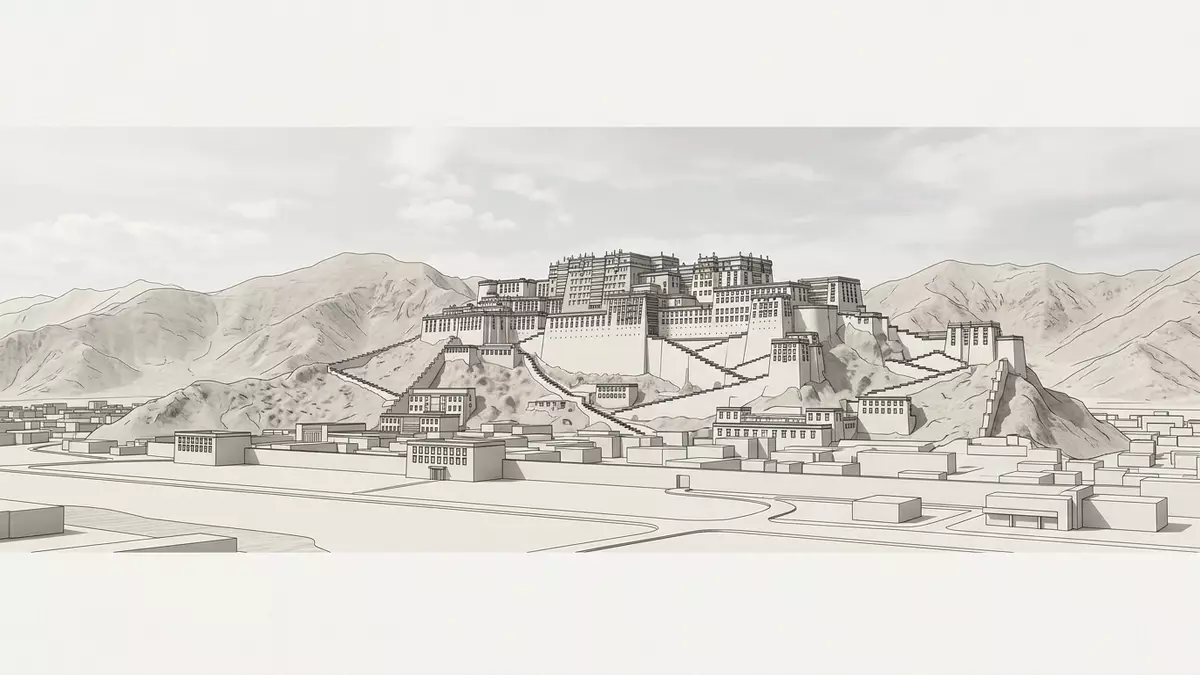
Potala rises above Lhasa from Red Hill as a layered complex of white walls, red halls and gilded roofs. The palace combines Tibetan Buddhist spaces with the former residence and administrative centre of the Dalai Lamas.
Potala on Red Hill above Lhasa
Potala stands in the Lhasa Valley at an altitude of about 3,700 m (12,139 ft). Its position on Red Hill places the palace above the city, with broad masonry façades stepping across the slope.
The complex is formed by the White Palace, the Red Palace and associated buildings. Whitewashed surfaces dominate the residential and administrative sections, while the Red Palace contains major religious spaces, chapels, assembly halls and tomb stupas.
From Songtsen Gampo to the Fifth Dalai Lama
The hill has a seventh-century connection with Songtsen Gampo, ruler of the Tibetan Empire. The present palace began in 1645 under the Fifth Dalai Lama, Lobsang Gyatso, and developed into the large complex visible in Lhasa today.
The palace served as the winter residence of successive Dalai Lamas from the seventeenth century until 1959. Its rooms joined religious activity, government administration and residential life within one fortified architectural ensemble. The seventeenth-century rebuilding marks the central phase of Potala’s present form.
White walls, red halls and Tibetan craftsmanship
Potala’s exterior presents a strong colour division. The White Palace spreads across the lower and broader sections, while the Red Palace rises as the central religious core.
Stone, timber, earth and painted surfaces appear throughout the complex. Inside, murals, sculptures, scriptures, ritual objects and decorated halls preserve layers of Tibetan Buddhist art. Gilded roofs crown the upper buildings, adding a bright metallic detail above the dark red walls.
The palace belongs to the Historic Ensemble of Potala, which also includes the Jokhang Temple and Norbulingka. Potala entered the UNESCO World Heritage List in 1994, while the wider ensemble received extensions in 2000 and 2001.
Its formal significance rests on the combination of religious, administrative and symbolic functions. The buildings remain readable as a palace, monastery, archive of Tibetan art and monument to the political history of Lhasa.
Visiting Potala: what travellers from Western Europe should know
- Potala stands on Red Hill in central Lhasa, in the Tibet Autonomous Region of China. Lhasa Gonggar Airport serves the region, while rail services connect Lhasa with mainland China.
- The palace is reached across elevated ground and a sequence of steps. Lhasa lies at roughly 3,700 m (12,139 ft), so the altitude forms part of the physical setting.
- The official language is Mandarin Chinese and the currency is the renminbi.
- Entry requirements depend on your nationality; UK travellers can check the FCDO travel advice at gov.uk/foreign-travel-advice, Irish travellers the Department of Foreign Affairs at ireland.ie.
- Potala stands near major Lhasa landmarks including Jokhang Temple and the historic Barkhor area.
Searching for Potala on social platforms
These links open searches for Potala on each platform.
Frequently asked questions about Potala
Where is Potala?
Potala is on Red Hill in Lhasa, in the Tibet Autonomous Region of China. The palace rises above the Lhasa Valley at roughly 3,700 m (12,139 ft).
What can visitors expect inside?
The interior contains Buddhist chapels, assembly halls, murals, sculptures, scriptures and ritual objects. Residential and administrative areas are associated with the White Palace, while major religious spaces occupy the Red Palace.
What makes Potala distinctive?
Its white and red palace buildings form a single complex above Lhasa. The site also brings together Tibetan Buddhist, residential and governmental functions within architecture begun in 1645.


