
Prazsky hrad and the stone ridge above Prag
Published on 09/17/2026 at 10:35 | Editorial responsibility: Rafael Müller, Editor-in-Chief AD HOC NEWS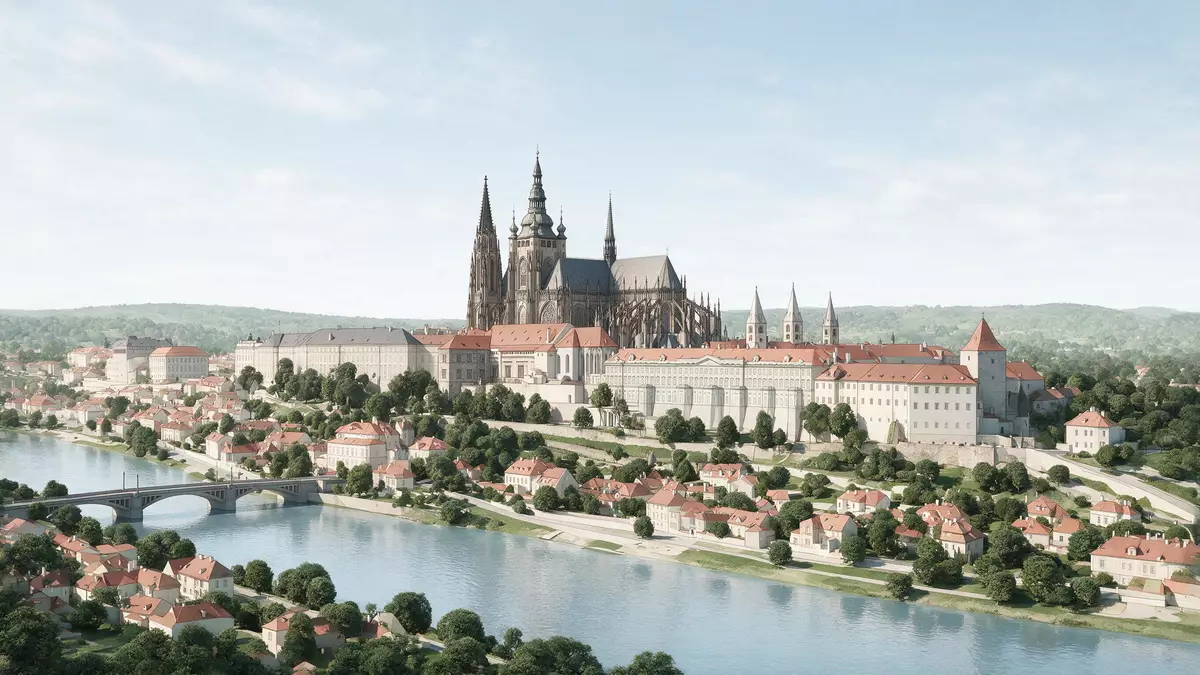
Prazsky hrad, known in English as Prague Castle, spreads along a long stone ridge above the Vltava River in Prag and gathers more than a thousand years of Czech history into one fortified complex. Founded in the ninth century under Prince Bo?ivoj of the P?emyslid dynasty, it has grown into an intricate landscape of palaces, churches, courtyards and gardens that still serves as the seat of the Czech head of state.
The castle on the ridge: scale and setting
Prazsky hrad occupies a limestone promontory on the left bank of the Vltava, forming a high, elongated silhouette that defines the western side of Prag’s historic centre.aggregation of palaces and fortifications line the crest of the hill, facing the river and the Old Town beyond. The complex covers a substantial area, with successive courtyards stepping along the ridge and linking residential wings, ceremonial halls and ecclesiastical buildings into a single sequence.
Stone terraces and retaining walls hold the courtyards in place above the slope, so that the castle feels more like a small walled town than a single building. On the southern side, views open down to the Vltava and across to the spires of the Old Town, while to the north the ground falls towards former defensive works and gardens. Entrance gates from Hrad?any Square lead into the first courtyard, from which the route climbs gently towards the inner courts and the great mass of St Vitus Cathedral.Prague Castle for visitors
A thousand-year palimpsest of Czech power
The origins of Prazsky hrad are traditionally dated to the late ninth century, when Prince Bo?ivoj established a fortified settlement and the first church on the ridge as a seat for the P?emyslid rulers.founded around the year 880 by Prince Bo?ivoj Early stone churches appeared in the tenth century, including the beginnings of St George’s Basilica and the rotunda associated with St Vitus, marking the castle as a centre of Christian worship as well as royal authority.history of the castle began in 870
In the twelfth century a Romanesque palace rose within the walls, adding a more permanent residence for the Bohemian rulers. The fourteenth century brought a major transformation under Charles IV, king of Bohemia and Holy Roman emperor, who rebuilt the royal palace in Gothic style and strengthened the fortifications.royal palace rebuilt in Gothic style Work on the vast Gothic church that became St Vitus Cathedral began in this period and continued for centuries, so that its fabric carries traces of medieval and later phases alike.Gothic modifications of the fourteenth century
St Vitus, Vladislav Hall and Golden Lane
Within the castle, St Vitus Cathedral dominates the skyline of Prag with its soaring nave, flying buttresses and delicate stone tracery. It serves as the former coronation church of Bohemian kings and the burial place of Czech patron saints and major rulers, embedding the building deeply in Czech political and religious history.coronation church and burial place Inside, the cathedral’s chapels and stained glass windows show the long timeline of the site, from medieval saints to twentieth-century designers.
Nearby, the Old Royal Palace preserves Gothic stone interiors, most notably Vladislav Hall with its wide-span vaulted ceiling and large floor area that once hosted royal ceremonies.major rebuilding took place in the fourteenth century On the northern side of the complex, Golden Lane runs along the inner face of the castle wall, lined with small, brightly painted houses that were constructed for castle defenders and later occupied by artisans and writers, including Franz Kafka in the early twentieth century.Zlatá Uli?ka in the north-east of Prague Castle
Layers of style and the modern presidency
Prazsky hrad is less a single stylistic statement than a long architectural palimpsest. Romanesque fragments survive in St George’s Basilica and parts of the early palace, while Gothic forms define St Vitus Cathedral and Vladislav Hall. Renaissance influences arrived with the Habsburgs in the sixteenth century, when new gardens and pleasure buildings appeared, and Baroque and later classicising façades reshaped several palace blocks under Empress Maria Theresa in the eighteenth century.architectural layers spanning Romanesque, Gothic, Renaissance and Baroque
In the twentieth century, the Slovenian architect Josip Ple?nik reworked parts of the castle complex during the period of the First Czechoslovak Republic, introducing new courtyards, stairways and garden structures that blend modern sensibilities with respect for the historical setting.extensive renovations by Josip Ple?nik Prazsky hrad forms part of the Historic Centre of Prague, which is inscribed on the UNESCO World Heritage List, and it continues to function as the official residence of the president of the Czech Republic.Historic Centre of Prague inscription
Visiting Prazsky hrad: what travellers from Western Europe should know
- Prazsky hrad rises above the left bank of the Vltava in Prag, with main visitor entrances from Hrad?any Square on the castle side of the river.
- The castle complex is built on a long ridge, and visiting its courtyards and major buildings involves walking over stone surfaces, climbing steps and crossing relatively large open spaces.
- Prazsky hrad stands within the Historic Centre of Prague in the Czech Republic, where the official language is Czech and the currency is the Czech koruna.
- Travellers reach the area by Prag’s urban transport system, including tram routes and nearby metro stations serving the Hrad?any district on the hill.
- Entry requirements depend on your nationality; UK travellers can check the FCDO travel advice at gov.uk/foreign-travel-advice, Irish travellers the Department of Foreign Affairs at ireland.ie.
Searching for Prazsky hrad on social platforms
These links open searches for Prazsky hrad on each platform.
Frequently asked questions about Prazsky hrad
Where is Prazsky hrad located within Prag?
Prazsky hrad stands on a hill above the left bank of the Vltava River in Prag, in the Hrad?any district west of the historic Old Town.
What can visitors expect when exploring the castle complex?
Visitors encounter a sequence of courtyards, palaces, churches and gardens along the ridge, including St Vitus Cathedral, the Old Royal Palace and the small houses of Golden Lane.
What makes Prazsky hrad distinctive among European castles?
Prazsky hrad is distinctive for its elongated setting on a stone ridge, its continuous role as a centre of Czech power and worship, and its rich layering of Romanesque, Gothic, Renaissance and Baroque architecture.


