
Puente Nuevo: a stone arc over Ronda’s El Tajo gorge
Published on 09/17/2026 at 07:38 | Editorial responsibility: Rafael Müller, Editor-in-Chief AD HOC NEWS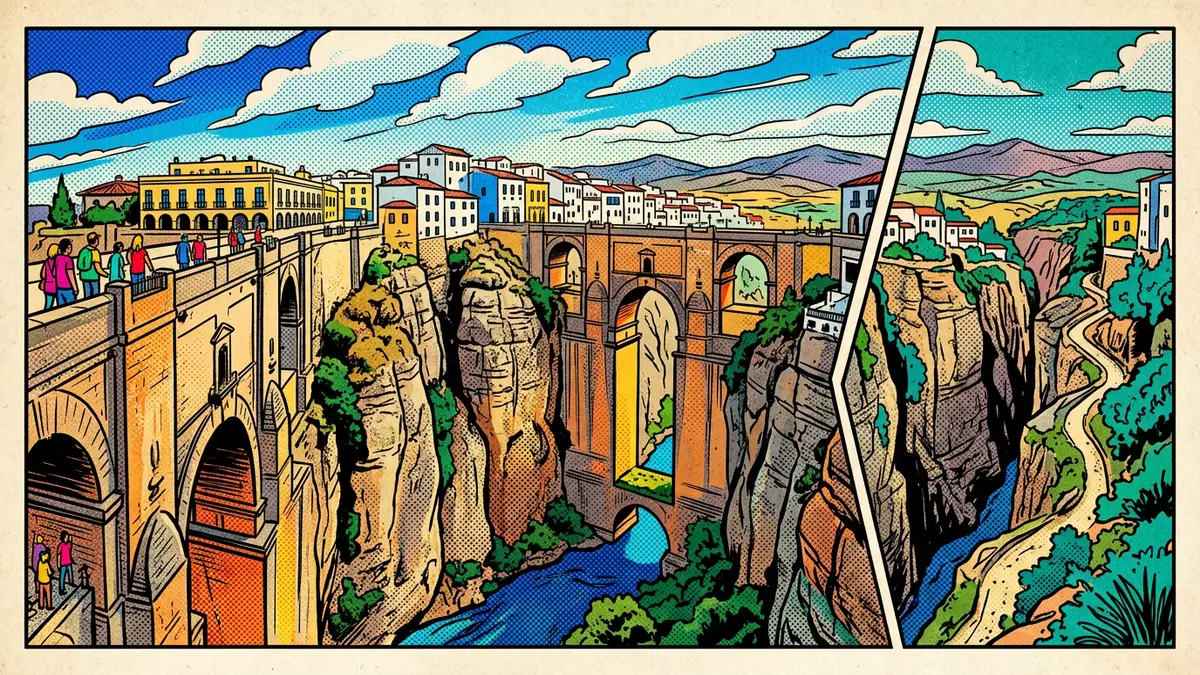
Puente Nuevo in Ronda is a high stone bridge that carries the main road across the deep El Tajo gorge, linking the historic centre with the later expansion on the opposite side of the chasm. Completed in 1793 after an eighteenth?century building campaign, it stands as one of the defining works of the architect José Martín de Aldehuela and fixes the outline of Ronda against the surrounding Andalusian hills.
A bridge suspended between two halves of Ronda
Puente Nuevo spans the Guadalevín River where it runs in the El Tajo gorge, a cleft that cuts through Ronda and divides the older quarter known as La Ciudad from the district called El Mercadillo on the plateau beyond.Guadalevín River in El Tajo gorge The bridge carries a stone roadway and pavements from one side of the gorge to the other, with solid masonry rising from the rock walls to support the central section high above the water. From the parapet the views reach over both parts of Ronda and out towards the surrounding countryside of Málaga province, with whitewashed houses lining the cliff edge and narrow streets feeding into the crossing.
The structure is built in dressed stone blocks, with three stacked openings visible in the centre: a large arch for the gorge itself and smaller arches above that carry the roadway and a chamber over the span.a markante Brücke At the level of the road, low walls and stone balustrades protect the edge, while lookouts near the parapet give clear lines into the gorge. On either side of the bridge, buildings stand close to the drop, so that the masonry of Puente Nuevo appears almost as an extension of the built fabric of Ronda itself.
Scale, height and eighteenth?century engineering
Puente Nuevo rises about 98 m (approximately 320 ft) from the base of the lowest arch to the top of the roadway, placing the road surface high above the Guadalevín River and giving the bridge a vertical profile that dominates the gorge.98m tall The span measures around 66 m (217 ft) from rock face to rock face, carried by the central arch whose masonry rests on foundations cut into the sides of El Tajo.spans 66m When it opened in the late eighteenth century, this combination of height and length placed Puente Nuevo among the most ambitious bridges of its time and established it as the largest of Ronda’s three crossings over the gorge.
Construction began in the mid?eighteenth century, with documented dates placing the main campaign between 1759 and 1793, under the direction of José Martín de Aldehuela and with stonemasons such as Juan Antonio Díaz Machuca involved in the work.construction period 1759–1793 The finished bridge uses stone taken from the gorge itself, and its articulation into piers, arches and relieving openings reflects eighteenth?century approaches to heavy masonry engineering. Inside the bridge, a room above the central arch once served as a prison and now houses an interpretation space, illustrating how the interior volume has been adapted over time without changing the outer form of the span.room above the central arch
Puente Nuevo’s place in Ronda and Andalusia
As well as linking two urban districts, Puente Nuevo shapes how Ronda relates to its surrounding landscape, framing views of the gorge, the distant sierra and the patchwork of fields beyond the town. The bridge stands close to Plaza de España, a central square on the Mercadillo side, so that many routes through Ronda naturally pass across it or approach viewpoints nearby.Location: Plaza de España On the La Ciudad side, lanes lead from the bridge into the older quarter, where traces of Moorish layout and later Spanish architecture appear in houses, churches and small squares.
Within Andalusia, Puente Nuevo and the Plaza de Toros de la Real Maestranza de Caballería together form a pair of symbols that carry much of Ronda’s identity in images and descriptions of the region.símbolo y el alma de la ciudad The bridge has been recognised as part of the natural monument status granted to the setting of El Tajo, underlining the way in which the stone structure and the carved gorge are treated as a single ensemble. For travellers who cross Andalusia by road or rail, Ronda’s position in the hills of Málaga province and the image of Puente Nuevo spanning the void make the town a distinct stop between the coastal plain and the interior.
Visiting Puente Nuevo: what travellers from Western Europe should know
- Puente Nuevo stands in Ronda, in Málaga province in southern Spain, with the crossing reached directly from streets on both the La Ciudad and El Mercadillo sides of the gorge.
- The gorge beneath the bridge is high and steep, and paths to lower viewpoints include descents on uneven ground and flights of steps that require sure footing.
- Approaches to Puente Nuevo pass through compact streets and plazas near Plaza de España, with short walks on paved surfaces before reaching the parapet or nearby lookouts.
- The official language is Spanish and the currency is the euro.
Searching for Puente Nuevo on social platforms
These links open searches for Puente Nuevo on each platform.
Frequently asked questions about Puente Nuevo
Where is Puente Nuevo and what does it cross?
Puente Nuevo is in Ronda, in Málaga province in southern Spain, and it crosses the El Tajo gorge where the Guadalevín River runs between La Ciudad and El Mercadillo.
What can visitors expect when walking across the bridge?
Visitors cross on a stone roadway with pavements beside low parapet walls, with viewpoints into the gorge and out towards the hills and the built?up slopes of Ronda.
What makes Puente Nuevo distinctive among bridges in Spain?
Its late eighteenth?century stone construction, considerable height above the river and role in linking two urban districts across a deep natural gorge together give Puente Nuevo a particular character within Andalusia.


