
Puente Nuevo spans Ronda’s gorge in stone
Published on 09/22/2026 at 19:12 | Editorial responsibility: Rafael Müller, Editor-in-Chief AD HOC NEWS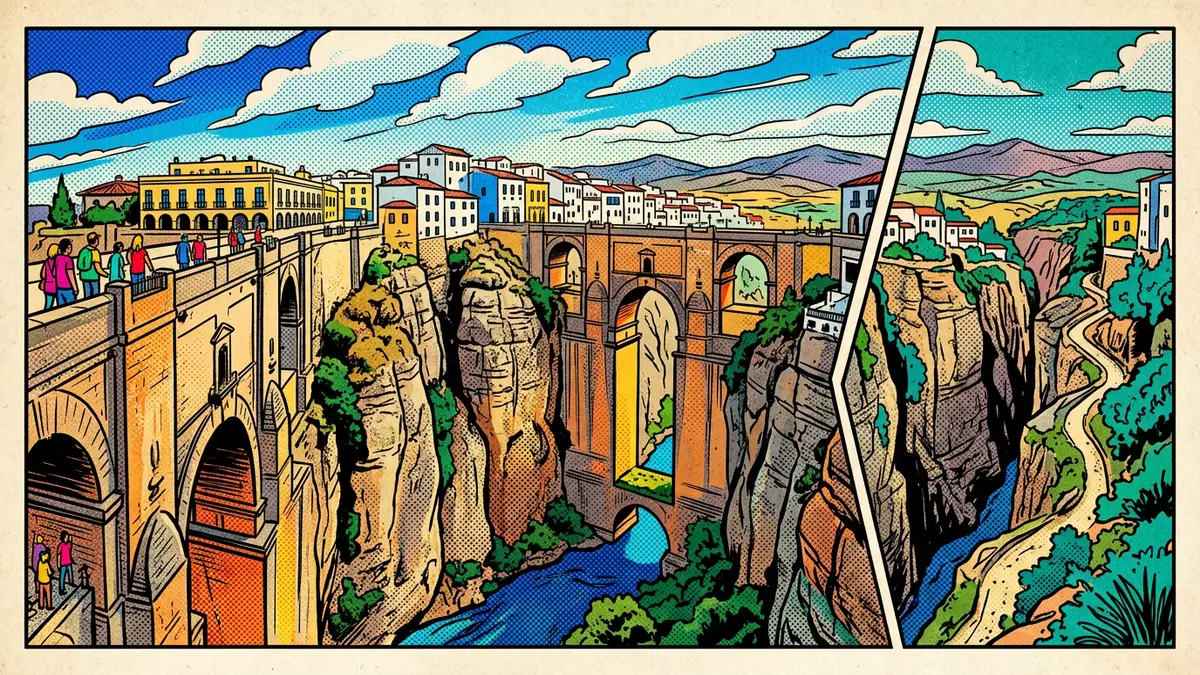
Puente Nuevo crosses the Guadalevín gorge at Ronda in Andalusia, joining the historic and modern parts of the city. Its stone roadway sits about 98 metres (322 ft) above the river, making the bridge inseparable from the deep landscape around it.
Puente Nuevo and the stone architecture of El Tajo
The bridge spans El Tajo, the gorge cut by the Guadalevín through the limestone landscape of Ronda. From the city, its broad masonry structure appears as a continuation of the rock walls, with substantial piers rising from the gorge and a central arch carrying the roadway.
Puente Nuevo measures about 66 metres (217 ft) across the gorge. Its visible stonework is built from carved blocks, while the bridge’s height gives the crossing a strong vertical presence above the river. The roadway joins the districts on either side of El Tajo and forms part of Ronda’s urban landscape.
The bridge is a late eighteenth-century work associated with the architect José Martín de Aldehuela. A Ronda tourism guide records its approximate height and its position across the Guadalevín gorge.
José Martín de Aldehuela and the eighteenth-century bridge
Construction of the bridge began in 1759 and ended in 1793. The finished structure belongs to the eighteenth century, a period when Ronda gained several of its defining civic monuments.
José Martín de Aldehuela directed the project during its final phase. Domingo Lois de Monteagudo is also associated with the design, while Juan Antonio Díaz Machuca is linked with the execution of the stonework. The completed bridge replaced an earlier crossing that had failed during the eighteenth century.
The date 1793 places Puente Nuevo within the final years of Spain’s ancien régime. Its masonry, arch system and deep foundations remain legible from the gorge, where the bridge can be viewed as both infrastructure and architecture.
The bridge’s recorded history is set out in a history of Puente Nuevo, which identifies the construction period and the connection with Domingo Lois de Monteagudo.
Ronda’s crossing between historic districts
Puente Nuevo connects the older quarter of Ronda with the area beyond the gorge. The crossing is part of the city’s street network, while the gorge below separates the built-up districts with a dramatic drop towards the Guadalevín.
Several bridges form part of Ronda’s wider historic landscape. Puente Viejo and the Puente Árabe lie elsewhere along the river, near the Arab Baths and older routes into the city. Puente Nuevo belongs to a later phase of urban development and carries the largest crossing over El Tajo.
The interior of the bridge contains a small interpretation space within the central structure. Its rooms occupy the masonry above the gorge, giving the building a second dimension beyond the road surface and allowing the bridge to be read from inside as well as from viewpoints around Ronda.
Puente Nuevo is listed among Ronda’s principal monuments on the city’s tourism information page.
Visiting Puente Nuevo: what travellers from Western Europe should know
- Puente Nuevo stands beside Plaza de España in central Ronda, Málaga. Ronda is reached by road and rail, with the bridge forming a direct connection between the city’s historic quarters.
- The roadway crosses the gorge at high level, while viewpoints and paths below descend through steep terrain. The gorge contains exposed rock, uneven ground and a substantial vertical drop.
- The official language is Spanish and the currency is the euro.
- Nearby landmarks include Puente Viejo, the Puente Árabe, the Arab Baths and the historic centre of Ronda.
Searching for Puente Nuevo on social platforms
These links open searches for Puente Nuevo on each platform.Frequently asked questions about Puente Nuevo
Where is Puente Nuevo?
Puente Nuevo is in Ronda, a city in Málaga province in Andalusia, southern Spain. It crosses the Guadalevín gorge known as El Tajo.
What can visitors expect at Puente Nuevo?
The bridge can be viewed from the roadway, city viewpoints and paths descending into the gorge. The surrounding terrain includes steep slopes, exposed rock and historic bridges.
What makes Puente Nuevo distinctive?
Its defining features are its stone construction, its 1793 completion date and its position about 98 metres above the Guadalevín. The bridge combines a working urban crossing with a dramatic gorge setting.


