
Puente Romano de Salamanca and its stone route into the old city
Published on 09/18/2026 at 19:39 | Editorial responsibility: Rafael Müller, Editor-in-Chief AD HOC NEWS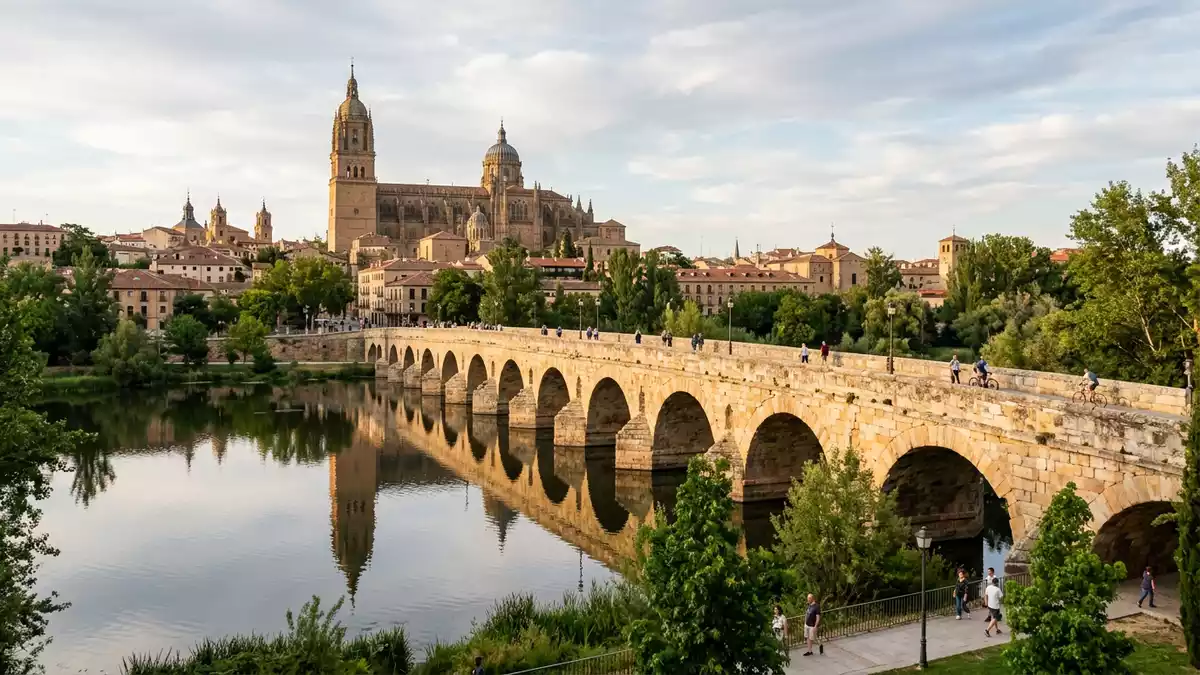
Puente Romano de Salamanca is the stone bridge that carries the ancient approach into Salamanca across the River Tormes, its line of arches leading the eye towards the city’s twin cathedrals on the northern bank. Built in the Roman era as part of the long-distance Vía de la Plata road through western Hispania, it still anchors the relationship between river, road and old city in Salamanca.
A Roman bridge on the River Tormes
Puente Romano de Salamanca crosses the River Tormes on the southern side of Salamanca in the Castile and León region of Spain, joining the historic centre with the low-lying ground and neighbourhoods on the far bank.Roman bridge of Salamanca The structure is also known locally as Puente Mayor del Tormes, a name that reflects its longstanding role as the principal stone crossing in this reach of the river.Puente Mayor del Tormes
The bridge stands where the river broadens, above a rocky riverbed that gave the builders a firm base for its heavy masonry.the bridge stands over a rocky subsoil Its deck runs in a gentle curve across the water, supported by a series of stone arches which together create a continuous route from the southern floodplain to the more compact urban fabric around the old core of Salamanca. From the riverbanks it reads as one elongated structure, but the masonry closer to the city and the sections further out differ in age and detail.
From Roman road to bimillennial monument
The origins of Puente Romano de Salamanca lie in the Roman consolidation of this part of Hispania, when a stone bridge was required to carry the Vía de la Plata, the “Silver Way” linking Mérida with Astorga, across the Tormes.part of the Via dell'Argento between Mérida and Astorga The bridge is traditionally dated to the first century AD, during the imperial period associated with Augustus, Vespasian and Trajan, making it a bimillennial work of engineering on the edge of the later medieval city.said to date back to the first century AD
The section of Puente Romano de Salamanca nearest the city, with its sequence of arches towards the northern bank, preserves the Roman fabric more clearly than the spans further out towards the southern shore.fifteen arches belong to the Roman structure Later centuries brought rebuilding and extension, particularly between the sixteenth and seventeenth centuries, when part of the crossing was renewed after flood damage and integrated into a longer bridge. The result is a single stone structure in which Roman and early modern masonry coexist, joined into one continuous deck yet distinguishable in details of stone colour and arch proportions.
Stone, arches and Salamanca’s skyline
Puente Romano de Salamanca is built from pale, warm-toned stone that reflects the regional granite used in many of Salamanca’s historic buildings.granite stone typical of the region Along its length, a regular rhythm of arches springs from solid piers, giving the bridge a measured profile above the current of the Tormes.a sequence of robust stone arches The deck is relatively narrow by modern standards, which emphasises its origin as a route for feet, animals and carts rather than wide motor traffic.
Standing on the bridge, the view upriver and towards the city is dominated by Salamanca’s Catedral Vieja and Catedral Nueva, whose towers rise above the houses on the northern bank.the bridge crosses the Tormes below the city’s cathedrals Downstream, the river flows away through flatter ground, with vegetation along the margins and the open forms of newer crossings further away. Puente Romano de Salamanca therefore acts as a foreground element in many views of the historic skyline, a horizontal band of stone set against the more vertical composition of towers and façades in the old centre.
Visiting Puente Romano de Salamanca: what travellers from Western Europe should know
- Puente Romano de Salamanca spans the River Tormes just south of Salamanca’s historic centre in Castile and León, reached on foot from the old town via streets leading towards the riverside.
- The bridge carries a level stone deck across the river with low parapets; approaches from the city side slope down towards the span, while the southern end meets flatter ground on the far bank.
- The surroundings include riverside paths and open ground on the southern bank, with the view back towards the cathedrals and the clustered buildings of Salamanca’s old core.
- Spain’s official language is Spanish and the currency is the euro.
Searching for Puente Romano de Salamanca on social platforms
These links open searches for Puente Romano de Salamanca on each platform.
Frequently asked questions about Puente Romano de Salamanca
Where is Puente Romano de Salamanca located?
Puente Romano de Salamanca crosses the River Tormes on the southern edge of Salamanca in Castile and León, Spain, linking the old city with the river’s far bank.
What can visitors expect when walking across the bridge?
Visitors find a stone deck lined by parapets and a sequence of arches beneath, with views along the river and towards Salamanca’s historic skyline dominated by the twin cathedrals.
What makes Puente Romano de Salamanca distinctive among bridges in Spain?
Its bimillennial Roman origins, later extensions and role as part of the ancient Vía de la Plata make it a rare surviving example of a long-used imperial crossing integrated into a living city.


