
Puente Romano de Salamanca carries the Vía de la Plata
Published on 09/24/2026 at 11:04 | Editorial responsibility: Rafael Müller, Editor-in-Chief AD HOC NEWS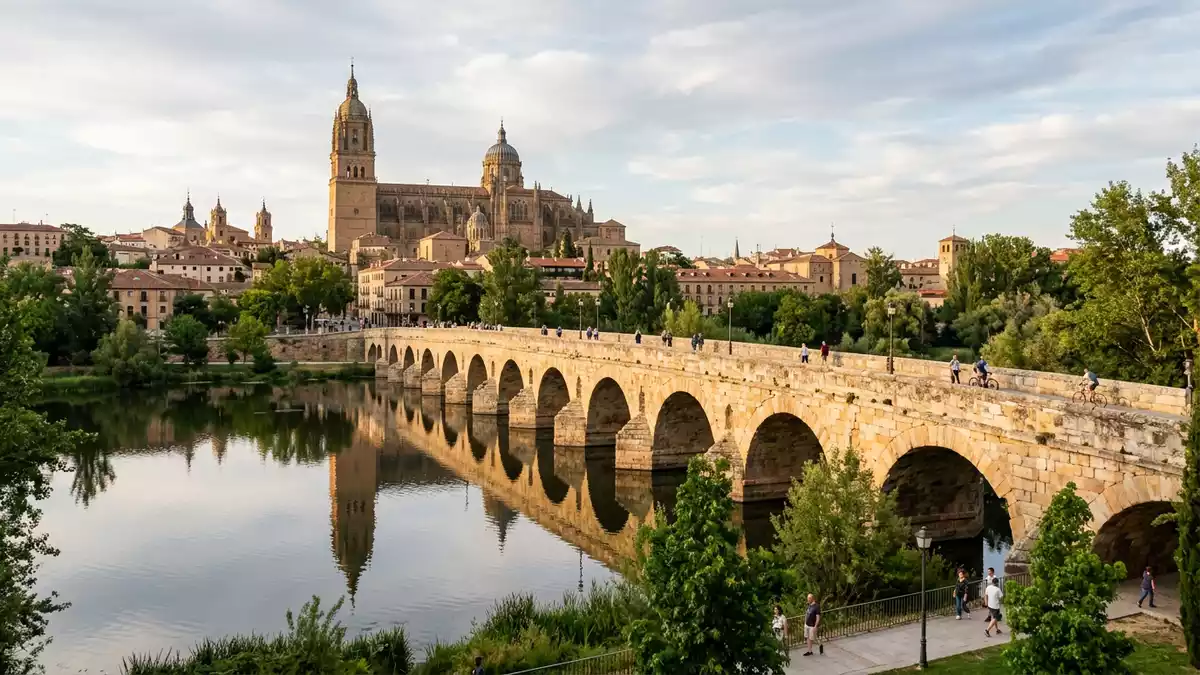
Puente Romano de Salamanca crosses the River Tormes on the southern side of Salamanca. Its stone roadway gathers Roman arches, later rebuilding and the route of the Vía de la Plata into one visible crossing.
The bridge belongs to Salamanca’s historic landscape, where the river, the old city and a long-distance Roman road meet. Its surviving fabric records several periods without losing the strong rhythm of the masonry arches.
Puente Romano de Salamanca and the River Tormes
The bridge extends across the Tormes near the city’s southern approach. Granite masonry forms the piers, arch rings and roadway, while the river occupies the broad channel below.
Spain’s national tourism portal gives the bridge a length of 176 m and a width of 3.70 m. It also records 26 round arches and substantial supporting piers, features that give the crossing its clear, regular profile. bridge dimensions and arches
Roman masonry and later rebuilding
The bridge’s origin belongs to the Roman period, traditionally dated to the first century AD. The exact construction year is not fixed, and the Roman work is associated with the imperial road network of Hispania.
Fifteen arches nearest the city belong to the Roman section. The other eleven arches underwent rebuilding after floods affected the Tormes, leaving a structure that combines ancient engineering with later stonework. Roman arches and reconstructions
The Vía de la Plata reaches Salamanca
Puente Romano de Salamanca formed part of the Vía de la Plata, the Roman route linking Mérida with Astorga. The crossing connected the road network of western Hispania with the passage across the Tormes.
That connection explains the bridge’s place in Salamanca’s geography without requiring any imagined reconstruction of ancient travellers. The route, the river and the city remain legible in the alignment of the crossing.
The bridge also carries a local cultural reference at its entrance. A granite boar represents the Vettones, a pre-Roman people associated with the region, and the sculpture appears in the story of Lazarillo de Tormes. the bridge’s historical record
Visiting Puente Romano de Salamanca: what travellers from Western Europe should know
- Puente Romano de Salamanca crosses the Tormes beside Salamanca’s southern edge. The address is Paseo de San Gregorio in Salamanca.
- The crossing is a stone roadway above a river channel, with masonry arches and uneven historic surfaces. The approach includes an exterior walk across the bridge.
- The Vía de la Plata connection places the bridge within Salamanca’s Roman heritage. The old city lies beyond the northern end of the crossing.
- The official language is Spanish and the currency is the euro.
Searching for Puente Romano de Salamanca on social platforms
These links open searches for Puente Romano de Salamanca on each platform.
Frequently asked questions about Puente Romano de Salamanca
Where is Puente Romano de Salamanca?
It crosses the River Tormes on Salamanca’s southern side, near Paseo de San Gregorio and the historic centre.
What can visitors see at the bridge?
Visitors can see granite masonry, Roman arches, later rebuilt spans and the river beneath the roadway. A Vettonian boar sculpture stands at the entrance.
What makes the bridge distinctive?
Its 26 arches combine a Roman section with later rebuilding. The crossing also preserves the route of the Vía de la Plata between Mérida and Astorga.


