
Punta Cana’s long arc of sand where Atlantic meets Caribbean
Published on 09/21/2026 at 21:15 | Editorial responsibility: Rafael Müller, Editor-in-Chief AD HOC NEWS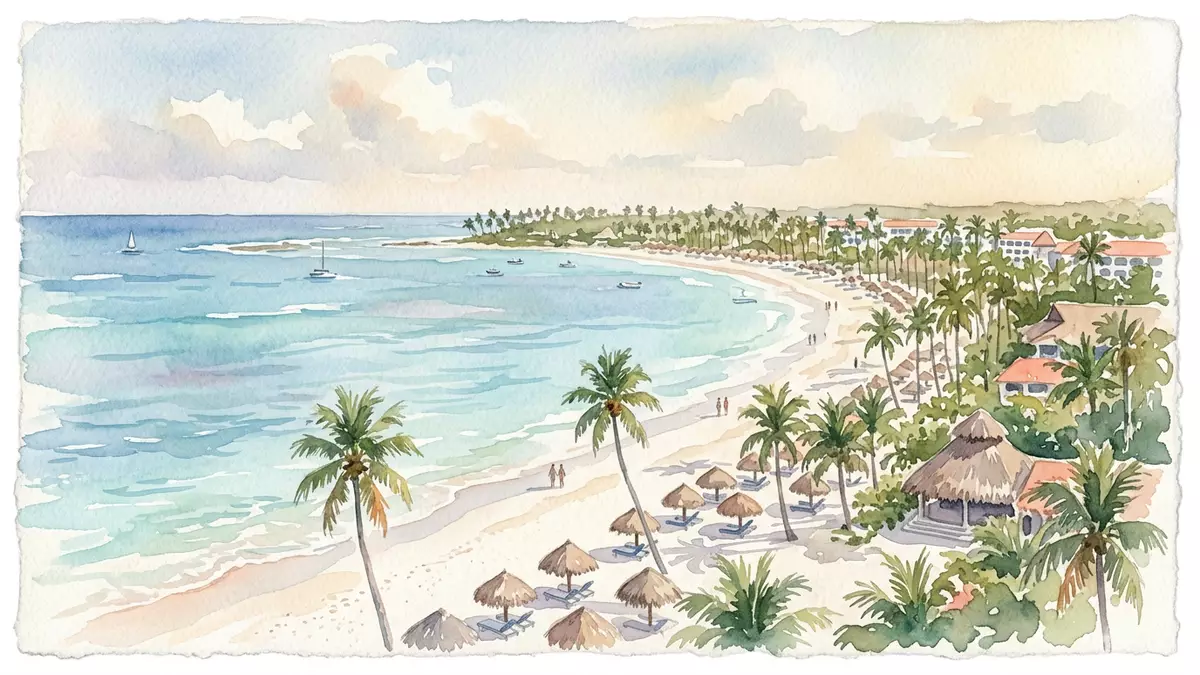
Punta Cana is a coastal resort region on the eastern tip of the Dominican Republic, a long arc of pale sand where the Atlantic Ocean meets the Caribbean Sea and hotel zones line the shore. The broader area forms part of La Altagracia province and is included in the Verón–Punta Cana touristic municipal district, under the municipality of Higüey.
A resort belt built along a meeting of seas
Punta Cana occupies the easternmost point of the Dominican Republic, a low-lying coast where beaches run almost unbroken along the shoreline and coconut palms fringe the sand. The resort strip marketed under the Punta Cana name extends along roughly 50 to 60 km (31 to 37 miles) of coastline, a continuous sequence of beach zones and hotel areas that share the same ribbon of white sand.long arc of pale sand The sea off this coast forms a visible meeting line between Atlantic and Caribbean waters, giving Punta Cana its double-ocean setting and a wide horizon of water.
The name Punta Cana is used for both a specific village and the wider resort corridor. Administratively, the area lies in La Altagracia province and belongs to the Verón–Punta Cana touristic municipal district created in 2006, reflecting its status as a distinct tourism hub within the municipality of Higüey.Verón–Punta Cana touristic municipal district Within that corridor, beaches and resort clusters such as Bávaro, Arena Gorda, Cabeza de Toro and Uvero Alto form parts of a single, long coastal strip whose sand and shallow waters define the region’s character.areas such as Cabeza de Toro, Arena Gorda and Uvero Alto
From remote coast to organised resort economy
Before large-scale tourism arrived, the stretch of coast around Punta Cana consisted of jungle and beach with sparse settlement and no major town on the site that would later carry the Punta Cana name.58 million square metre stretch of jungle and beach A turning point came in 1969, when Dominican entrepreneur Frank Rainieri and New York attorney Theodore Kheel acquired a large tract of land on the eastern coast and began developing a resort project that would become Puntacana Resort & Club.
The first small hotel on this shore opened in 1971, giving direct accommodation on the beach and setting the pattern for later resort growth along the sand.first small hotel followed in 1971 In 1978, Club Med established a resort at Punta Cana, reinforcing the area’s role as a centre for all-inclusive holidays on the Dominican Republic’s eastern tip and drawing international attention to the coast.Club Med established a resort at Punta Cana in 1978 The development of a commercial airstrip, opened in 1984 as Punta Cana International Airport, provided a dedicated aviation gateway for the region and enabled the resort belt to expand along the coastline.Punta Cana International Airport opened in 1984
Beach zones along the Coconut Coast
Punta Cana is often grouped with Bávaro under the label La Costa del Coco, or Coconut Coast, a descriptive name for the long curve of beach lined with palms and resort compounds.La Costa del Coco, or the Coconut Coast Within this curve, individual beach areas have distinct characters while sharing the same pale sand and shallow, clear water. Bávaro Beach is a prominent section, a long stretch of white sand backed by resort buildings and beach clubs that has become an emblematic image of the Dominican Republic’s east coast.Bávaro is the Punta Cana beach
Other named beaches along the Punta Cana corridor include Macao, Arena Gorda, Cabeza de Toro, Uvero Alto and Juanillo, each forming its own zone along the long shore.Juanillo, Playa Blanca, Bavaro, Cabeza de Toro, Macao, Arena Gorda and Uvero Alto Some beaches lie in front of large resort complexes, while others such as Macao retain a more open character without built-up hotel strips directly on the sand.beach of Macao in the north Together, these zones form a coastal chain in which the sea and sand are continuous even as the style of the built environment changes from section to section.
Visiting Punta Cana: what travellers from Western Europe should know
- Punta Cana lies on the eastern tip of the Dominican Republic in La Altagracia province, reached via Punta Cana International Airport (PUJ), which serves the resort region and its coastal zones.
- The terrain along the Punta Cana shore is low-lying and sandy, with long beaches backed by resort buildings; walking on the beach involves stretches of soft sand and occasional sections with coastal vegetation.
- The wider resort corridor includes districts such as Bávaro, Cap Cana, Cabeza de Toro and Uvero Alto, so accommodation and facilities are spread along several beach zones rather than concentrated in a single compact town.
- The official language is Spanish and the currency is the Dominican peso.
- Entry requirements depend on your nationality; UK travellers can check the FCDO travel advice at gov.uk/foreign-travel-advice, Irish travellers the Department of Foreign Affairs at ireland.ie.
Searching for Punta Cana on social platforms
These links open searches for Punta Cana on each platform.
Frequently asked questions about Punta Cana
Where is Punta Cana located?
Punta Cana is on the easternmost tip of the Dominican Republic, in La Altagracia province, within the Verón–Punta Cana touristic municipal district under the municipality of Higüey.
What can visitors expect on a visit to Punta Cana?
Visitors encounter a long coastal strip of white-sand beaches backed by resort zones and low-lying vegetation, with shallow sea along an arc where Atlantic and Caribbean waters meet.
What makes Punta Cana distinctive among Caribbean coasts?
Punta Cana combines a continuous band of beaches and resort districts with a double-ocean setting at the meeting of Atlantic and Caribbean waters on the Dominican Republic’s eastern tip.


