
Qal'at al-Bahrain, ancient harbour mound on Bahrain’s coast
Published on 09/14/2026 at 20:48 | Editorial responsibility: Rafael Müller, Editor-in-Chief AD HOC NEWS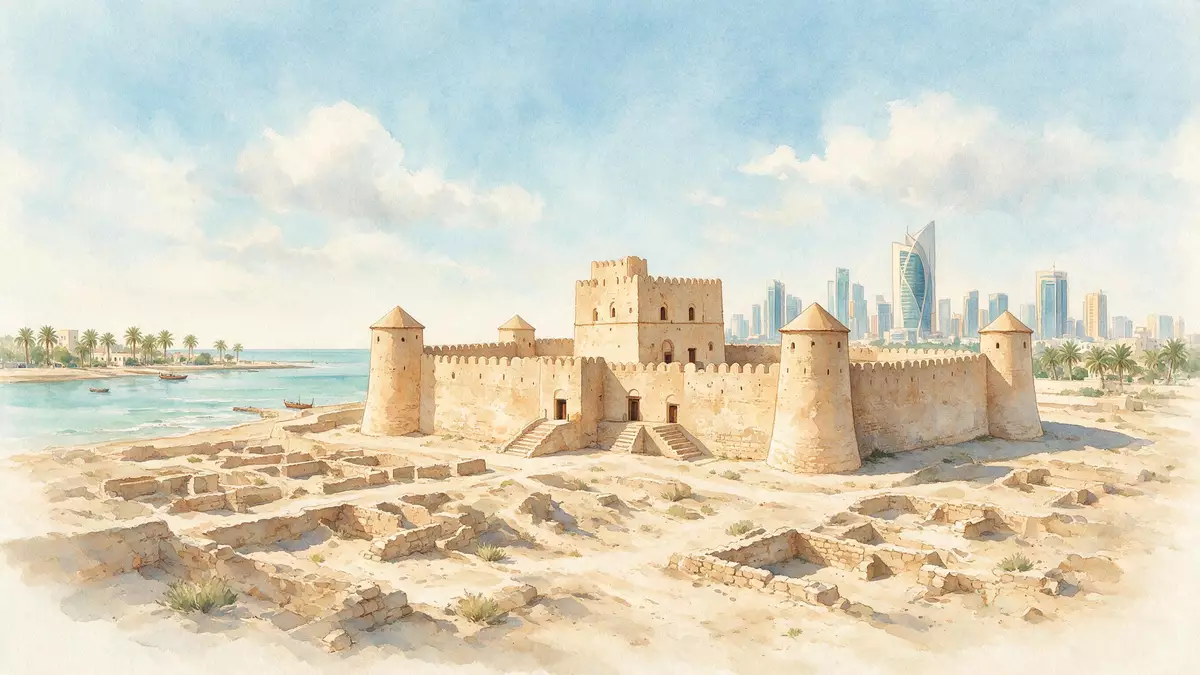
Qal'at al-Bahrain on the northern coast of Bahrain near Manama is an archaeological mound crowned by a fort and recognised as a UNESCO World Heritage Site since 2005. The site is associated with the ancient Dilmun civilisation and preserves successive layers of settlement from the Bronze Age through later Islamic and Portuguese periods.
An artificial hill of successive settlements
Qal'at al-Bahrain is described as a typical tell, an artificial hill created as generations of inhabitants built and rebuilt in the same coastal location. The mound extends over an area that sources place at more than 16 hectares, forming a broad rise immediately beside the Gulf shoreline.typical tell Excavations have revealed a stratigraphy that runs from around 2300 BC to the sixteenth century AD, with residential, public, commercial, religious and military buildings preserved in the layers of the hill.stratigraphy that runs from around 2300 BC
The layout of the mound shows zones where fortifications and palatial buildings once stood, alongside quarters interpreted as housing and market areas. Stone and mud-brick structures emerge from the earth in stepped terraces and platforms, their walls tracing narrow passages and courts that follow the natural rise of the hill. Archaeological work has uncovered only part of the total area, leaving a substantial proportion of the mound unexcavated and still covered by soil and sparse vegetation.
Capital of Dilmun and gateway for Gulf trade
The World Heritage inscription names the property “Qal'at al-Bahrain – Ancient Harbour and Capital of Dilmun”, reflecting its role as the principal urban centre of that Bronze Age civilisation.Ancient Harbour and Capital of Dilmun Dilmun occupied a key position in regional trade routes linking Mesopotamia with regions as far as the Indus Valley; goods moved across the Gulf and passed through coastal settlements such as this one.trade routes from Mesopotamia to the Indus Valley At Qal'at al-Bahrain, the harbour city developed beside a naturally favourable sea channel cut through the coral reef and foreshore, giving ships access to sheltered waters close to the mound.
Archaeological surveys identify monumental palaces from the Dilmun period within the hill, described as distinctive public architecture that influenced building traditions elsewhere in the region.palaces of Dilmun are unique examples Later phases include structures from the era known as Tylos and from Islamic societies, indicating that the site remained an active centre for centuries after Dilmun’s prominence. The continuity of occupation, seen in the layering of different cultural remains on one mound, is one of the reasons Qal'at al-Bahrain was selected as a cultural World Heritage property under criteria that emphasise its representation of an important civilisation and its architectural record.
The Portuguese fort and the site museum
On the summit of the mound stands a substantial stone fort whose presence gives the entire site its name, since “qal'a” in Arabic means fort. This fortress was last developed under Portuguese control in the sixteenth century and is sometimes referred to in sources as the Portuguese fort.mound topped by a Portuguese fort Its thick outer walls enclose a series of courtyards, rooms and defensive towers, all positioned to command views over the coast and the remains of the ancient city below.
Adjacent to the archaeological area stands the Qal'at al-Bahrain Site Museum, which opened to the public in 2008.site museum display area consists of 5 exhibition halls Exhibitions there present artefacts recovered from the mound, including ceramics, tools and decorative objects, arranged around a large wall segment that illustrates the thickness of the tell’s accumulated layers. Interpretive displays explain the different phases of the site, from the earliest settlement around the third millennium BC to its gradual abandonment after the seventeenth century.
Visiting Qal'at al-Bahrain: what travellers from Western Europe should know
- Qal'at al-Bahrain lies on the northern coast of Bahrain in the Capital Governorate, a short distance north-west of central Manama, and can be reached by road from the city.
- The archaeological mound rises above a coastal plain, and walking within the site involves uneven ground, low walls, loose stones and sections of sloping paths on the hill.
- The fort at the top of the mound is accessed by external ramps and stairways, and movement within its interior passes through corridors and courtyards with stone floors.
- The Qal'at al-Bahrain Site Museum stands beside the archaeological area and provides structured indoor exhibitions that complement the open-air remains on the mound.
- The official language is Arabic and the currency is the Bahraini dinar.
Searching for Qal'at al-Bahrain on social platforms
These links open searches for Qal'at al-Bahrain on each platform.
Frequently asked questions about Qal'at al-Bahrain
Where is Qal'at al-Bahrain located?
Qal'at al-Bahrain stands on the northern coast of Bahrain in the Capital Governorate, close to Manama and directly beside the Gulf shoreline.
What can visitors expect to see at Qal'at al-Bahrain?
Visitors encounter an extensive archaeological mound with exposed ruins from several eras, crowned by a stone fort, alongside a modern museum presenting artefacts from the site.
What makes Qal'at al-Bahrain distinctive compared with other historic sites?
The site combines a long, continuous sequence of occupation from the Bronze Age to the early modern period with its role as the capital and harbour of the Dilmun civilisation, all preserved in one coastal mound.


