
Qal'at al-Bahrain and the layered mound of Bahrain
Published on 08/16/2026 at 13:20 | Editorial responsibility: Rafael Müller, Editor-in-Chief AD HOC NEWS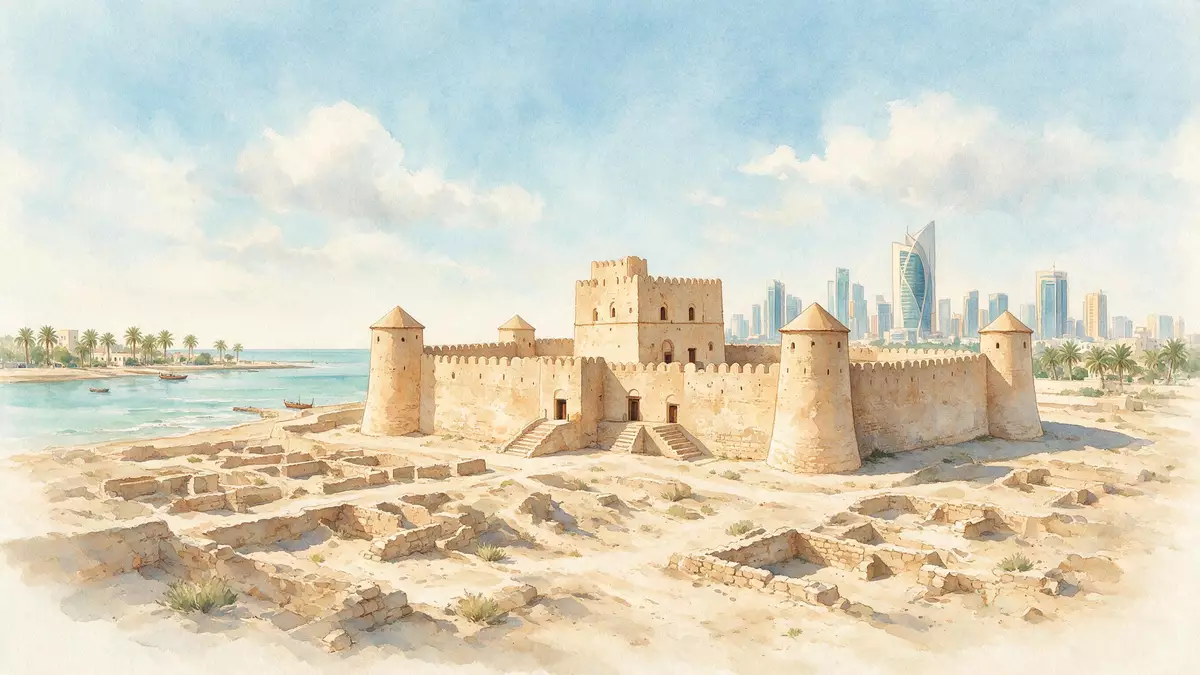
Qal'at al-Bahrain rises as a layered tell on Bahrain's northern coast, about 5.5 km west of Manama. The mound carries a Portuguese fort and traces of Dilmun, a Bronze Age civilisation tied to the site.
The mound above Bahrain's northern coast
Qal'at al-Bahrain is a tell, an artificial mound formed by successive layers of occupation, not a single-period ruin. Its 300 × 600 m footprint and 12 m height make the profile easy to grasp on site.
The place is recognised as the ancient harbour and capital of Dilmun, and it was inscribed on the UNESCO World Heritage List in 2005. The designation reflects both the mound and the maritime setting around it.
Layers from Dilmun to the Portuguese fort
The stratigraphy runs from about 2300 BC to the 16th century AD, giving the site an unusually long sequence of settlement. Residential, public, commercial, religious and military remains all appear in the excavated areas.
The Portuguese fort on the summit belongs to the site's last major building phase and gave the place its Arabic name, qal'a, meaning fort. The fort stands above older levels that belong to earlier phases of occupation.
Trade, sea access and archaeological depth
The site formed part of a trading port linked to wider routes across the Gulf, and its archaeology includes remains associated with commerce and defence. It also preserves a sea tower and a channel through the reef, both part of the wider heritage landscape.
That combination of mound, fort, and sea-side elements makes the place read as a settlement landscape rather than a single monument. The archaeological deposit is what gives Qal'at al-Bahrain its depth and variety.
Visiting Qal'at al-Bahrain: what travellers from Western Europe should know
- The site lies on Bahrain's northern coast in the Northern Governorate, west of Manama. Road access links it with the capital and the surrounding district.
- The tell is a raised archaeological mound with uneven ground and stepped levels. Footwear for stone surfaces and warm weather is practical.
- The Portuguese fort sits on top of the mound. The site below contains excavated layers, so the place combines open earthworks with masonry remains.
- The surrounding landscape includes the coast and the sea-related elements that belong to the heritage property. The setting reads as archaeology beside water rather than an inland ruin.
Searching for Qal'at al-Bahrain on social platforms
These links open searches for Qal'at al-Bahrain on each platform.
Frequently asked questions about Qal'at al-Bahrain
Where is Qal'at al-Bahrain?
It stands on Bahrain's northern coast, west of Manama, in the Northern Governorate. The site sits close to the sea and forms part of a wider archaeological landscape.
What should a visit expect?
The place combines a raised earth mound, excavated remains and the Portuguese fort on the summit. The terrain is uneven and layered, with masonry and open archaeological areas visible together.
What makes Qal'at al-Bahrain distinctive?
Its long sequence of occupation, from about 2300 BC to the 16th century AD, gives it unusual historical depth. The site also preserves the memory of Dilmun and the later Portuguese fort on the same mound.


