
Qal'at al-Bahrain, layered capital of the ancient Dilmun world
Published on 08/15/2026 at 14:49 | Editorial responsibility: Rafael Müller, Editor-in-Chief AD HOC NEWS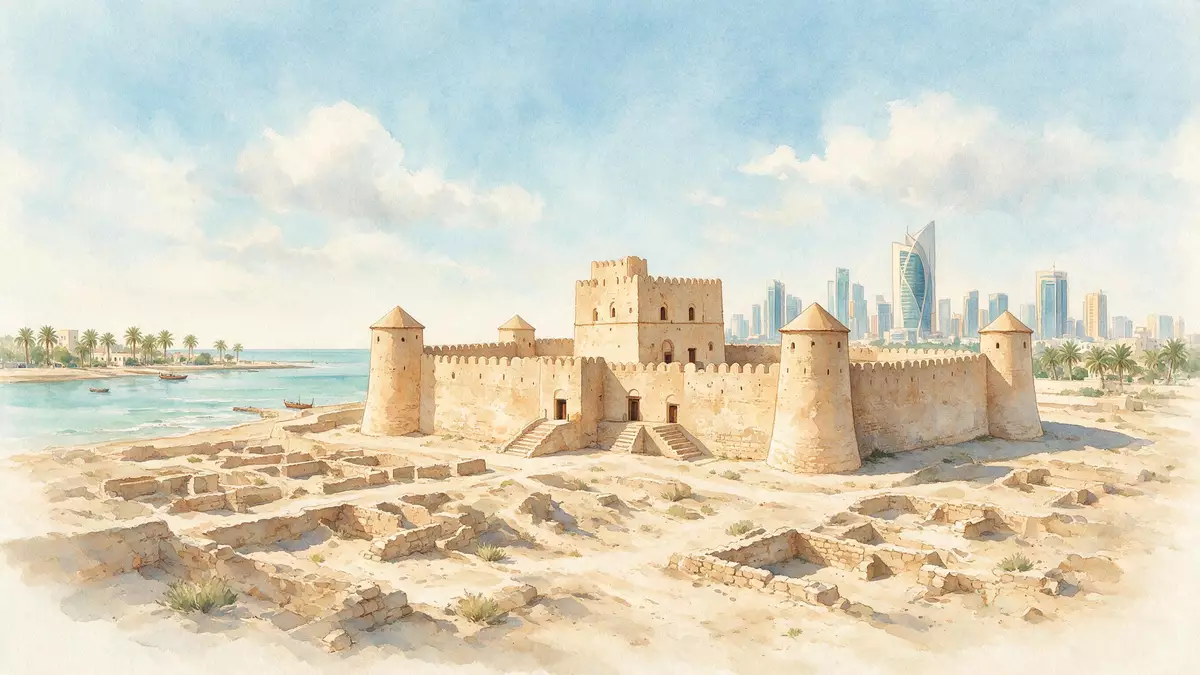
Qal'at al-Bahrain rises on Bahrain’s northern shore near Manama as a rare combination of massive coastal fort and deeply stratified archaeological mound, recognised as a UNESCO World Heritage Site since 2005.
An ancient harbour city beneath a coastal fort
Qal'at al-Bahrain lies on the fertile north coast of Bahrain Island, a short distance west of Manama in the Capital Governorate, facing the Gulf and the shipping lanes that link Mesopotamia and the wider Indian Ocean world.The archaeological site of a port is concentrated in a broad mound beside the shore, with palm groves forming a green fringe between the settlement and the sea.
The core of the site is a tell, an artificial hill formed by many successive layers of human occupation that extend back to about 2,300 BC.The 300 × 600 m mound records continuous human presence through Bronze Age Dilmun, Classical Tylos, early Islamic periods and the age of Portuguese expansion. On its summit stands the fort that gave the whole complex its Arabic name, qal'a, meaning “fortress”.
Dilmun capital and maritime crossroads
From the third millennium BC, Qal'at al-Bahrain formed the heart of Dilmun, an ancient civilisation known in Sumerian texts for its trade connections and fertile land.The site held the capital of Dilmun, and its palaces and fortifications illustrate how this Gulf kingdom organised power and commerce. The tell preserves large public buildings alongside residential quarters, giving archaeologists a rare view of an entire port city rather than a single palace or temple.
Qal'at al-Bahrain’s position on a low coastal rise beside navigable water turned it into a key trading harbour.Maritime routes from the Indus Valley, Mesopotamia, China and the Mediterranean converged on the island, and the archaeological remains include commercial buildings that reflect this long-distance exchange. Beyond the mound itself, the protected palm groves and the line of the ancient sea channel form part of the World Heritage property, tying the historic harbour to its wider cultivated landscape.
The Portuguese fort and the site museum
The most visible structure at Qal'at al-Bahrain is the fort built on the crown of the tell in the sixteenth century, when Portuguese forces controlled strategic points along Gulf sea routes.This Portuguese fort, sometimes called Portugal Fort, overlays those earlier Dilmun and Islamic levels with thick defensive walls and projecting bastions. Inside the enclosure lie parade spaces, inner buildings and surviving staircases that reveal the military architecture of an early modern garrison on a Gulf island.
At the edge of the mound, the Qal'at al-Bahrain Site Museum offers a more structured path through that long history.The museum’s exhibition halls are organised around the massive tell wall, and the displays bring together artefacts from domestic, religious, commercial and military structures uncovered across the site. Outside, walkways run between excavated building lines, so that the fortifications, town quarters and the surrounding palm groves can be seen as parts of a single historic landscape.
Visiting Qal'at al-Bahrain: what travellers from Western Europe should know
- Qal'at al-Bahrain lies in the Karbabad area of the Capital Governorate on Bahrain’s north coast, on the outskirts of Manama and close to the Seef and Al Qalah districts.
- The site stands on a broad earth mound beside the shoreline, and exploring the fort and excavated areas involves walking on uneven ground and climbing exterior stairways.
- Manama’s urban districts spread towards Qal'at al-Bahrain, and the fort site is signposted from major city roads, with local buses and taxis serving the surrounding neighbourhood.
- The official language is Arabic and the currency is the Bahraini dinar.
- Entry requirements depend on your nationality; UK travellers can check the FCDO travel advice at gov.uk/foreign-travel-advice, Irish travellers the Department of Foreign Affairs at ireland.ie.
Searching for Qal'at al-Bahrain on social platforms
These links open searches for Qal'at al-Bahrain on each platform.
Frequently asked questions about Qal'at al-Bahrain
Where is Qal'at al-Bahrain located?
Qal'at al-Bahrain stands on the northern coast of Bahrain Island in the Capital Governorate, near Manama and the coastal village of Al Qalah.
What can visitors expect to see at Qal'at al-Bahrain?
Visitors encounter a large archaeological mound with excavated town structures, a sixteenth-century Portuguese fort on its summit and a site museum displaying finds from the ancient harbour city.
What makes Qal'at al-Bahrain distinctive among Gulf heritage sites?
The site combines a multi-period harbour city, the capital of Dilmun, with an early modern coastal fort and surrounding palm groves within a single UNESCO World Heritage landscape.


