
Qalat Salah al-Din over Kairo’s historic cityscape
Published on 08/25/2026 at 15:46 | Editorial responsibility: Rafael Müller, Editor-in-Chief AD HOC NEWS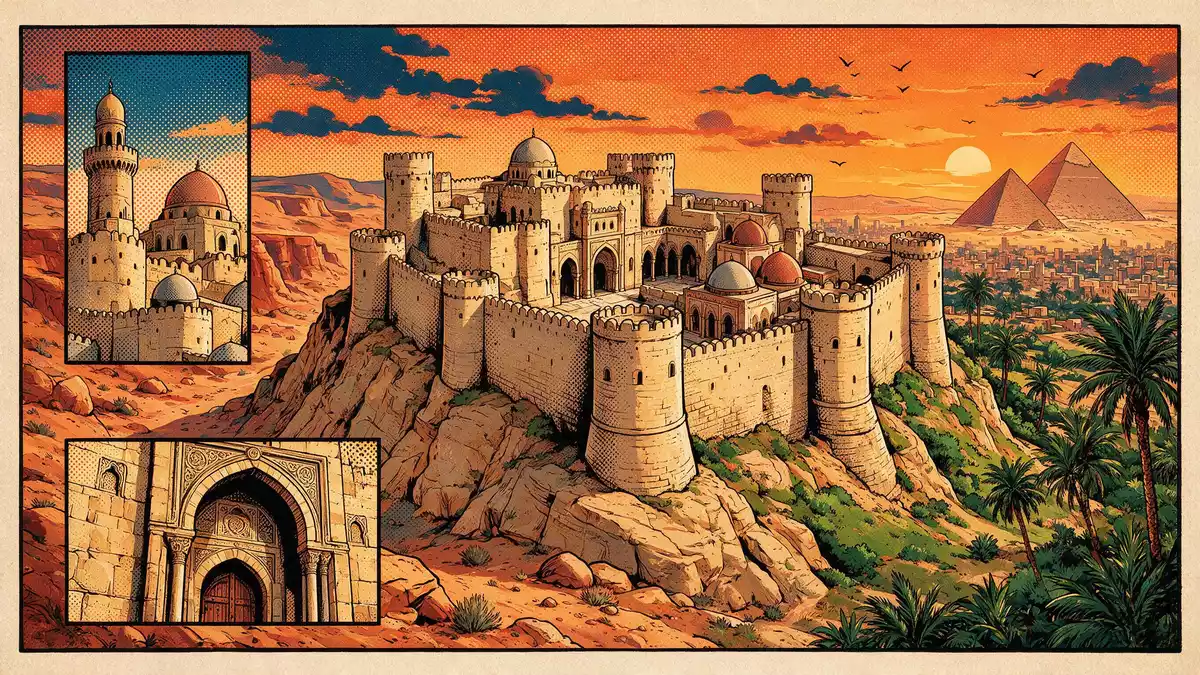
Qalat Salah al-Din, known in English as the Citadel of Saladin or Cairo Citadel, is a vast medieval fortress on the eastern side of Kairo that has watched over the city since the twelfth century.Citadel of Saladin Built under the Ayyubid ruler Salah al-Din al-Ayyubi and reshaped by later dynasties, it rises on the slopes of the Mokattam Hills above the historic quarters sometimes described as Islamic Cairo.
A hilltop citadel above Historic Cairo
The defining feature of Qalat Salah al-Din is its position on a limestone spur of the Mokattam Hills, a height that places its walls and towers above Kairo’s older districts and the wider Nile valley plain.citadel on the Mokattam Hills From this vantage point, the fortress forms a continuous skyline of masonry, with curtain walls stepping along the ridge and bastions projecting towards the city below.
The citadel belongs to the ensemble recognised as Historic Cairo, a World Heritage area inscribed in 1979 that covers the dense fabric of mosques, madrasas and markets stretching across the old urban core.part of Historic Cairo since 1979 Within that wider landscape, Qalat Salah al-Din stands as a walled plateau, its interior divided into precincts where religious, military and residential buildings have accumulated across centuries.
From Ayyubid fortress to royal seat
The citadel was established in the late twelfth century under Salah al-Din, the Kurdish commander who founded the Ayyubid dynasty in Egypt, as a fortified stronghold controlling approaches to the city.twelfth-century citadel built by Saladin Subsequent rulers extended and refashioned the complex, and it became the seat of Egyptian government for centuries, with successive dynasties adding palaces, administrative quarters and armouries behind the defensive walls.
Mamluk and later Ottoman periods left their own markers, including new gates, towers and domestic ranges set within the original Ayyubid enclosure.Salah El-Din Citadel as an ancient landmark Over time the interior became a layered architectural archive of Egyptian rule from the twelfth to the nineteenth century, with mosques, ceremonial halls and government buildings arranged around paved courtyards.
Mosques, palaces and museum spaces inside the walls
Inside Qalat Salah al-Din, visitors encounter a sequence of open squares and enclosed structures that reflect its combined military and ceremonial roles. One of the most prominent monuments is the Mosque of Muhammad Ali, a nineteenth-century Ottoman-style mosque whose domes rise above the southern section of the citadel and whose pale stone cladding gives it a distinct profile against the sky.Mosque of Mohamed Ali and El Gawhara Palace
Nearby stands El Gawhara Palace, built in the early nineteenth century and later adapted as a museum, occupying a position facing the main entrance to the mosque and forming part of a cluster of palatial buildings on the southern side of the citadel.palaces and museums within the citadel Elsewhere within the enclosure, older mosques, museum spaces and military structures line the courtyards, while stretches of rampart offer viewpoints across Kairo’s dense urban fabric and towards the Nile.
Visiting Qalat Salah al-Din: what travellers from Western Europe should know
- Qalat Salah al-Din stands on the south-eastern side of Historic Cairo, on the slopes of the Mokattam Hills above districts such as El Abageyah in Qesm Al Khalifah; it is reached along urban roads from central Kairo.
- The terrain within the citadel involves walking across paved courtyards and ascending stone staircases to reach mosque terraces and sections of the ramparts, with noticeable changes in level between different precincts.
- Qalat Salah al-Din lies in Egypt; the official language is Arabic and the currency is the Egyptian pound.
- Entry requirements depend on your nationality; UK travellers can check the FCDO travel advice at gov.uk/foreign-travel-advice, Irish travellers the Department of Foreign Affairs at ireland.ie.
Searching for Qalat Salah al-Din on social platforms
These links open searches for Qalat Salah al-Din on each platform.
Frequently asked questions about Qalat Salah al-Din
Where is Qalat Salah al-Din located in Kairo?
Qalat Salah al-Din stands on a limestone spur of the Mokattam Hills at the south-eastern edge of Historic Cairo, above older urban districts and the wider city.
What can visitors expect inside the citadel?
Visitors find defensive walls, mosques, palaces and museum spaces arranged around courtyards, with elevated terraces and sections of rampart offering wide views across Kairo.
What makes Qalat Salah al-Din distinctive among Kairo’s historic sites?
Its combination of twelfth-century Ayyubid origins, later Mamluk and Ottoman additions and its hilltop position above Historic Cairo gives the citadel a layered architectural character and a commanding presence over the city.


