
Qelat Hewler and the layered hill above Erbil
Published on 09/24/2026 at 05:30 | Editorial responsibility: Rafael Müller, Editor-in-Chief AD HOC NEWS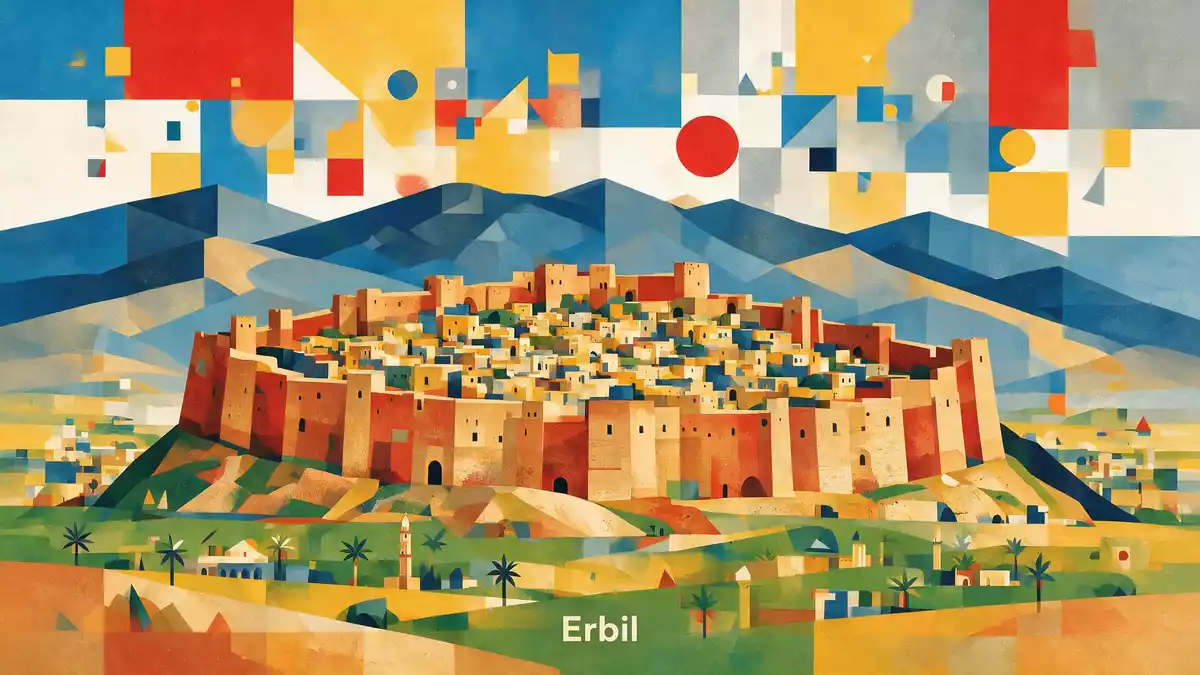
Qelat Hewler rises from the centre of Erbil as an inhabited mound rather than a detached fortress. Its broad earthen form carries streets, courtyard houses and archaeological layers associated with more than six millennia of settlement.
Qelat Hewler: a city raised on its own history
The citadel occupies the summit of an ovoid tell, a hill formed by successive periods of building and rebuilding. Its elevation is modest beside a mountain, yet its raised outline is unmistakable within Erbil’s urban centre. The mound gathers the history of northern Mesopotamia into a compact urban landscape.
Settlement on the mound reaches at least the fifth millennium BC. Ancient Arbela was associated with Assyrian political and religious life, while later communities shaped the hill through Islamic and Ottoman periods. The name Qelat Hewler belongs to the Kurdish identity of Erbil and remains closely connected with the city’s historical centre.
Ottoman houses around narrow lanes
The visible fabric of Qelat Hewler belongs mainly to the nineteenth and early twentieth centuries. Brick and other local materials form residential fronts along narrow lanes, with courtyard houses gathered close together across the summit. The arrangement records the citadel as an urban settlement, not merely a military enclosure.
Late Ottoman influence appears in the street pattern and domestic architecture. Facades meet the lanes in a continuous band, while enclosed courtyards sit behind the outward-facing walls. The result is a settlement whose exterior edge reads as a single built mass, although its interior consists of homes, lanes and named historic buildings.
Several cultural institutions occupy buildings within the citadel, including spaces connected with archaeology, textiles and local heritage. These uses place objects and crafts within the same elevated settlement where domestic life, public history and archaeological research meet.
A World Heritage mound in Erbil
Qelat Hewler entered the UNESCO World Heritage List in 2014 as Erbil Citadel. The designation identifies it as a rare surviving example of a formerly fortified settlement developed on an imposing tell, and records the relationship between its topography and historic urban form. The World Heritage listing places the citadel within the international history of archaeological settlements.
The mound is also a record of continuity without requiring every period to survive in visible form. Ancient layers lie beneath streets and houses, while the surviving buildings largely reflect the Ottoman town that occupied the summit in the nineteenth century. The UNESCO description of the site’s successive rebuilding gives the hill its clearest physical meaning.
Seen from the surrounding city, the citadel reads as a continuous settlement on raised ground. Seen from within, it separates into lanes, walls, courtyards and individual buildings. That contrast between a unified outer silhouette and a detailed inner neighbourhood defines Qelat Hewler’s character.
Visiting Qelat Hewler: what travellers from Western Europe should know
- Qelat Hewler stands at the centre of Erbil in the Kurdistan Region of Iraq. City roads and local taxis reach the surrounding urban district, with the citadel approached from the streets below.
- The site occupies a raised earthen mound. Access involves an uphill approach, paved surfaces and lanes that can be uneven around historic buildings.
- The official language is Kurdish and Arabic, and the currency is the Iraqi dinar.
- Entry requirements depend on your nationality; UK travellers can check the FCDO travel advice at gov.uk/foreign-travel-advice, Irish travellers the Department of Foreign Affairs at ireland.ie.
Searching for Qelat Hewler on social platforms
These links open searches for Qelat Hewler on each platform.Frequently asked questions about Qelat Hewler
Where is Qelat Hewler?
Qelat Hewler is in the centre of Erbil, in northern Iraq’s Kurdistan Region. The citadel occupies the summit of a raised archaeological mound within the city.
What can visitors expect to see?
Visitors encounter narrow lanes, courtyard houses, brick facades, historic buildings and cultural spaces. The visible architecture mainly reflects Erbil’s Ottoman-era urban settlement.
What makes Qelat Hewler distinctive?
Its distinctive feature is the combination of an ancient settlement mound and a surviving urban neighbourhood. The site entered the UNESCO World Heritage List in 2014.


