
Qelat Hewler, the layered hilltop heart of Erbil
Published on 08/17/2026 at 13:21 | Editorial responsibility: Rafael Müller, Editor-in-Chief AD HOC NEWS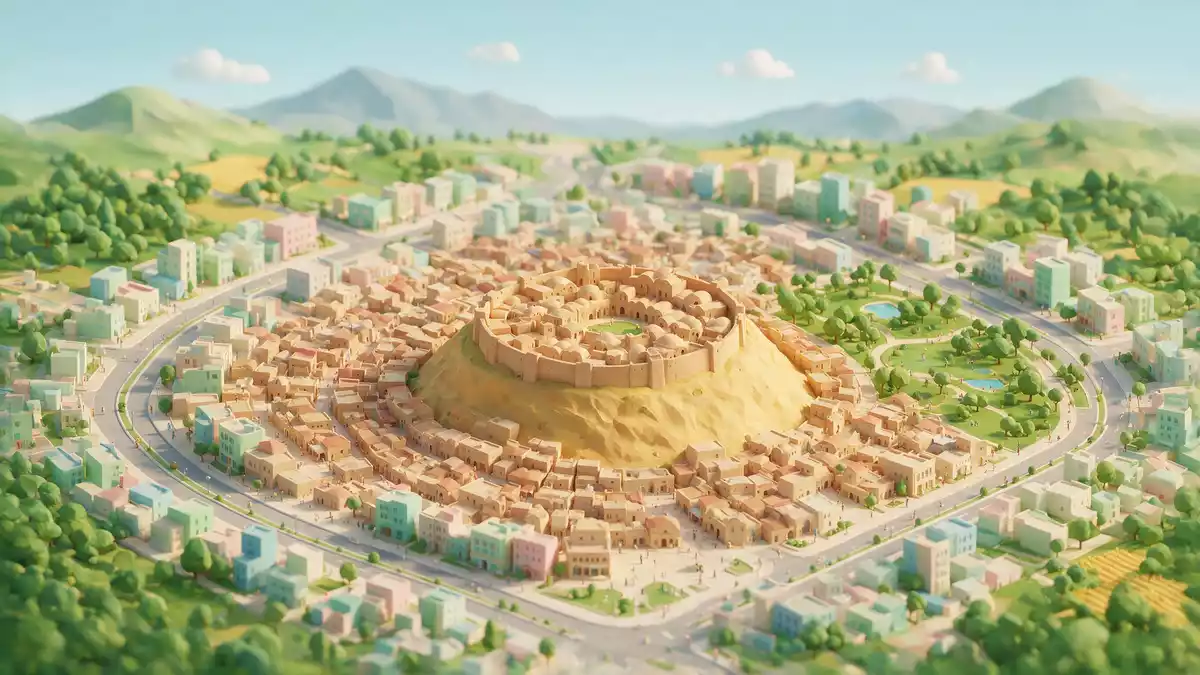
Qelat Hewler, known internationally as the Erbil Citadel, crowns a high earthen hill in the centre of Erbil and distils millennia of urban life into a single compact site. Inscribed as a UNESCO World Heritage cultural property in 2014, it forms the historic core of the city and remains one of Iraq’s most recognisable fortified settlements from antiquity to the modern era.
A city stacked in layers upon a man-made hill
Seen from the surrounding streets, Qelat Hewler stands on an artificial mound rising above the newer city, with the settlement forming a continuous ring of buildings around the edge. The hill itself is a tell, a human-made elevation created as generations built, rebuilt and compacted structures on the same footprint, gradually lifting the townscape far above the surrounding plain.fortified settlement on top of an imposing tell The resulting profile is almost symmetrical when viewed from a distance, emphasising the citadel’s dominance over the lower quarters of Erbil.
Archaeological and historical studies place occupation of the hill far back in antiquity, within the context of northern Mesopotamia and later Assyrian and Islamic periods.over 6,000 years old The site is widely recognised as one of the longest continuously inhabited urban locations on Earth, with settlement continuing across shifting empires and dynasties in the wider region. This continuity is embedded in the mound itself: each buried level represents an earlier city whose remains form the foundation for the streets visitors see.
Ottoman-era houses and gates on the rim of the citadel
At the crest of the hill, Qelat Hewler presents a dense band of courtyard houses aligned along narrow lanes, largely dating from the nineteenth century and reflecting domestic architecture of the late Ottoman period in northern Iraq.courtyard houses from the early nineteenth century Built in brick and other local materials, these dwellings cluster close to each other, creating shaded passages and enclosed yards that recall the social and climatic conditions of their time. The houses form a continuous perimeter wall when seen from outside, giving the citadel its fortified appearance even though many buildings behind the façade are primarily residential.
Access to the summit passes through gates set into this perimeter, leading from the traffic of modern Erbil into the compact street grid above. Within the walls, religious buildings, former administrative structures and houses share the limited space of the mound, illustrating how successive generations adapted the existing urban fabric rather than expanding outward. The surviving architecture documents domestic life, small-scale commerce and civic functions from the Ottoman era onwards, in contrast to the larger-scale boulevards and towers of the present-day city spreading around the base.Ottoman settlement built on top of a high multi-layered tell
World Heritage recognition and the role of Erbil’s historic core
Qelat Hewler’s international profile rests in part on its recognition as a UNESCO World Heritage Site, with inscription on the World Heritage List in 2014 under cultural criterion (iv).added to the World Heritage List on 21 June 2014 The formal listing highlights the citadel as an outstanding example of a multilayered archaeological mound still emerging into the modern urban landscape, where accumulated strata remain legible both in the topography and in the surviving architecture.
The designation also acknowledges the citadel as the historic centre of Erbil and a focal point for preservation efforts in Iraq.reviving the World Heritage Site of Erbil Citadel Conservation and rehabilitation programmes work within the constraints of a small, elevated site surrounded by a fast-growing city, seeking to stabilise structures, retain the characteristic ring of houses and keep the mound legible as a record of long-term settlement. From the surrounding districts, the citadel remains a visual reference point, with the encircling buildings and sharp break between hill and plain marking the boundary between historic and newer Erbil.
Visiting Qelat Hewler: what travellers from Western Europe should know
- Qelat Hewler stands in central Erbil in northern Iraq, rising above the surrounding streets and reachable from the city’s road network that converges around the base of the mound.
- The approach from the lower town involves a noticeable ascent onto the tell and passages through gates into the ring of buildings, with sections of sloping streets and flights of steps.
- The wider setting of the citadel forms part of the Kurdistan Region, where the official language is Kurdish alongside Arabic, and the national currency is the Iraqi dinar.
- Entry requirements depend on your nationality; UK travellers can check the FCDO travel advice at gov.uk/foreign-travel-advice, Irish travellers the Department of Foreign Affairs at ireland.ie.
Searching for Qelat Hewler on social platforms
These links open searches for Qelat Hewler on each platform.
Frequently asked questions about Qelat Hewler
Where is Qelat Hewler located?
Qelat Hewler stands on a high earthen mound in central Erbil in northern Iraq, forming the historic core of the city and rising above the surrounding districts.
What should visitors expect on a visit?
Visitors encounter a compact ring of historic houses, narrow lanes and gates on top of a prominent hill, together illustrating the layered urban history of Erbil in a confined space.
What makes Qelat Hewler distinctive among historic sites?
Its distinction lies in being a fortified settlement built on a multi-layered human-made mound, recognised as a UNESCO World Heritage Site for long-term continuous habitation within a modern city.


