
Qubbat as-Sakhra and its octagonal presence in Jerusalem
Published on 08/15/2026 at 14:47 | Editorial responsibility: Rafael Müller, Editor-in-Chief AD HOC NEWS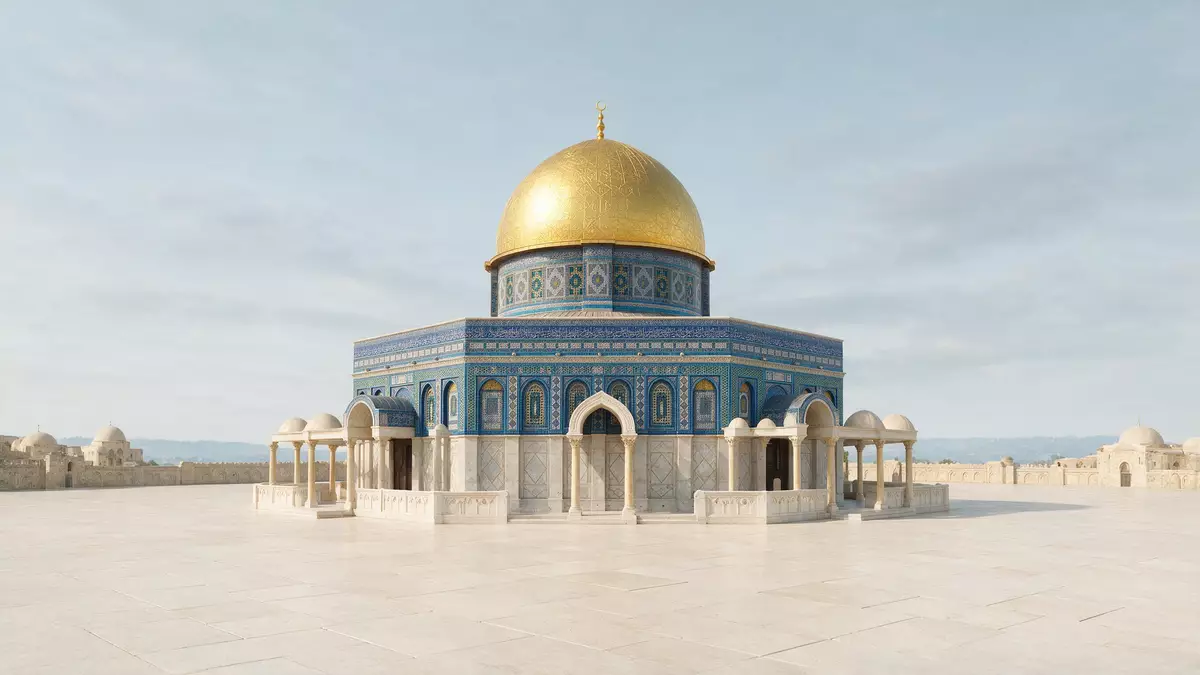
Qubbat as-Sakhra, known in English as the Dome of the Rock, is an Islamic shrine with an octagonal plan and a gilded dome that has shaped the skyline of the Old City of Jerusalem since the late seventh century.
An early Islamic monument over the rock
Qubbat as-Sakhra stands on the elevated platform of the Haram al-Sharif in Jerusalem, a site also known as the Temple Mount, where a broad stone paving opens into a large open-air esplanade framed by arcades and other religious buildings.the Haram al-Sharif The shrine’s Arabic name, “Qubbat as-Sakhra”, refers directly to the exposed outcrop of bedrock at its centre, a rock enclosed and framed rather than obscured.
The building was commissioned in the late seventh century by the Umayyad caliph Abd al-Malik ibn Marwan and is generally associated with a completion date around 691–692 CE, placing it among the earliest surviving works of Islamic architecture.Abd al-Malik ibn Marwancompleted in 691–692 CE Inscriptions inside the structure record the year 72 of the hijra, which corresponds to this period in the Gregorian calendar.year 72 of the hijra
Octagonal plan and gilded dome
Architecturally, Qubbat as-Sakhra is built on an octagonal plan, with outer walls forming an eight-sided ring around the central rock and inner arcades echoing the same geometry.octagonal plan Above this octagon rises a drum supporting a large dome, clad on the exterior in metal plates that give it a golden appearance and make the shrine visible from many viewpoints in the Old City.golden-colour dome
The interior combines structural stone with rich surface decoration. Marble revetments line the lower walls, while upper zones are covered with mosaics and painted ornament, creating a layered envelope around the rock. Columns and piers carry the inner arcades, which guide movement around the central outcrop and differentiate the outer ambulatory from the more enclosed inner space around the stone.piers and columns
Religious significance and inscriptions
At the heart of Qubbat as-Sakhra lies the rock itself, an irregular mass of local stone that carries layered religious meanings in Islam, Judaism and Christianity.the large rock Islamic tradition connects the rock with the Prophet Muhammad’s Night Journey and ascent, while Jewish tradition links it with the Foundation Stone of the Temple and narratives around Abraham and Isaac. These associations give the shrine a role that extends beyond architecture into shared sacred geography.
Running around the inner faces of the building are long Qur’anic inscriptions in early Arabic script, some of the earliest surviving monumental proclamations of Islam and of Muhammad’s prophethood.earliest inscriptions proclaiming Islam The combination of text, geometry and the exposed rock creates a spatial focus that has drawn worshippers, scholars and travellers for many centuries.
Visiting Qubbat as-Sakhra: what travellers from Western Europe should know
- Qubbat as-Sakhra stands within the Haram al-Sharif in the Old City of Jerusalem, reached on foot through its gates after entering the historic walled quarter.
- The shrine rises on a broad paved platform above the surrounding streets, and movement around it involves walking over stone surfaces and climbing shallow steps.
- The official language is Arabic and the currency is the Israeli new shekel.
- Entry requirements depend on your nationality; UK travellers can check the FCDO travel advice at gov.uk/foreign-travel-advice, Irish travellers the Department of Foreign Affairs at ireland.ie.
Searching for Qubbat as-Sakhra on social platforms
These links open searches for Qubbat as-Sakhra on each platform.
Frequently asked questions about Qubbat as-Sakhra
Where is Qubbat as-Sakhra located?
Qubbat as-Sakhra stands on the Haram al-Sharif platform in the Old City of Jerusalem, within the wider historic compound that also includes the Al-Aqsa Mosque.
What can visitors expect when they see Qubbat as-Sakhra?
Visitors encounter an octagonal shrine with a gilded dome, richly decorated interiors and a central exposed rock framed by arcades and marble-lined walls on a high stone terrace.
What makes Qubbat as-Sakhra distinctive among religious buildings?
Its combination of an early Islamic date, an octagonal plan, a single venerated rock at the core and some of the earliest large-scale Qur’anic inscriptions gives it a distinctive place in Jerusalem’s sacred landscape.


