
Qubbat as-Sakhra and the golden shrine above Jerusalem’s rock
Published on 09/17/2026 at 06:50 | Editorial responsibility: Rafael Müller, Editor-in-Chief AD HOC NEWS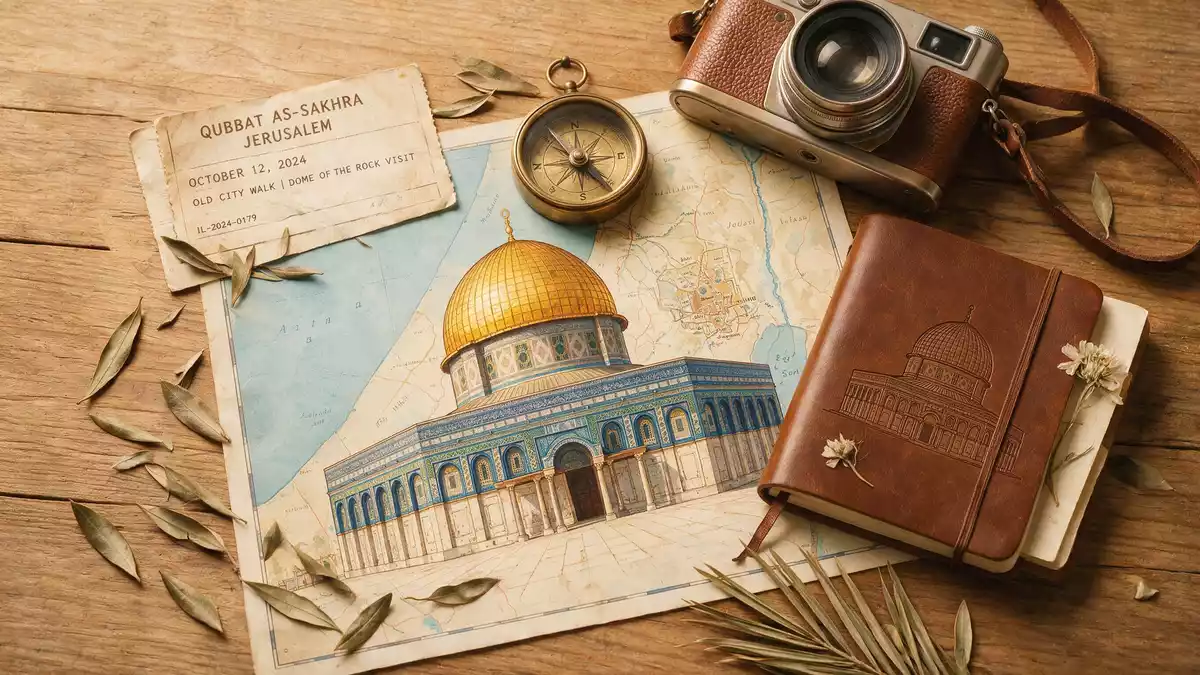
Qubbat as-Sakhra, known in English as the Dome of the Rock, is an early Islamic shrine on the elevated Temple Mount in the Old City of Jerusalem, marked by a gilded dome above an octagonal base. Built in the late seventh century under the Umayyad caliph Abd al-Malik ibn Marwan, it stands over a natural outcrop of bedrock that carries deep religious significance in both Islamic and Jewish traditions.
The octagonal plan and gilded dome
The core of Qubbat as-Sakhra is its octagonal plan, wrapped by arcaded ambulatories and crowned by a prominent dome that has become one of Jerusalem’s defining silhouettes. The shrine is widely described as an octagonal Islamic structure at the centre of the Al-Aqsa mosque compound, part of the wider Haram al-Sharif plateau that rises above the streets of the Old City.octagonal Islamic shrine The dome itself is set on a circular drum and sheathed in metal plating that has been renewed over time, giving the building its characteristic golden presence against the pale stone of the platform.
The building dates from the Umayyad period and is traditionally associated with the years around 691, making it one of the oldest surviving monuments of Islamic architecture.Hegira 72 / AD 691 In architectural histories it is described as the earliest religious structure known to have been built by a Muslim ruler whose date and patron can be firmly identified.late 7th century Umayyad monument The octagonal layout frames a central space beneath the dome, where the bedrock rises above the floor in a distinctive irregular mass rather than a carved altar or platform.
Foundation Stone and layered traditions
At the heart of Qubbat as-Sakhra lies the exposed bedrock known in Arabic as al-Sakhra and often referred to in English as the Foundation Stone, a point where physical geology and religious meaning meet. In Islamic tradition this rock is associated with the Prophet Muhammad’s ascent through the heavens, the event known as the Mi?r?j, and is treated as a direct connection between the earthly sanctuary and the divine realm.rock above which the dome is constructed Jewish tradition links the same stone to episodes in the Hebrew Bible, including the binding of Isaac, and to the location of the inner sanctum of the former Temple of Jerusalem; the overlap of associations is part of what gives the building its weight in regional memory.
The shrine stands within the Haram al-Sharif, the plateau known to Jews and Christians as the Temple Mount, occupying a position close to the Al-Aqsa Mosque and the Western Wall plaza.Temple Mount/Al Haram Ash Sharif Within this compound, Qubbat as-Sakhra is not a congregational mosque but a freestanding shrine raised over the stone itself, making the rock the focus of devotion rather than a separate chamber or hall. The uneven surface of the bedrock is ringed by a low screen and approached by steps, with the drum of the dome rising immediately above, so that visitors perceive the building and the rock as a single composition rather than separate elements joined by later alteration.
Decoration, inscriptions and architectural setting
Much of the character of Qubbat as-Sakhra comes from its decoration, which combines marble revetments, mosaics and calligraphic bands to create a dense skin of pattern around the structural frame. Early descriptions emphasise that the building contains some of the earliest surviving inscriptions that proclaim Islam and name the Prophet Muhammad, woven into friezes that run around the interior and exterior of the octagon.earliest inscriptions proclaiming Islam These inscriptions form part of a programme that also includes Qur?anic verses and statements about the nature of God, set in mosaic against backgrounds of vegetal and geometric motifs.
The site occupies the centre of the Haram al-Sharif platform, reached from the surrounding quarters of the Old City by gates and stairways that lead up from lower streets to the elevated stone paving.Haram al-Sharif/Temple Mount plateau Around the shrine, other structures and colonnades mark the edges of the compound, but the gilded dome is the dominant vertical element, visible between cypress trees and above the roofs of adjacent buildings. Inside, the space beneath the dome is ringed by arcades of columns and piers, with windows in the drum admitting daylight that plays across the stone, the marble and the mosaic surfaces.
Visiting Qubbat as-Sakhra: what travellers from Western Europe should know
- Qubbat as-Sakhra stands on the Haram al-Sharif in the south-eastern part of Jerusalem’s Old City, reached on foot from the surrounding historic streets and gates.
- The shrine is set on a broad stone platform above the city, and approaches from the Old City involve climbing exterior stairways and walking across open paved areas.
- The official language is Hebrew and the currency is the Israeli shekel.
- Entry requirements depend on your nationality; UK travellers can check the FCDO travel advice at gov.uk/foreign-travel-advice, Irish travellers the Department of Foreign Affairs at ireland.ie.
Searching for Qubbat as-Sakhra on social platforms
These links open searches for Qubbat as-Sakhra on each platform.
Frequently asked questions about Qubbat as-Sakhra
Where is Qubbat as-Sakhra located in Jerusalem?
Qubbat as-Sakhra stands on the Haram al-Sharif, the historic Temple Mount plateau in the south-eastern part of Jerusalem’s Old City, above the surrounding streets and courtyards.
What can visitors expect when they reach the shrine?
Visitors encounter a gilded dome rising above an octagonal building on a broad stone platform, with arcades, trees and other structures around it and the rock visible inside the shrine.
What makes Qubbat as-Sakhra distinctive among religious buildings?
Its combination of an early Islamic date, an octagonal plan, a gilded dome and the direct exposure of the Foundation Stone beneath that dome makes Qubbat as-Sakhra a singular landmark in Jerusalem’s sacred landscape.


