
Rapa Nui’s stone faces and ocean horizon
Published on 09/17/2026 at 20:16 | Editorial responsibility: Rafael Müller, Editor-in-Chief AD HOC NEWS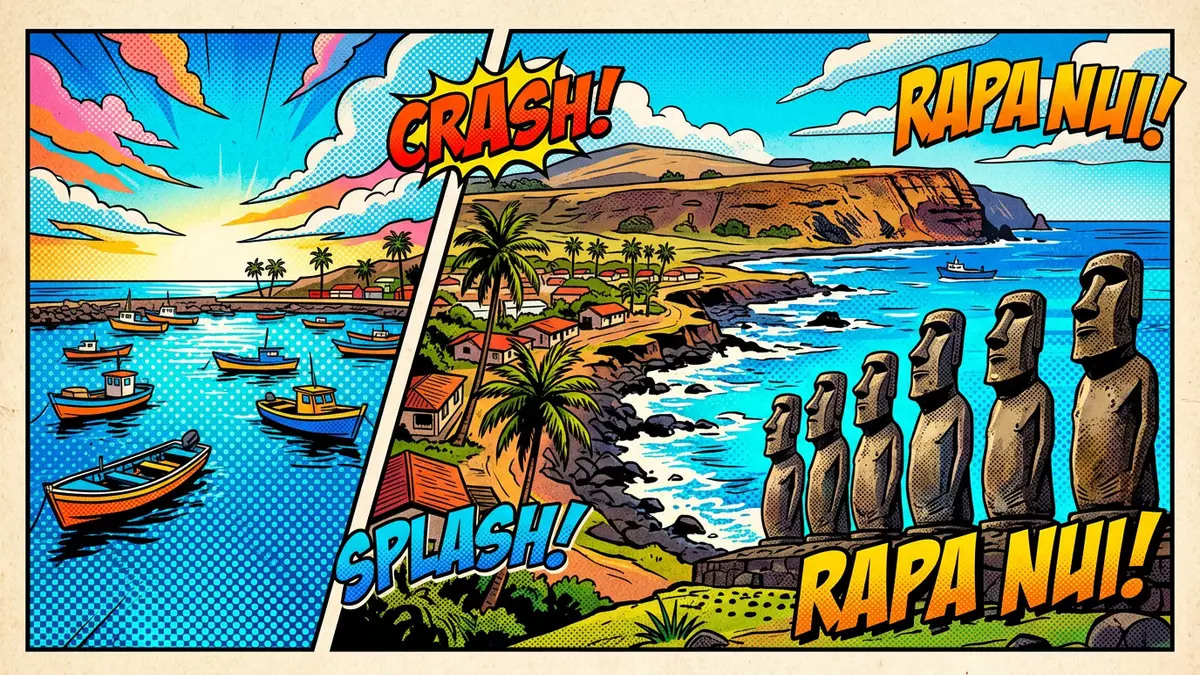
Rapa Nui, better known in English as Easter Island, rises from the Pacific Ocean as a remote triangle of volcanic rock, west of continental Chile and centred on the small town of Hanga Roa. Its landscape is defined by the partnership of land and ocean: lines of carved stone figures stand between grassy slopes and the open sea, turning the island itself into a vast ceremonial ground shaped by the Rapa Nui people in the late prehistoric period.Easter Island, the most remote inhabited island
Moai and ahu: a ceremonial coastline in stone
The most striking feature of Rapa Nui is the combination of moai statues and ahu platforms arranged along the island’s coastline. The moai are monolithic figures carved from volcanic rock, raised upright on stone platforms and aligned in rows that follow the contours of the shore.The moai are monolithic human figures Many retain their long, stylised faces and heavy brows, while some carry additional stone elements on their heads, forming a repeated yet individual series of ancestral images facing inland.
Archaeological surveys count several hundred ceremonial platforms and a large number of moai spread around the island, creating a continuous chain of ritual sites rather than a single monumental centre.There are about 900 statues and more than 300 ceremonial platforms In coastal areas near Hanga Roa, visitors encounter restored platforms where statues stand upright once more, their stone surfaces contrasting with the low grass and the waves below, so that each headland becomes both a lookout and a memorial.
Rapa Nui National Park and a World Heritage island
Much of Rapa Nui’s landscape forms Rapa Nui National Park, a protected area that includes the principal archaeological sites and large parts of the island’s interior.Rapa Nui National Park is a national park on Easter Island The park encompasses coastal platforms with restored statues, inland quarries where unfinished moai lie embedded in the ground, and traces of dwellings, agricultural fields and other stone structures.
Rapa Nui National Park was inscribed as a World Heritage Site by UNESCO in 1995, recognising its status as a cultural landscape shaped by an isolated Polynesian society over many centuries.Rapa Nui National Park was inscribed on the World Heritage List in 1995 The inscription highlights the combination of monumental sculpture, architecture and the surrounding natural setting, in which extinct volcanoes, cliffs and grasslands frame the archaeological remains and give the island its distinctive outline.
Hanga Roa, volcanic craters and the wider island setting
Hanga Roa is the main town on Rapa Nui and the administrative centre of the island, located on the western coast between the extinct volcanoes Terevaka and Rano Kau.Hanga Roa is the main town and harbour of Easter Island From its streets and harbour, roads and tracks lead to coastal platforms, inland quarries and ceremonial villages, so that the town functions as a practical base for exploring the wider landscape.
The terrain around Hanga Roa reflects the island’s volcanic origin: slopes of weathered lava rise towards the central peak of Terevaka, while the broad crater of Rano Kau forms a natural amphitheatre above the sea.A society of Polynesian origin settled on the island and created monumental sculpture and architecture Inland paths pass stone walls and former planting areas, and in several locations caves, petroglyphs and stone dwellings add further layers to the visible record of the Rapa Nui culture.
Visiting Rapa Nui: what travellers from Western Europe should know
- Rapa Nui lies in the Pacific Ocean and forms part of Chile; Hanga Roa sits on the western coast and is reached by air services linking the island to mainland airports.
- Many archaeological sites stand in open coastal terrain, where paths can cross uneven lava surfaces and low stone walls, and approaches to platforms may involve walking over short distances on grass and rock.
- The island’s volcanic character means gentle slopes in some areas and steeper ground around craters, so visits to viewpoints such as Rano Kau involve gradients that require steady footing on natural paths.
- Beyond the town, facilities are limited to small settlements and individual site facilities, so exploring Rapa Nui typically involves returning to Hanga Roa for services and supplies.
- The official language is Spanish and the currency is the Chilean peso. Entry requirements depend on your nationality; UK travellers can check the FCDO travel advice at gov.uk/foreign-travel-advice, Irish travellers the Department of Foreign Affairs at ireland.ie.
Searching for Rapa Nui on social platforms
These links open searches for Rapa Nui on each platform.
Frequently asked questions about Rapa Nui
Where is Rapa Nui and how is it related to Chile?
Rapa Nui, also known as Easter Island, is a Pacific island that forms part of Chile, with Hanga Roa as its main town and harbour.
What can visitors expect when exploring Rapa Nui?
Visitors encounter coastal platforms lined with moai, inland quarries with unfinished statues, volcanic craters and a landscape where archaeological remains sit in open terrain.
What makes Rapa Nui distinctive among Pacific islands?
Rapa Nui is distinctive for its concentration of moai statues, extensive ceremonial platforms and the recognition of its cultural landscape as a UNESCO World Heritage Site.


