
Recife Antigo, the island quarter where Recife began
Published on 09/05/2026 at 19:48 | Editorial responsibility: Rafael Müller, Editor-in-Chief AD HOC NEWS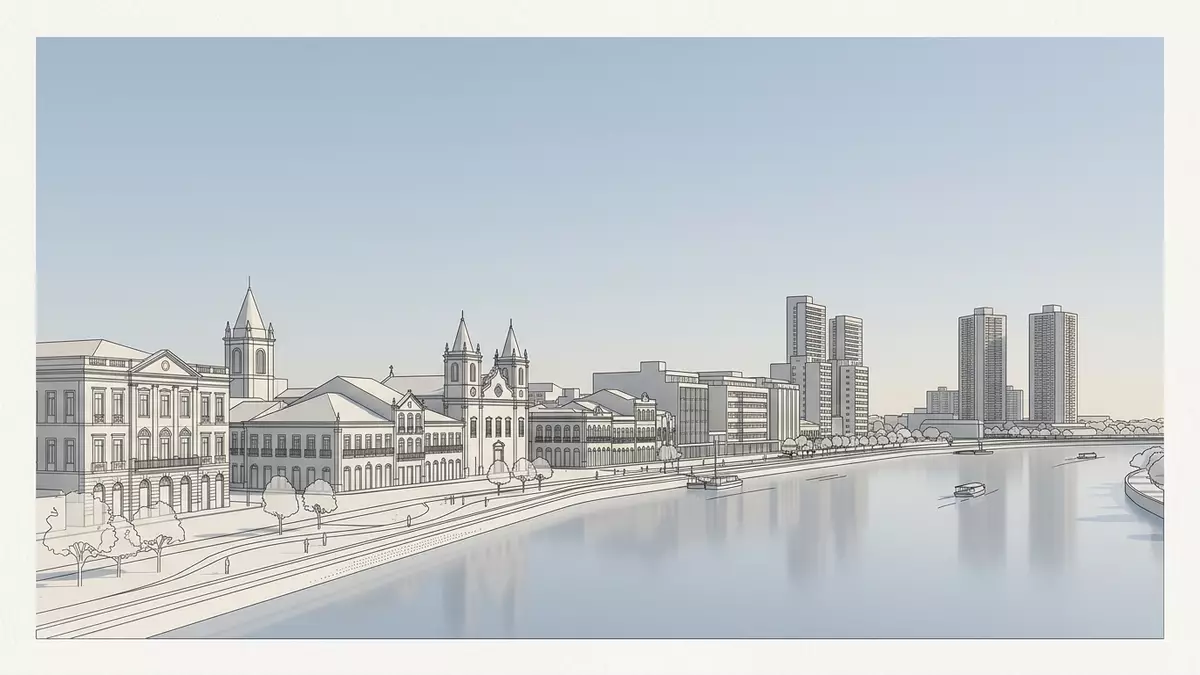
Recife Antigo is the historic island quarter of Recife in north-eastern Brazil, where the city first took shape along river channels, docks and cobbled streets. Officially known as Bairro do Recife, it forms the eastern part of Recife’s historic centre and occupies the Island of Recife between the Capibaribe and Beberibe rivers and the Atlantic harbour, a strip of land that still shows how a colonial port grew into an urban district of culture and technology.
An island of streets between river and ocean
Recife Antigo occupies the Island of Recife at the point where the Capibaribe and Beberibe rivers meet the Atlantic Ocean, giving many streets water on one side and built fabric on the other.Recife Antigo occupies the Island of Recife Bridges carry road traffic across the water to adjoining districts, but once on the island the scale shifts to narrower streets, older façades and a dense grid that still reflects its colonial roots.the eastern side of Recife’s historic centre
The island setting gives Recife Antigo a distinct waterside character, with quays, estuarine channels and harbour structures forming part of the everyday streetscape. The historic centre, including Bairro do Recife, was listed in 1998 by Brazil’s Instituto do Patrimônio Histórico e Artístico Nacional as a site of architectural and urban interest, recognising the ensemble of streets, squares and buildings set between river and ocean.listed in 1998 as a site of architectural and urban interest
From colonial harbour to eclectic urban fabric
Recife Antigo is the historical section of central Recife, consisting of the initial Portuguese settlement in the sixteenth century around the port, where sugar cane from Pernambuco was loaded for departure to Europe.initial Portuguese settlement in the sixteenth century The official neighbourhood name Recife, widely known as Recife Antigo, corresponds to the eastern part of the historic centre, with early streets and warehouses clustered close to the harbour installations.Recife neighbourhood known as Recife Antigo
In 1910 a major urban reform introduced wide, straight avenues and new buildings inspired by Parisian architecture, adding façades with neoclassical French influences to streets still lined with older structures.1910 reform with Parisian-inspired avenues Walking through Recife Antigo reveals an eclectic mix of colonial churches, early merchants’ houses, former customs and port buildings and French-influenced civic architecture, all set within a street pattern that combines narrow lanes with broader later avenues.cobbled streets and French-inspired layout
Marco Zero and markers of Recife’s memory
At the heart of Recife Antigo lies Praça Rio Branco, widely known as Marco Zero, the official point from which road distances in the region are measured and a symbolic marker of where Recife began as an urban settlement.Marco Zero as official point for road distances A bronze marker installed in the square in 1938 formalised this function, turning the plaza into both a practical reference for road numbering and a civic monument tied to the city’s geography.bronze marker installed in 1938
Recife Antigo also contains sites that speak to wider strands of Atlantic history, including the Kahal Zur Israel Synagogue on Street of the Jews, regarded as the first synagogue built in the Americas.Kahal Zur Israel Synagogue on Street of the Jews The combination of port-related structures, religious buildings and civic squares within a compact island district makes Recife Antigo a place where the layers of Recife’s past are legible in stone, brick and street alignments.
Visiting Recife Antigo: what travellers from Western Europe should know
- Recife Antigo forms part of the city of Recife on Brazil’s north-eastern Atlantic coast and is reached by road bridges that link the Island of Recife to adjoining districts.reached from Recife by road with bridges
- The island quarter combines cobbled streets, Portuguese stone pavements and quays, so walking involves uneven surfaces and occasional changes of level between street, dockside and waterfront squares.cobbled streets and Portuguese stone pavements
- Recife Antigo lies within the state of Pernambuco in Brazil, where the official language is Portuguese and the currency is the Brazilian real.
- Marco Zero square in Recife Antigo marks the reference point for measuring road distances in the region, making it a useful geographical anchor within the wider urban layout.official point from which road distances are measured
- Entry requirements depend on your nationality; UK travellers can check the FCDO travel advice at gov.uk/foreign-travel-advice, Irish travellers the Department of Foreign Affairs at ireland.ie.
Searching for Recife Antigo on social platforms
These links open searches for Recife Antigo on each platform.
Frequently asked questions about Recife Antigo
Where is Recife Antigo located within Recife?
Recife Antigo, officially Bairro do Recife, occupies the Island of Recife at the eastern side of the historic centre, between the Capibaribe and Beberibe rivers and the harbour.
What should visitors expect when walking through Recife Antigo?
Visitors encounter cobbled streets, Portuguese stone pavements, former port warehouses, churches and civic squares within a compact island district linked to the rest of Recife by bridges.
What makes Recife Antigo distinctive among Brazilian historic quarters?
Recife Antigo combines its sixteenth-century origins as a colonial port, the Marco Zero road-distance marker and an eclectic mix of Portuguese, Dutch and French-influenced urban fabric on a waterfront island.


