
Redwood National Park’s living giants along the Pacific coast
Published on 08/30/2026 at 14:24 | Editorial responsibility: Rafael Müller, Editor-in-Chief AD HOC NEWS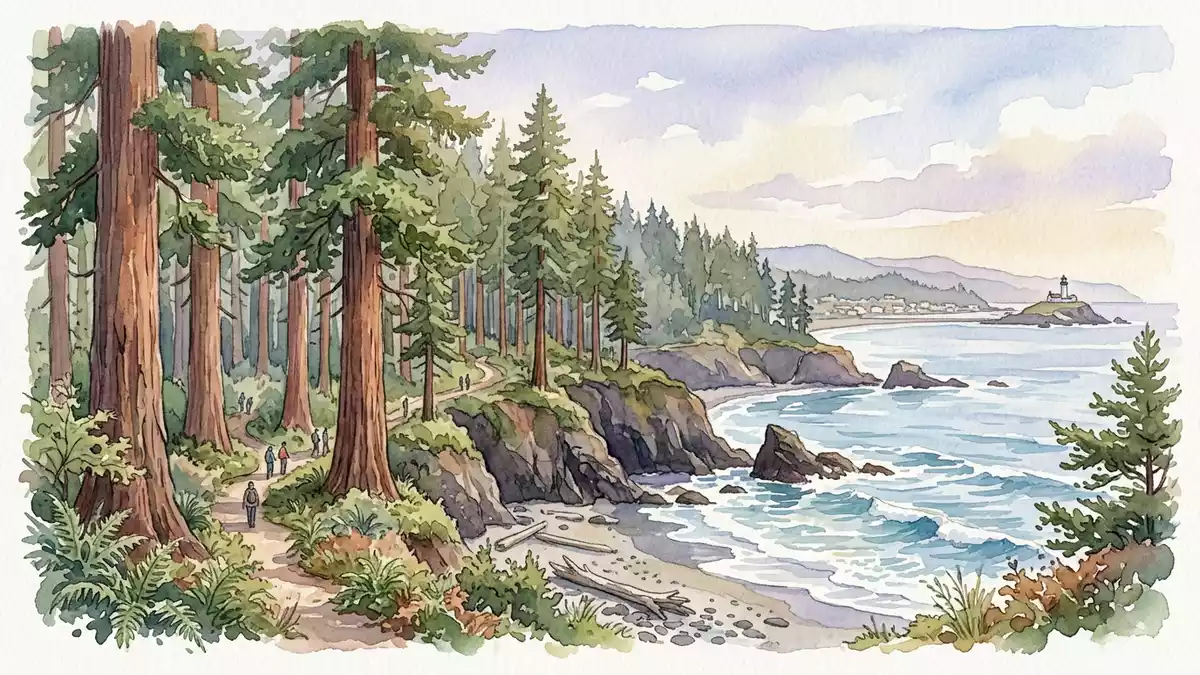
Redwood National Park, part of the wider Redwood National and State Parks complex in northern California, brings together towering coast redwood forests and wild Pacific coastline in a single, continuous landscape north of Crescent City. In this stretch of Del Norte and Humboldt counties, some of the tallest known trees on Earth rise above prairies, rivers and beaches, forming a protected belt of woodland and shore that has become a landmark of the United States’ Pacific Northwest.
Coast redwoods and an ancient forest lineage
The defining experience of Redwood National Park is to step into a forest dominated by coast redwoods, or Sequoia sempervirens, a species native to the foggy coastal belt of northern California and southern Oregon. The park protects extensive tracts of old-growth coast redwood forest, including groves with trees reaching well over 100 m (328 ft) in height, making them among the tallest living trees known.some of the tallest trees These redwoods carry buttressed trunks, reddish bark and a high canopy that filters the coastal light into a cool, dim understorey of ferns and shade-tolerant shrubs.
Scientifically, the forest at Redwood National Park represents a surviving fragment of a much older lineage. The wider coast redwood ecosystem has roots in a group of trees that has existed since the Jurassic period, connected to plant communities that once extended across moist temperate regions far beyond the modern Pacific coast.a surviving remnant of ancient trees Walking among the redwoods brings this timescale into focus: many individual trees pre-date major phases of United States history, and the undisturbed forest floor preserves layers of fallen needles, decaying logs and moss that have built up over centuries.
A protected mosaic of rivers, prairies and shoreline
Although the redwood groves are the park’s most widely recognised feature, Redwood National Park also encompasses open prairies, oak woodlands, river corridors and long sections of Pacific shoreline. The protected area extends along a band of coastal mountains and plain bordering the Pacific Ocean, with the forested uplands descending to beaches, estuaries and rocky points.coastal mountains bordering the ocean This range of environments makes the park an important refuge for terrestrial and marine species, from elk grazing in meadows to sea lions and pelicans along the shore.
Three major river systems cut through the protected landscape: the Smith River, the Klamath River and Redwood Creek.Smith River, Klamath River and Redwood Creek Each has carved gorges and valleys that shape the forest and provide corridors for wildlife, with gravel bars, side channels and floodplains visible from bridges and trails. Along the coastline, visitors encounter long sand and shingle beaches, offshore rocks used by seabirds, and headlands where forested slopes meet the Pacific in steep bluffs. In the northern sections, near Crescent City and Klamath, the shoreline and river mouths give views back towards the inland ridges where the redwoods stand.
World Heritage recognition and conservation history
Redwood National Park was formally established on 2 October 1968, adding federal protection to land already safeguarded in California’s Jedediah Smith, Del Norte Coast and Prairie Creek Redwoods State Parks.established on 2 October 1968 Combined, the national and state parks now cover tens of thousands of hectares of forest, river and coast, with management shared between the National Park Service and California State Parks from headquarters in Crescent City.jointly managed by federal and state agencies This cooperative arrangement reflects the park’s origins in separate state reserves and later federal expansion.
In 1980, the combined Redwood National and State Parks were inscribed on the UNESCO World Heritage List under natural criteria (vii) and (ix), recognising the area both for its superlative natural phenomena and for its outstanding examples of ecological and biological processes.inscribed on the UNESCO World Heritage List in 1980 The inscription emphasises that the parks protect the largest remaining contiguous ancient coast redwood forest in its original setting of forest and streams.largest remaining contiguous ancient coast redwood forest For travellers, this status underscores that a visit to Redwood National Park is not only a journey through impressive scenery but also an encounter with a globally significant protected ecosystem.
Visiting Redwood National Park: what travellers from Western Europe should know
- Redwood National Park forms part of Redwood National and State Parks along the northern California coast, with Crescent City as the nearest city and park headquarters at Second Street. The wider protected area extends south towards the town of Orick.
- The terrain in and around the park varies from level coastal plain and beaches to steep forested hillsides and river gorges, so routes may include substantial gradients and long stretches on foot across natural surfaces.
- The Smith River and Klamath River corridors, as well as Redwood Creek, are prominent landscape features, so several viewpoints and trails are close to water and may involve crossings on bridges or paths beside riverbanks.
- The official language is English and the currency is the United States dollar.
- Entry requirements depend on your nationality; UK travellers can check the FCDO travel advice at gov.uk/foreign-travel-advice, Irish travellers the Department of Foreign Affairs at ireland.ie.
Searching for Redwood National Park on social platforms
These links open searches for Redwood National Park on each platform.
Frequently asked questions about Redwood National Park
Where is Redwood National Park located?
Redwood National Park lies in Del Norte and Humboldt counties on the northern California coast, with Crescent City as the nearest city and administrative centre.
What should visitors expect on a first visit?
Visitors encounter tall old-growth coast redwood forests alongside prairies, river valleys and Pacific beaches, with routes that range from gentle paths on level ground to steeper trails through forested hillsides.
What makes Redwood National Park distinctive among forested landscapes?
Redwood National Park is distinctive for its concentration of ancient coast redwoods in a largely continuous belt of forest and streams, recognised by UNESCO since 1980 as a World Heritage Site of outstanding natural value.


