
Reggia di Caserta and its palace-to-water garden axis
Published on 09/22/2026 at 12:28 | Editorial responsibility: Rafael Müller, Editor-in-Chief AD HOC NEWS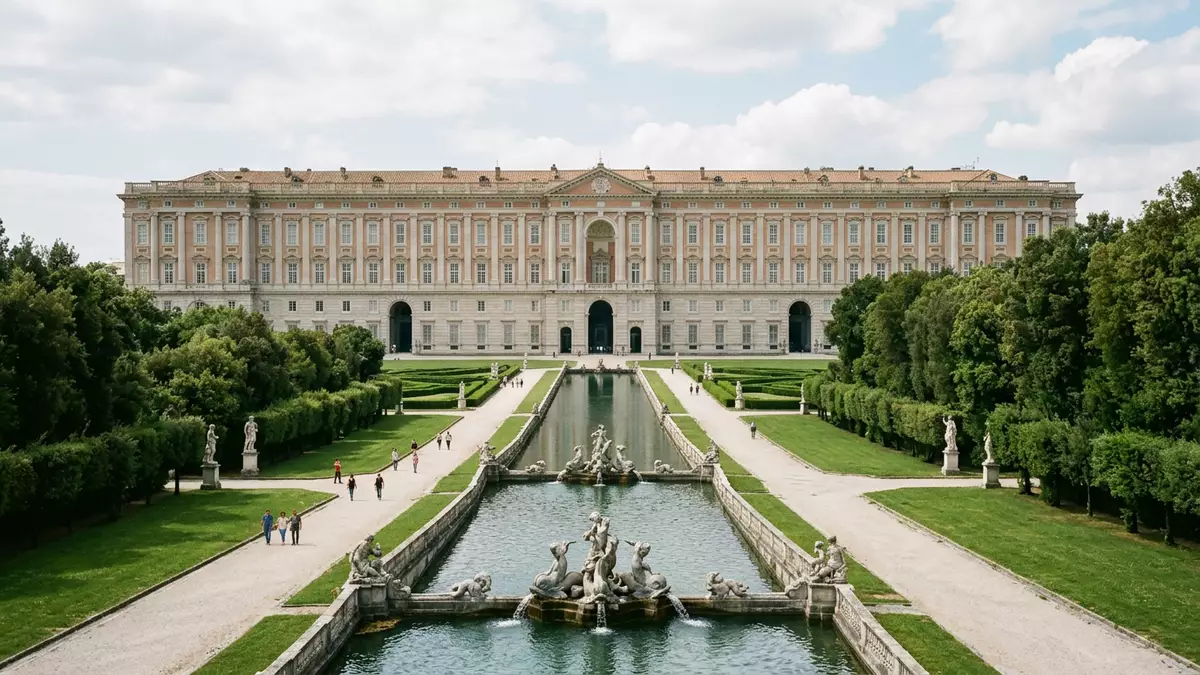
Reggia di Caserta is a Bourbon palace in Caserta whose rooms, courtyards and gardens align along a grand central axis. Luigi Vanvitelli began the project for Charles of Bourbon in 1752, creating a royal residence connected to fountains, woodland and the Caroline Aqueduct.
Reggia di Caserta: a palace aligned with water
The palace presents a broad, formal façade in the city of Caserta. Its interior is organised around courtyards and atriums, while the Royal Staircase leads towards the apartments, chapel, theatre and ceremonial rooms. The scale is architectural rather than merely decorative: the complex contains 1,742 windows and the Royal Park covers 123 hectares. These dimensions are recorded in the official palace description.
Behind the building, the Via d’Acqua extends through the park for 3 km. Pools, fountains and cascades form a sequence along the central view, ending at the waterfall and the upper landscape. The waterway is part of the composition itself, joining the residence to the Caroline Aqueduct and to the wider Bourbon estate.
Luigi Vanvitelli and the Bourbon palace
Charles of Bourbon commissioned Luigi Vanvitelli, an architect born in Naples in 1700 and active across Italy. The foundation stone was laid in Caserta on 20 January 1752. Vanvitelli remained responsible for the principal conception until his death in 1773, while his son Carlo and other architects continued the work.
The building belongs to the grand architecture of the eighteenth century, combining Baroque spatial drama with an increasingly ordered classical language. The Royal Staircase, the Upper Vestibule and the Grand Gallery form the ceremonial sequence. The Court Theatre adds an intimate performance space within the larger residence, while the Palatine Chapel and Royal Apartments preserve the palace’s courtly functions in architectural form.
The palace was connected with a broader territorial project that included the park, water infrastructure, San Leucio and the surrounding landscape. The Caroline Aqueduct supplied water to the fountains and connected the royal complex with places associated with manufacturing and agriculture. Its inclusion in the UNESCO World Heritage complex records the relationship between palace, park, aqueduct and San Leucio.
From royal rooms to the English Garden
The interior itinerary moves through spaces made for ceremony, residence and representation. The Throne Hall, Four Seasons Rooms, Palatine Library and apartments belong to different aspects of court life. Their arrangement places state rooms beside more private quarters, with the architecture passing from monumental stairs to carefully furnished chambers.
The Royal Park changes the character of the estate without breaking its axis. Formal avenues, fountains and basins occupy the principal composition, while the English Garden introduces winding paths, water, planted areas and architectural features. It contains more than 200 botanical species, alongside elements including a lake, a ruined temple, the Cryptoporticus and the Bath of Venus.
The wider property also includes the Bosco di San Silvestro and the Belvedere of San Leucio. San Leucio is associated with silk production and forms part of the same eighteenth-century cultural landscape. Reggia di Caserta therefore survives as more than a palace: it is a connected group of architecture, gardens, woodland, water engineering and industrial history.
The complex entered the UNESCO World Heritage List in 1997 under the title “18th-Century Royal Palace at Caserta with the Park, the Aqueduct of Vanvitelli, and the San Leucio Complex”. Its recorded significance rests on the combination of monumental architecture, landscape planning and Enlightenment-era infrastructure. The World Heritage designation covers the connected estate rather than the palace façade alone.
Visiting Reggia di Caserta: what travellers from Western Europe should know
- Reggia di Caserta stands in Caserta, north of Naples. Caserta railway station is directly opposite the palace precinct, with the entrance reached on foot.
- The Royal Park extends for 123 hectares, and the Via d’Acqua continues for 3 km. Exploring the fountains and upper park involves substantial walking.
- The estate includes formal gardens, the English Garden and the Bosco di San Silvestro. The English Garden contains more than 200 botanical species.
- The official language is Italian and the currency is the euro.
Searching for Reggia di Caserta on social platforms
These links open searches for Reggia di Caserta on each platform.
Frequently asked questions about Reggia di Caserta
Where is Reggia di Caserta?
Reggia di Caserta is in Caserta, Campania, north of Naples. The railway station stands opposite the palace precinct.
What can visitors see there?
The complex contains royal apartments, ceremonial rooms, a chapel, a court theatre, a formal park and the English Garden.
What makes the complex distinctive?
Its palace, gardens, waterway, aqueduct, woodland and San Leucio silk complex form a connected eighteenth-century estate.


