
Reggia di Caserta and the long view of royal Baroque
Published on 09/24/2026 at 06:27 | Editorial responsibility: Rafael Müller, Editor-in-Chief AD HOC NEWS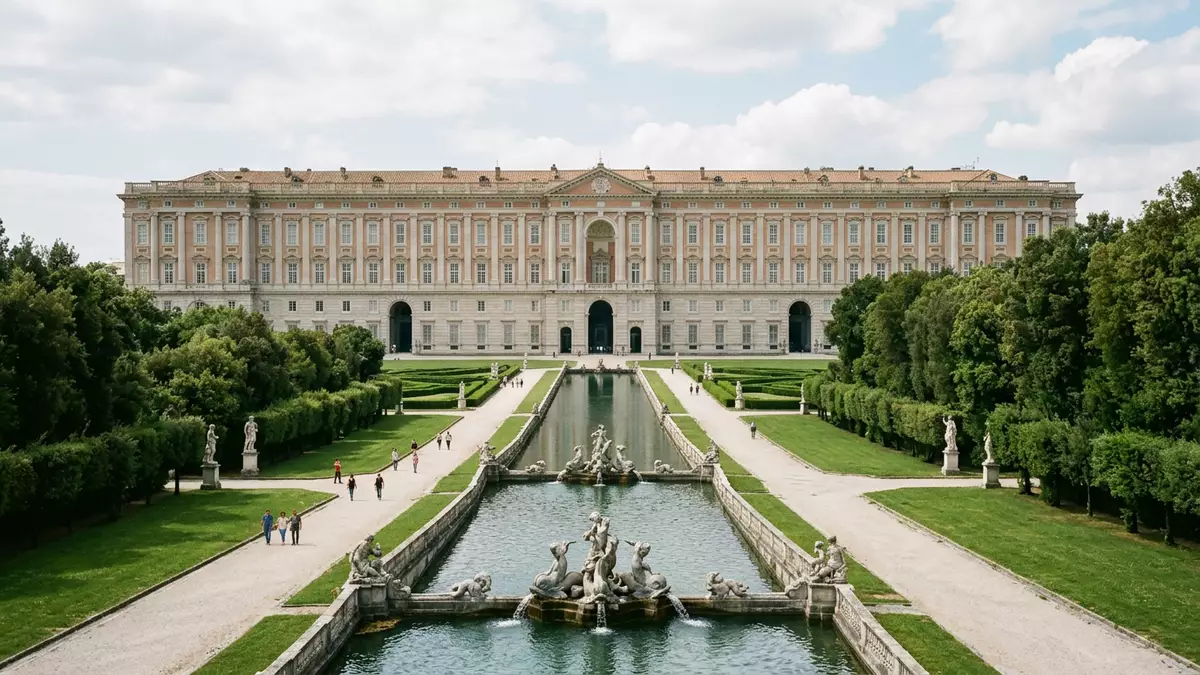
Reggia di Caserta is a palace whose architecture continues into the landscape. In Caserta, southern Italy, Luigi Vanvitelli’s eighteenth-century complex extends from grand state rooms to a long park marked by water, terraces and formal planting.
Reggia di Caserta: a palace built around perspective
Construction began on 20 January 1752, when Charles of Bourbon placed the first stone. The commission went to Luigi Vanvitelli, an architect whose work joined late Baroque grandeur with the ordered clarity of the Enlightenment. The first stone in 1752 anchors the palace to a precise moment in European architectural history.
The building presents a broad façade towards Caserta, while its interior is organised around crossing axes, courtyards and ceremonial routes. The central axis continues through the park, creating a long visual relationship between the palace and the fountains beyond it. The result is not a single isolated monument, but a connected composition of rooms, courtyards, water and woodland.
From Bourbon residence to architectural landscape
Charles of Bourbon commissioned the palace for the Bourbon monarchy in the Kingdom of Naples. Vanvitelli developed the project with a scale suited to court life, representation and administration. His son Carlo Vanvitelli continued the work after Luigi Vanvitelli’s death in 1773.
The palace contains monumental stairways, theatres, chapels, apartments and halls decorated with paintings, stucco and sculpture. Its interiors belong to the language of European royal architecture, while the park carries that language outdoors through long avenues, basins, cascades and sculptural groups. The royal palace and gardens are therefore read together as parts of one eighteenth-century project.
Water, woodland and the wider Caserta complex
The park runs behind the palace towards the lower slopes of the Campanian landscape. Its formal areas contain fountains and pools, while the upper grounds include the English Garden and the Bosco di San Silvestro. These spaces bring together clipped planting, open lawns, woodland and waterworks.
The wider heritage property includes the Caroline Aqueduct, also called the Aqueduct of Vanvitelli, and the Belvedere of San Leucio. The aqueduct supplied the palace complex and its gardens, while San Leucio forms part of the same cultural landscape. The UNESCO heritage property records these elements together as an eighteenth-century royal complex.
Reggia di Caserta entered the UNESCO World Heritage List in 1997. Its formal designation is “18th-Century Royal Palace at Caserta with the Park, the Aqueduct of Vanvitelli, and the San Leucio Complex”. The 1997 World Heritage inscription reflects the relationship between palace, park, infrastructure and surrounding cultural sites.
Visiting Reggia di Caserta: what travellers from Western Europe should know
- Reggia di Caserta stands in Caserta, north of Naples. The palace faces Piazza Carlo di Borbone, and Caserta railway station is near the historic centre.
- The visit combines interior rooms with an extensive park. The route includes large courtyards, long avenues, fountains, terraces and woodland.
- The upper park contains the English Garden and the highest fountains. Reaching these areas involves substantial walking across the palace grounds.
- The official language is Italian and the currency is the euro.
Searching for Reggia di Caserta on social platforms
These links open searches for Reggia di Caserta on each platform.
Frequently asked questions about Reggia di Caserta
Where is Reggia di Caserta?
Reggia di Caserta is in Caserta, in Campania, southern Italy. The palace stands near Piazza Carlo di Borbone and the city railway station.
What does a visit to Reggia di Caserta include?
The complex combines royal interiors with a large park. Its spaces include ceremonial rooms, courtyards, fountains, the English Garden and woodland.
What makes Reggia di Caserta distinctive?
Its defining feature is the connection between palace and landscape. The central axis continues through the park, while the UNESCO property also includes the Caroline Aqueduct and San Leucio.


