
Rijksmuseum and the building that tells Dutch history
Published on 09/23/2026 at 22:45 | Editorial responsibility: Rafael Müller, Editor-in-Chief AD HOC NEWS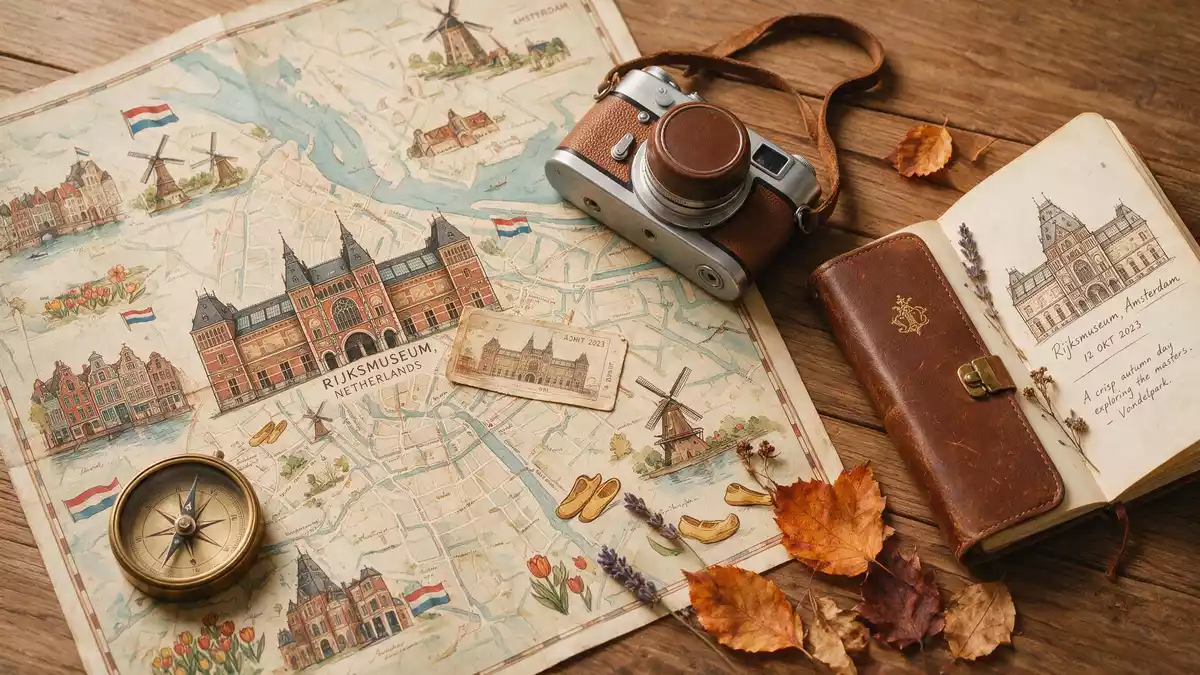
Rijksmuseum in Amsterdam brings Dutch art and history together inside a building designed by Pierre Cuypers. Its Gothic and Renaissance forms frame a collection that moves from the Middle Ages through the twentieth century, while the building itself remains part of the story.
Rijksmuseum: a national collection in an architectural frame
The museum began as a national collection outside Amsterdam. The government decided to establish a national museum in 1798, and the National Art Gallery opened in The Hague on 31 May 1800. Its early holdings included paintings and historical objects from national institutions and former stadtholder collections.
Louis Napoleon Bonaparte moved the collections to Amsterdam in 1808. They entered the Royal Palace on Dam Square, where the Royal Museum opened in 1809. After Willem I came to the throne in 1813, the collections moved to Trippenhuis, a seventeenth-century city palace. The name Rijks Museum expressed the institution’s national role.
Pierre Cuypers and the 1885 museum
Pierre Cuypers designed the present museum in a historicising style that combines Gothic and Renaissance elements. Construction began in 1876, and the building officially opened in 1885. Its exterior, galleries and decorative details form a single architectural setting for the collections.
Cuypers also designed Amsterdam Central Station, but the Rijksmuseum presents a different kind of public building. Towers, masonry, ornament and large interior passages give the museum a civic presence, while the galleries contain paintings, sculpture, prints, furniture and historical objects.
The building changed during the twentieth century. The Philips Wing was added between 1904 and 1916, and the original courtyards were filled during the 1950s and 1960s. A major renovation from 2003 to 2013 restored the building to Cuypers’ architectural plan while retaining contemporary museum functions.
From Rembrandt to Asian art
Rijksmuseum presents Dutch art and history through a chronological arrangement. The collection includes paintings by Rembrandt, Johannes Vermeer and Frans Hals, alongside applied art, sculpture, prints, furniture, weapons and objects from Asia.
Rembrandt’s The Night Watch is among the museum’s best-known works. Other rooms bring together portraits, domestic objects, maritime material and decorative arts, connecting individual works with the political, religious and social history of the Netherlands.
The museum’s research library occupies part of the main building, including the Cuypers Library. Books, catalogues, periodicals and collection records support study of the works displayed in the galleries and the wider history of art collecting.
Visiting Rijksmuseum: what travellers from Western Europe should know
- Rijksmuseum is on Museumstraat beside Museumplein in Amsterdam. Trams and buses serve the museum quarter, and Amsterdam Zuid station is a nearby rail reference point.
- The building contains grand staircases, long gallery passages and several changes of level. Museumplein provides a broad public setting around the museum’s entrance.
- The museum’s route links paintings, objects and historical rooms in chronological order. The building’s architecture remains visible throughout the galleries.
Searching for Rijksmuseum on social platforms
These links open searches for Rijksmuseum on each platform.
Frequently asked questions about Rijksmuseum
Where is Rijksmuseum?
Rijksmuseum is on Museumstraat beside Museumplein in Amsterdam, the Netherlands. The museum forms part of Amsterdam’s Museum Quarter.
What can visitors expect inside?
The galleries contain paintings, sculpture, prints, furniture, historical objects and Asian art. A chronological route connects Dutch art and history across the museum.
What makes Rijksmuseum distinctive?
Pierre Cuypers’ 1885 building combines Gothic and Renaissance elements with a national art collection. The architecture and the objects are presented as parts of one historical setting.


