
Robben Island: a low island of memory in Table Bay
Published on 09/17/2026 at 15:33 | Editorial responsibility: Rafael Müller, Editor-in-Chief AD HOC NEWS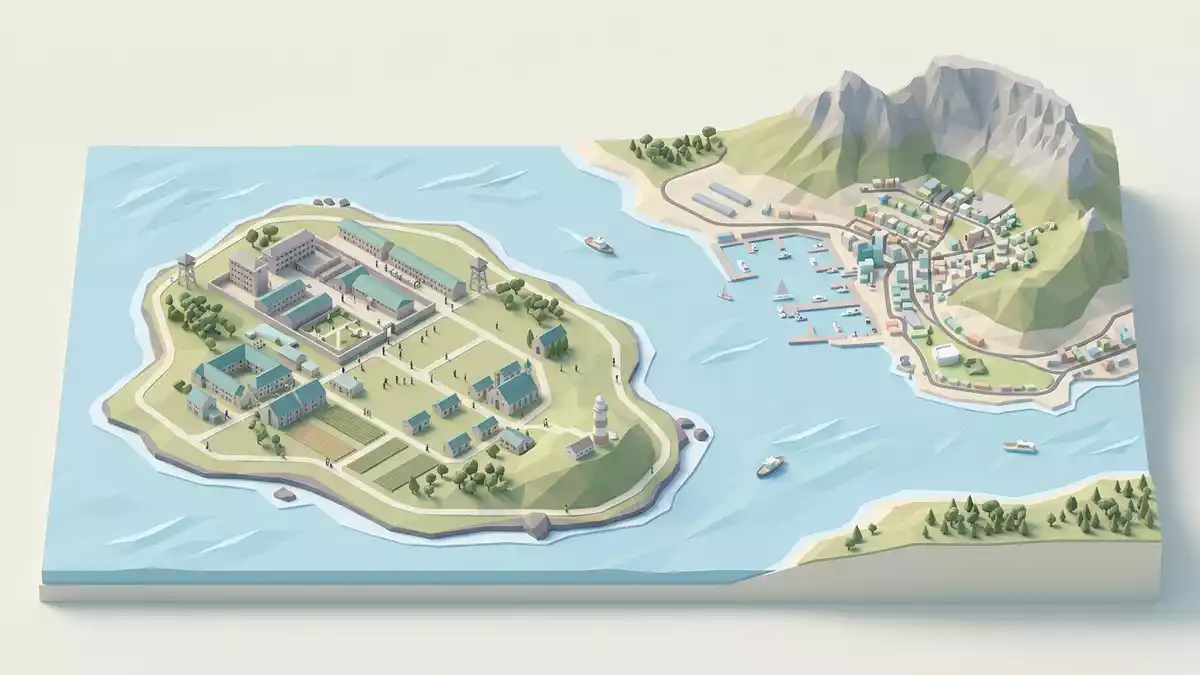
Robben Island off Kapstadt in South Africa is a low, flat island where former prison buildings stand amid scrub and sand, surrounded by the waters of Table Bay. It is recognised as a South African National Heritage Site and has been inscribed as a UNESCO World Heritage Site since 1999, marking its role in South Africa’s history and the struggle against apartheid. Nelson Mandela, later President of South Africa, spent 18 years of his 27-year imprisonment here, and the island’s surviving structures continue to show how isolation and incarceration were organised on this strip of land in the Atlantic Ocean.
An island shaped by sea and wind
Robben Island lies in Table Bay, off the Western Cape coast of South Africa, roughly north of Kapstadt and west of Bloubergstrand, in waters that form the maritime foreground to the city and the backdrop to Table Mountain. The island is roughly oval in plan, stretching about 3.3 km north to south and around 1.9 km across at its widest point, with a land area a little over 5 km², and it rises only a few metres above sea level as a result of ancient erosion that smoothed its surface.roughly oval in plan From the mainland, Robben Island appears as a low strip against the horizon, and from the island the skyline of Kapstadt, Table Mountain and the surrounding hills can be seen across the water.
The island’s name derives from Dutch and Afrikaans words for seals, reflecting the presence of marine life in the surrounding bay and the use of the island by early European sailors as a stopping point. As shipping routes along the southern African coast grew in the sixteenth and early seventeenth centuries, Robben Island served passing vessels as a place to take on supplies and to shelter, long before it became associated with prisons and political incarceration.a stopping point for passing ships A lighthouse was installed on the island in the nineteenth century, adding a maritime marker that still signals its position within Table Bay.
Centuries of isolation and imprisonment
Human use of Robben Island for isolation and control dates back to the seventeenth century, when Dutch colonial authorities began using it as a place of exile and as a penal colony for people who challenged their rule or were considered undesirable. Over time, British colonial authorities continued this use, and the island became associated with confinement in several forms: it housed a leper colony from the mid-nineteenth century to the early twentieth century, and people judged insane were also sent there, reinforcing its reputation as a place set aside for those kept at a distance from society.a leper colony from the mid-nineteenth century Military fortifications were added during the Second World War, as the island’s position at the entrance to Table Bay made it a strategic location.
From the mid-1960s Robben Island served as South Africa’s maximum-security prison for men held for political offences under apartheid, alongside criminal prisoners, most of them black, and this late-twentieth-century use is what many visitors associate most directly with the island.maximum security prison for political prisoners Nelson Mandela was imprisoned on Robben Island for 18 years, and other leaders of movements such as the African National Congress, the Pan Africanist Congress and Namibia’s SWAPO were also held here, making the cell blocks and exercise yards part of a wider story of resistance and political organisation.leaders of the ANC and other movements Political prisoners were released in 1991, and the remaining prisoners had left by the mid-1990s, bringing the penal phase of the island’s history to a close.
From prison complex to museum and memorial
After the closure of the prison in the 1990s, Robben Island was converted into a museum that interprets its role as a place of exile, isolation and incarceration over nearly four centuries. In 1997 the island was declared a national monument and opened to visitors in its new role as a museum site, and in 1999 it was inscribed on the UNESCO World Heritage List, recognising both the physical remains and their symbolic value for people in South Africa and elsewhere.declared a national monument and opened to visitors The World Heritage inscription emphasises the continuity of human use from the second half of the seventeenth century to the late twentieth century, and the role of the island in the history of colonialism, segregation and the struggle against apartheid.inscribed on the UNESCO World Heritage List
Visitors encounter a landscape in which prison buildings, military installations and earlier structures stand together, showing the successive layers of use. The former maximum-security prison, with its cell blocks and work yards, forms a central element, while the leper cemetery, the lighthouse and remnants of fortifications speak to earlier periods of the island’s role as a place apart from the mainland. The museum uses these physical remains to convey the lived realities of isolation, hard labour and political organisation, and to trace connections from the experiences of individual prisoners to wider changes in South African society.
Visiting Robben Island: what travellers from Western Europe should know
- Robben Island lies in Table Bay off Kapstadt in South Africa, reached across the bay from the city’s waterfront district by sea, with the island’s low outline visible from the mainland on clear days.
- The island itself is low and exposed, with flat terrain, scrubby vegetation and a network of roads and tracks crossing former prison and military areas, so time on foot is spent moving between dispersed buildings.
- In winter in the Western Cape, weather over Table Bay can be unsettled, with wind and rain affecting conditions on the island, while in the South African summer the exposed setting means strong sun on open concrete and tarmac surfaces.
- South Africa’s official language policy recognises several languages, including English, and the currency is the South African rand.
- Entry requirements depend on your nationality; UK travellers can check the FCDO travel advice at gov.uk/foreign-travel-advice, Irish travellers the Department of Foreign Affairs at ireland.ie.
Searching for Robben Island on social platforms
These links open searches for Robben Island on each platform.
Frequently asked questions about Robben Island
Where is Robben Island in relation to Kapstadt?
Robben Island lies in Table Bay off the Western Cape coast of South Africa, north of Kapstadt and west of Bloubergstrand, forming part of the bay’s seaward edge.
What should visitors expect when they reach the island?
Visitors encounter low, flat terrain with former prison buildings, military installations, a lighthouse and scattered structures, connected by roads and tracks across scrubland and exposed concrete surfaces.
What makes Robben Island distinctive among historic sites?
The combination of a long history of exile and imprisonment, the role of Nelson Mandela’s long incarceration, and the preserved maximum-security prison buildings within a small island setting gives Robben Island a distinctive place in South Africa’s story.


