
Robben Island, a low-lying fortress of memory off Kapstadt
Published on 09/04/2026 at 20:17 | Editorial responsibility: Rafael Müller, Editor-in-Chief AD HOC NEWS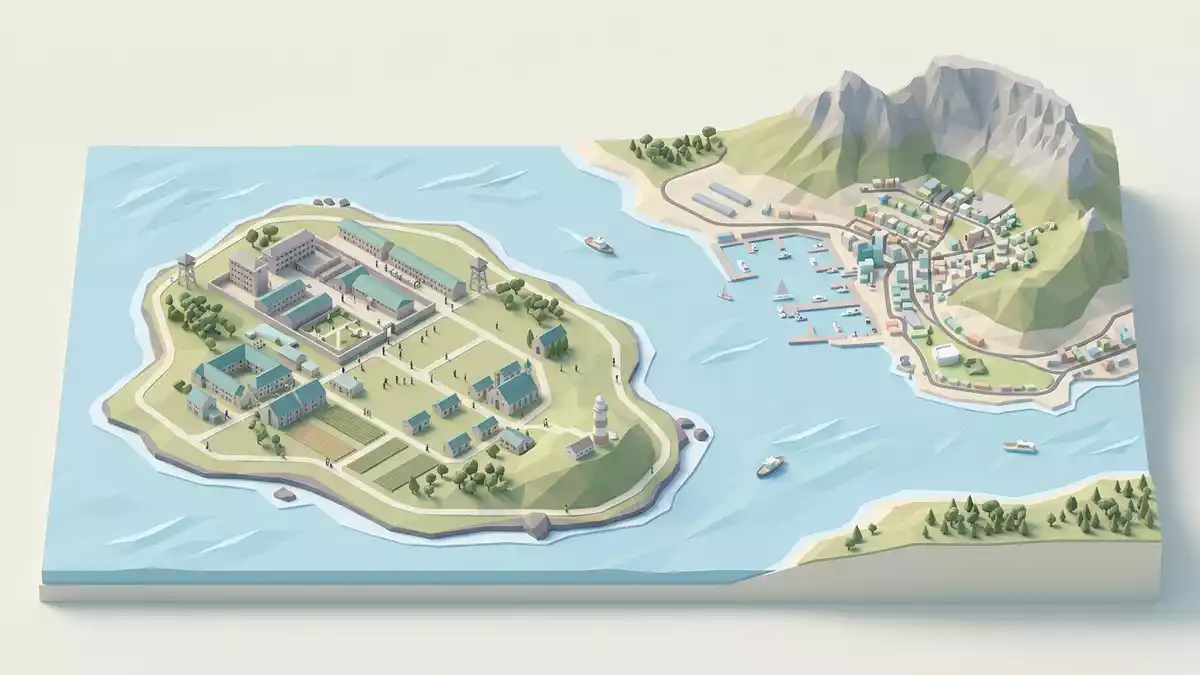
Robben Island is a low-lying island in the Atlantic off Kapstadt, where flat terrain, sea views and stark prison buildings together embody a long history of isolation and resistance from the seventeenth century into the late twentieth century.
An island shaped by the sea and the bay
Robben Island sits in Table Bay in the Atlantic Ocean, west of the Bloubergstrand coast and north of the Cape Peninsula, facing the skyline of Kapstadt across constantly shifting water and light.Table Bay in the Atlantic Ocean The island lies several kilometres offshore, forming the only main island in the bay and a distinct landmass between the open ocean and the mainland harbour approaches.the only main island in Table Bay
The island is roughly oval in outline, stretching a few kilometres in length and less than that in width, with its highest point, Minto Hill, rising only about 30 m (98 ft) above sea level.Minto Hill reaches about 30 m Much of Robben Island’s surface is gently undulating ground underlain by Precambrian rocks of the Malmesbury Group, overlain in places by calcrete and unconsolidated sands that create low cliffs and beaches along parts of the shore.rocks of the Malmesbury Group
From anchorage and hospital to maximum-security prison
European sailors were already using Robben Island as a stopping point in the sixteenth and early seventeenth centuries, anchoring off its shores for shelter and supplies on long voyages around the Cape.a common stopping point for ships Portugese navigator Bartolomeu Dias recorded the island in 1488, placing it early in the written history of the South African coast and linking it to the era of oceanic exploration.Bartolomeu Dias recorded the island in 1488
From the seventeenth century onwards, colonial administrations turned Robben Island into a place for those they sought to isolate, using it in turn as a prison, a leper colony and a site for those labelled mentally ill.used as prison, hospital and military base In the nineteenth century, buildings for leprosy patients and other institutions were added, and during the twentieth century fortifications and military installations appeared, including structures from the period around the Second World War.churches and institutions for lepers and military installations
The apartheid-era prison and its legacy
Robben Island became internationally known in the second half of the twentieth century as South Africa’s maximum-security prison for Black political prisoners under apartheid, with the most restrictive complex operating from the mid-1960s to 1991.maximum-security prison from the mid-1960s to 1991 In these years, the South African Prisons Department ran the facility, holding men convicted of political offences alongside criminal prisoners in different sections of the island’s prison system.claimed as a maximum security prison by the Prisons Department
Nelson Mandela, later President of South Africa, spent 18 of his 27 years of incarceration on Robben Island between 1964 and 1982, alongside many other leaders of movements opposing apartheid.Mandela spent 18 years on the island The maximum-security prison for political prisoners closed in 1991, and the remaining medium-security facilities for criminal prisoners ceased operation in 1996, ending more than three centuries of recorded incarceration on the island.prison sections closed in 1991 and 1996
Robben Island as museum, memorial and World Heritage Site
After the closure of the prison, the main complexes on Robben Island were transformed into the Robben Island Museum, with the former cells, yards and service buildings forming the core of a memorial landscape.turned into a museum and national monument in 1997 The island is recognised as a South African National Heritage Site, reflecting its significance in national memory and its associations with the struggle against racial segregation and authoritarian rule.South African National Heritage Site
In 1999 UNESCO inscribed Robben Island on the World Heritage List, highlighting its role in the history of imprisonment and its symbolic association with the achievement of democratic government in South Africa.inscribed on the World Heritage List in 1999 The designation emphasises not just the prison buildings but also the wider island setting, including former medical facilities, military structures and the maritime buffer zone that surrounds the landmass.
Visiting Robben Island: what travellers from Western Europe should know
- Robben Island lies off the coast of Kapstadt in Table Bay, and ferries connect the island with the city’s harbour area across the bay.
- The island’s terrain is largely flat, with low rises such as Minto Hill and a network of roads and paths that pass former prison blocks and other historic structures.
- The surrounding Atlantic waters and exposure to sea winds mean that conditions can change along the waterfront, particularly on open sections near the shore.
- The official language is Afrikaans and the currency is the South African rand.
- Entry requirements depend on your nationality; UK travellers can check the FCDO travel advice at gov.uk/foreign-travel-advice, Irish travellers the Department of Foreign Affairs at ireland.ie.
Searching for Robben Island on social platforms
These links open searches for Robben Island on each platform.
Frequently asked questions about Robben Island
Where is Robben Island in relation to Kapstadt?
Robben Island lies in Table Bay in the Atlantic Ocean, several kilometres off the Bloubergstrand coast and roughly north of Kapstadt’s city centre.
What should visitors expect when exploring Robben Island?
Visitors encounter a low, windswept island landscape with former prison buildings, medical and military structures, roads and paths, and wide views across the bay towards Kapstadt and the Cape Peninsula.
What makes Robben Island distinctive among South African sites?
The combination of long-standing use for incarceration, Nelson Mandela’s 18-year imprisonment, its transformation into a museum and its status as a UNESCO World Heritage Site gives Robben Island a singular place in South Africa’s political and cultural history.


