
Robben Island’s prison landscape off Kapstadt
Published on 08/18/2026 at 13:59 | Editorial responsibility: Rafael Müller, Editor-in-Chief AD HOC NEWS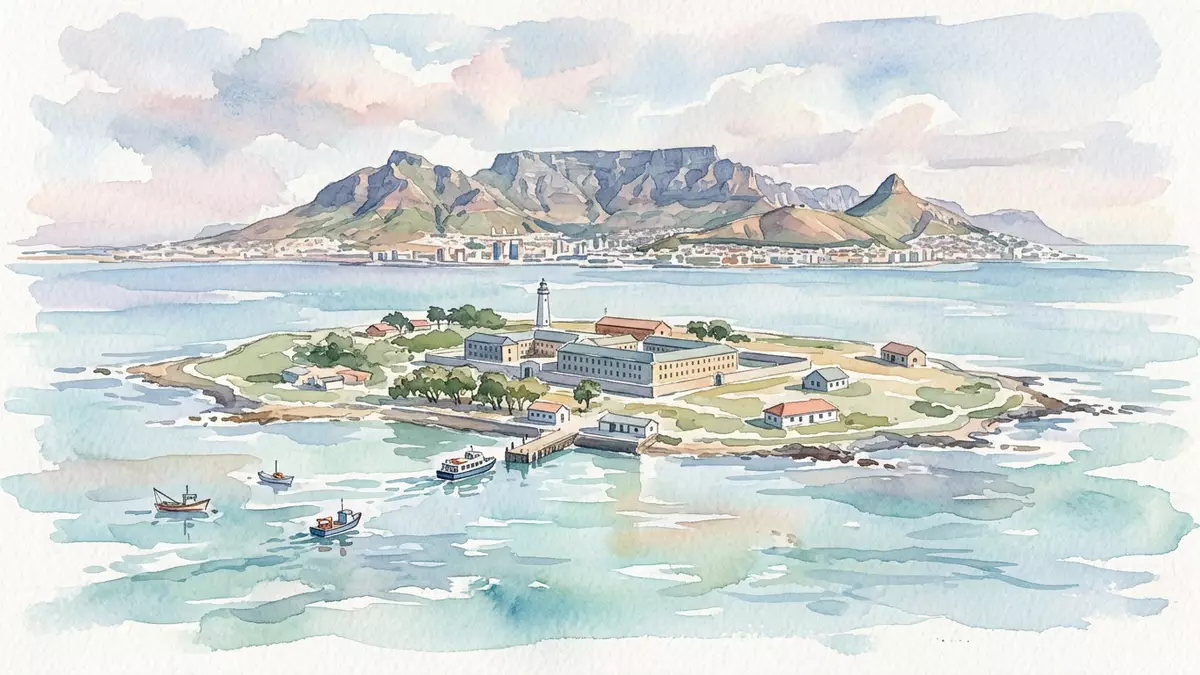
Robben Island off Kapstadt in South Africa is a low, wind?exposed island whose flat outline contrasts with the wall of Table Mountain on the horizon. Across this modest scrap of land, layers of buildings, quarries and fences trace a history that turned the island into one of the most recognisable prison landscapes in the world of the twentieth century.
A flat island shaped by confinement
Robben Island lies in Table Bay off the Atlantic seaboard north of central Kapstadt, reached across the water from the Victoria & Alfred Waterfront with Table Mountain as a constant backdrop.Robben Island is an island in the Atlantic Ocean in Table Bay The island’s Dutch name refers to the seals that once gathered in the surrounding waters, and its low limestone and sandstone platform rises only gently above the sea.Its name is the Dutch word for “seals”
From early European voyages in the fifteenth and sixteenth centuries, seafarers stopped here to take on fresh water and meat, turning the island into a practical outpost on the sea route around the Cape.Portuguese explorer Bartolomeu Dias reached the island in 1488 When the Dutch East India Company established its settlement at the Cape in the seventeenth century, Robben Island entered a new phase as a place of banishment and imprisonment for those the authorities wanted to keep away from the mainland.Robben Island was used at various times between the seventeenth and twentieth centuries as a prison
From leper colony to apartheid maximum?security prison
Robben Island’s buildings reflect successive uses that all revolved around isolation. Under Dutch and later British rule, it served as a penal colony for criminals and political opponents, and in the nineteenth century it became a medical outpost where people with leprosy and other chronic illnesses were sent away from mainland society.The island housed a leper colony from 1846 to 1931 A lighthouse established in the 1860s still marks the northern side of the island, connected by simple roads that run across the scraped interior.A lighthouse was installed in 1864
In the twentieth century the state added military installations and artillery batteries, and from the early 1960s the South African government converted part of the island into a maximum?security prison for opponents of apartheid.The South African government converted Robben Island into a maximum-security prison for political opponents of apartheid in 1961 The prison complex held members of movements such as the African National Congress and the Pan Africanist Congress, and its best?known inmate was Nelson Mandela, who spent 18 years of his 27?year imprisonment on Robben Island before his release and election as president in 1994.Nelson Mandela spent 18 years on the island as a prisoner
Prison buildings, quarry and World Heritage status
The physical core of Robben Island as visitors encounter it is the former maximum?security prison, with its blocks of single cells, communal yards and the lime quarry where many political prisoners laboured. South African authorities closed the prison for political detainees in 1991, and the last criminal prisoners left in 1996, ending more than three centuries in which confinement in one form or another defined life here.The last of these prisoners were released in 1991 and the island continued as a prison until 1996 In 1997 the Robben Island Museum was established to preserve the site and present its history to visitors.Robben Island Museum was established in 1997 and is administered as a national heritage site
In 1999 Robben Island was inscribed as a UNESCO World Heritage Site for the way its cultural landscape bears witness to the triumph of democracy and human rights over oppression.Robben Island was inscribed on the World Heritage List in 1999 The ensemble of prison buildings, military structures, medical facilities and quarry together forms a tangible record of systems of exclusion that stretched from the seventeenth century into the late twentieth century, set against the deceptively simple backdrop of a low island and the skyline of Kapstadt across the bay.
Visiting Robben Island: what travellers from Western Europe should know
- Robben Island lies in Table Bay off Kapstadt and is reached by ferry services that depart from the Victoria & Alfred Waterfront in the city’s historic harbour.
- The terrain on the island is generally flat, but visits involve walking along paved roads and through the former prison complex, including passageways and courtyards.
- The climate is shaped by the Atlantic, and strong winds and spray can affect conditions on the boat crossing between Kapstadt and the island.
- South Africa’s official currency is the South African rand and the official languages include English, Afrikaans and several indigenous languages.
- Entry requirements depend on your nationality; UK travellers can check the FCDO travel advice at gov.uk/foreign-travel-advice, Irish travellers the Department of Foreign Affairs at ireland.ie.
Searching for Robben Island on social platforms
These links open searches for Robben Island on each platform.
Frequently asked questions about Robben Island
Where is Robben Island located?
Robben Island lies in the Atlantic Ocean in Table Bay, north of central Kapstadt and off the coast of South Africa’s Western Cape.
What can visitors expect to see on Robben Island?
Visitors encounter the former maximum?security prison buildings, the lime quarry linked to political prisoners and a wider landscape of roads, military structures and the lighthouse.
What makes Robben Island distinctive?
The island combines a stark, low?lying coastal landscape with a dense concentration of prison, medical and military sites that together map out centuries of enforced isolation.


